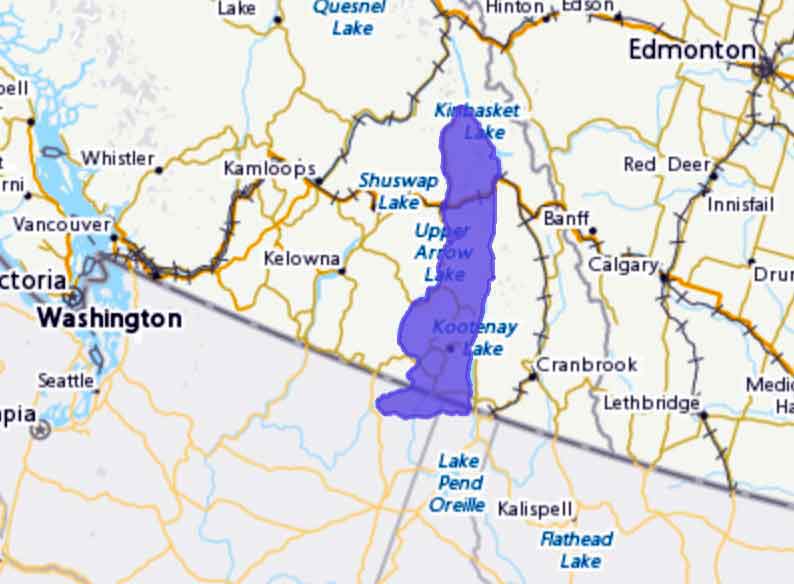
Flows NE into Fraser River between Penny and Crescent Spur
53.7547 N 121.0225 W — Map 093H14 — Google — GeoHack
Name officially adopted in 1958
Official in BC – Canada
Pre-emptor’s map Tête Jaune 3H 1919
Association with Dome Mountain.

Jasper House East Side Rocky Mountains
Paul Kane. Field sketch, November 7, 1847 Wikipedia
![‘Jasper House.’ Outlying trading huts of the Hudson Bay Company, near foot of the Leatherhead Pass, Rocky’s. Graves of Company’s Servants, murdered by Indian [1872]](/wp-content/uploads/2024/11/rylatt-jasper-house.jpg)
‘Jasper House.’ Outlying trading huts of the Hudson Bay Company, near foot of the Leatherhead Pass, Rocky’s. Graves of Company’s Servants, murdered by Indian [1872] [1]

Jasper House and Roche Miette, Sandford Fleming expedition. Photo: Charles Horetzky, 1872 [2]

Jasper House. A “bush inn,” or stopping-place, where meals are served at two shillings per time. R. C. W. Lett photo, ca. 1911 Talbot, Making Good in Canada, p. 103 [accessed 15 February 2025][3]
The situation of Jaspers House is beautifully Wild and romantic, on the borders of the Athabasca River which here spreads itself out into a small Lake surrounded by Lofty Mountains. This is a temporary summer post for the convenience of the Columbians in crossing; the Winter Establishment of last Year on the borders of the Smoky River about 80 to 100 miles Northward, but it was this Season determined that it should be removed to Moose or Cranberry Lake situated more in the heart of the Mountain near the height of Land and where we suppose Frazers River takes its source; the object of this is to draw the Freemen further into the Mountain than they have been in the habit of gound, where they are expected to make good hunts as it has been rarely Wrought and thereby the lower parts of Smoky river and the Country they used to occupy towards Lesser Slave Lake will be allowed to recruit, we have it likewise in view to draw the Shewhoppes or natives of the North Branch of Thompsons river to the mountain from the Establishmnent of Kamloops or Thompsons River which they have hitherto frequented as that post on account of the heavy Establishment of people required for the purpose of defence yields little or no profit. [4]
Interlaken was between Jasper House and Henry House on the Grand Trunk Pacific Railway. Possibly situated between Jasper Lake and Talbot Lake.
Bohi records it as being in Edson Division, Pocahontas Branch, of the
Canadian National Railway, originally a Type E Depot (Plan100-152) built by the GTP in 1913. Abandoned on site in 1921; turned over to Parks Department in 1923, for use as base for Park fire rangers.
(Interlaken is a resort town located between two lakes in the mountainous Bernese Oberland region of central Switzerland, the home town of guides Edouard Feuz, Jr., and Gottfried Feuz, who worked in Canada.)
On the 1912 map of Mount Robson by Arthur Oliver Wheeler [1860–1945] and a Grand Trunk Pacific Railway map from around 1912 there is an “Albreda” station between Tête Jaune Cache and Mount Robson.
The current Albreda railway point is on the North Thompson River.
Former station name on the Grand Trunk Pacific Railway, between Geikie and Yellowhead Pass.
Undoubtedly related to British nurse Edith Cavell, namesake of nearby Mount Edith Cavell, which was named in 1916.
Adopted in 1956 on Jasper National Park map, as labelled on BC Reference Map 18A (date not cited).
There are only 10 Cottonwood Creeks in Canada.

Seven Sisters Yellowhead Lake, Lucerne, B.C.
William James Topley, 1914
Library and Archives Canada

Mr. C. H. Cummings cottage Yellowhead Lake, Lucerne, B.C. (with Seven Sister Peaks).
William James Topley, 1914
Library and Archives Canada
A special train was organized to take Conan Doyle, his wife, and friends to visit the area near Mount Robson. The mountain, located just over the Alberta border in British Columbia, is one of the highest and most iconic mountains in the Canadian Rockies. William Topley, the celebrated Ottawa photographer, dutifully took these photos.
Extending over 11,000 square kilometres, Jasper National Park is the largest national park in the Canadian Rockies and part of UNESCO’s Canadian Rocky Mountain Parks World Heritage Site.

Pre-emptor’s map, Tête Jaune Sheet 3H, 1919
University of Wisconsin Milwaukee Library