Head of Astoria River near Continental Divide
52.6492 N 118.2539 W — Map 083D09 — Google — GeoHack
Name officially adopted in 1935
Topo map from Canadian Geographical Names
Boundary Commission Sheet 28 (surveyed in 1921)
As of 2023, here is a seasonal closure in place for caribou conservation. No access to this backcountry area is permitted between November 1 and May 15.

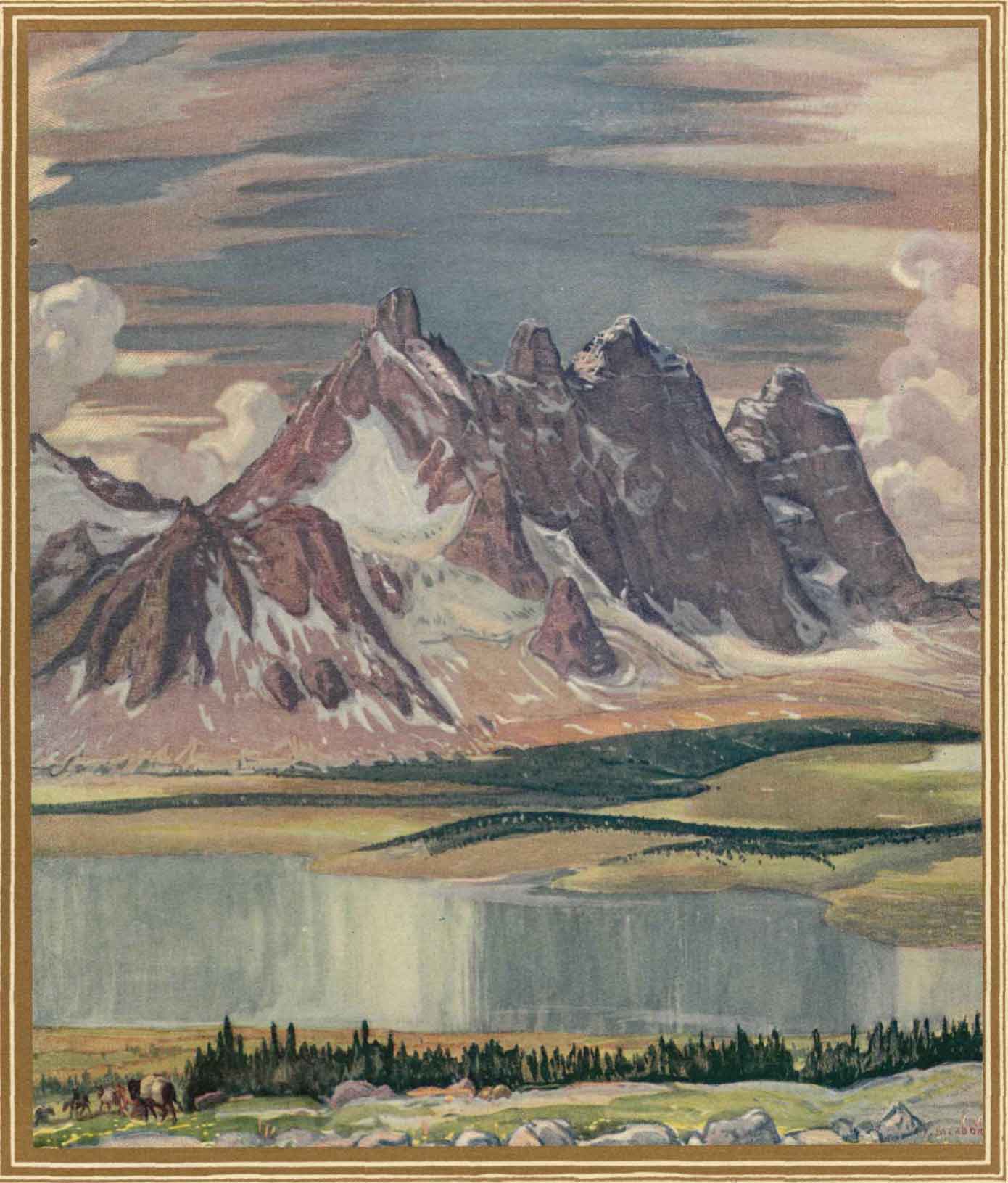
Anethyst Lake. A. Y. Jackson, 1927
Jasper National Park, Canadian National Railways
Referenced by Cyril G. Wates [1883–1946] in 1923.
James Monroe Thorington [1895–1989] visited the region in 1924:
Moat Lake is finely situated in the eastern hollow of Tonquin Pass and sends a stream to join with a northern outflow from Amethyst Lakes; and, in an expanse of willow-covered, marshy ground, drains both to Meadow and Maccarib Creeks.
The name was “suggested by the Topographical Survey due to its proximity to the Meadows Fire Ranger Station” — the Alberta-British Columbia Boundary Commission surveyors.
Named by association with Moat Lake.

Portrait of Sir Sandford Fleming by John Wycliffe Lowes Forster, 1892
Wikipedia [accessed 15 October 2025]
Sir Sandford Fleming, FRSC KCMG
b. 7 January 1827 — Kirkcaldy, Scotland
d. 22 July 1915 — Halifax, Nova Scotia
By 1871, the strategy of a railway connection was being used to bring British Columbia into federation and Fleming was offered the chief engineer post on the Canadian Pacific Railway. Although he hesitated because of the amount of work he had, in 1872 he set off with a small party to survey the route, particularly through the Rocky Mountains, finding a practicable route through the Yellowhead Pass. One of his companions, George Monro Grant, wrote an account of the trip, which became a best-seller. In June 1880, Fleming was dismissed by Sir Charles Tupper, with a $30,000 payoff. It was the hardest blow of Fleming’s life, though he obtained a promise of monopoly, later revoked, on his next project, a trans-pacific telegraph cable. Nevertheless, in 1884 he became a director of the Canadian Pacific Railway and was present as the last spike was driven.

Mary Jobe posed in winter amoungst trees in beaded buckskin clothing. n.d.
Whyte Museum of the Canadian Rockies
Mary Lenore Jobe Akeley [1878–1966]
b. 1878 — Tappan, Ohio, USA
d. 1966 — Mystic, Connecticut, USA
Jobe Akeley was an American explorer, author, mountaineer, and photographer. She undertook expeditions in the Canadian Rockies and in the Belgian Congo. She worked at the American Museum of Natural History creating exhibits featuring taxidermy animals in realistic natural settings. She worked on behalf of conservation efforts, including being one of the first advocates for the creation of game preserves. She also founded Camp Mystic, an outdoor camp for girls.
Jobe Akeley explored the Mount Sir Alexander area in 1914 and 1915, on expeditions guided by Donald “Curly” Phillips [1884–1938] of Jasper.
In 1924, Mary Jobe became the second wife of Carl Akeley (1864–1926), an explorer, natural scientist, sculptor, inventor, and “father of modern taxidermy”. On their first visit to Africa in 1926, Akeley died of disease in the remote mountains of the Congo. Jobe remained to take charge of his work, collecting specimens, and when she returned to the United Stated in 1927 she succeeded her husband as advisor in the development of the African Hall at the American Museum of Natural History in New York. In the same year, King Albert of Belgium awarded her with the Cross of the Knight, Order of the Crown, in recognition of her courage and service.
She revisited the Congo in 1946 to study the development of the parks system. Between her travels she lectured and wrote several books on her African experiences. She died in 1966, never returning to the mountains of western Canada.