Category Archives: Place

Rocky Mountain House

Alberta. National Historic Site
On the North Saskatchewan River near the confluence of the Clearwater River
52.3694 N 114.9639 W — Map 083B07 — GoogleGeoHack
Name officially adopted in 2001
Topo map from Canadian Geographical Names

Five fur trading posts were known as Rocky Mountain House near the same site as present-day Rocky Mountain House. Rocky Mountain House is post no. 467 in “Historic forts and trading posts” by Ernest Voorhis [1859–1933] :

North West Co. post on North Saskatchewan river, 1-1/4 miles above mouth of Clearwater river, 3 miles below Hangman’s tree (1790) on north bank of river, 70 yards from river’s edge. It stood on high bank, well adapted for defense as block-houses commanded the fort. Of exceptional strength being in territory of Blackfeet Indians. Hence it was sometimes called “Blackfeet post.” Built by John McDonald of Garth in 1802, although the first structure was erected in 1799. It was visited by David Thompson in 1800 and 1806 and by Alexander Henry Jr. in 1811. It was the uppermost permanent post of the North West Co. on the Saskatchewan river. Ruins were still visible in 1886. After union of the two companies it was occupied by the Hudson’s Bay Co. for many years and finally discontinued in 1875.

The Hudson’s Bay Co. constructed a fort nearby (about 114°59′ w. & 52°22’ N.) called Acton House or Rocky Mt. House, both names being given on some maps. [1]

Archaeologists at the Rocky Mountain House National Historic Site have identified four fur trade post:

Rocky Mountain House of the North West Company, built in 1799.
Acton House of the Hudson’s Bay Company, also built in 1799.
Rocky Mountain House, the Hudson’s Bay Company post of 1835-1861
Rocky Mountain House, the Hudson’s Bay Company Post of 1868-1875.
They searched for the fifth post, but it stood where the river runs now. The Hudson’s Bay Company built this temporary post (1865-1868). It housed fur traders and their families until the last post was finished.

Voorhis notes that there was also a North West Company fort on the Mackenzie River called Rocky Mountain House, built in 1800 and soon abandoned. The following forts were also called Rocky Mountain House: Jasper House (No. 245), Hudson’s Hope (No. 227), Acton House (No. 3), Henry’s House (No. 218).

References:

  • 1. Voorhis, Ernest [1859–1933]. Historic Forts and Trading Posts of the French Régime and of the English Fur Trading Companies. Ottawa: Department of the Interior, 1930, p. 149. University of British Columbia Library [accessed 3 January 2026]
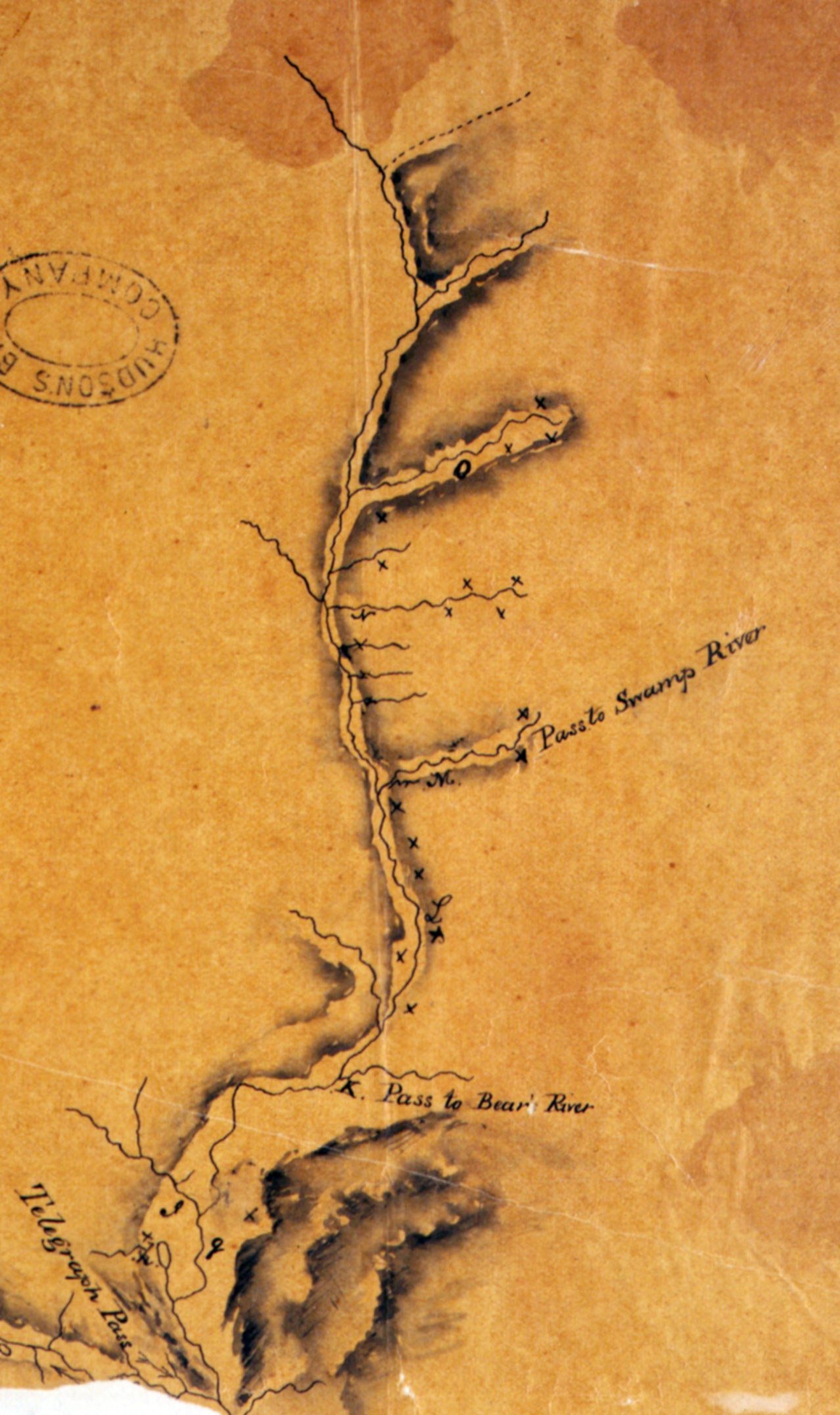
Henry’s House (1)

Alberta. Fur trade post
Not currently an official name.

Listed as “Henry’s House (1),” post no. 218 in Ernest Voorhis [1859–1933], “Historic Forts” [1]

Post built by William Henry 1812 on upper Athabaska river near confluence of Snaring river, about 8 miles below Jasper House village of today and about 20 miles above the last site of Jasper House, about 8 miles below confluence of Miette river. It was used as an outpost of Jasper House and was deserted about 1861.

References:

  • 1. Voorhis, Ernest [1859–1933]. Historic forts and trading posts of the French Régime and of the English Fur Trading Companies. Ottawa: Department of the Interior, 1930, p. 81. University of British Columbia Library [accessed 3 January 2026]

Fort McLeod

British Columbia. Fur trade post
East end of McLeod Lake
54.9831 N 123.0347 W — Map 093J14 — GoogleGeoHack
Name officially adopted in 1952
Topo map from Canadian Geographical Names

North West Co. fort at north end of lake McLeod, British Columbia, built by Simon Fraser for the Company in 1805. This is said to have been the first post erected in B.C. After the union of 1821 this post was operated by the Hudson’s Bay Co. to date.

— Ernest Voorhis [1859–1933], “Historic Forts” [1]

References:

  • 1. Voorhis, Ernest [1859–1933]. Historic forts and trading posts of the French Régime and of the English Fur Trading Companies. Ottawa: Department of the Interior, 1930, p. 10. University of British Columbia Library [accessed 3 January 2026]

Fort Fraser

British Columbia. Fur trade post
East end of Fraser Lake
54.0664 N 124.5514 W — Map 093K02 — GoogleGeoHack
Name officially adopted in 1982
Topo map from Canadian Geographical Names

North West Co. fort at east end of Fraser lake, B.C., built by Simon Fraser 1806. It was burned, October 4, 1817 and afterwards rebuilt. It was taken over by the Hudson’s Bay Co. after the union of 1821 and was operated by the Company until about 1900. It appears on all the Lists of forts to 1894. This fort is said to be “The first settlement made in the so-called Oregon Territory by civilized man”.

— Ernest Voorhis [1859–1933], “Historic Forts” [1]

Also see

References:

  • 1. Voorhis, Ernest [1859–1933]. Historic forts and trading posts of the French Régime and of the English Fur Trading Companies. Ottawa: Department of the Interior, 1930, p. 70. University of British Columbia Library [accessed 3 January 2026]

Davidson’s map North West Company 1817

America exhibiting principal trading stations of North West Co. in Davidson [1].

No. 5 in Voorhis [2].

This map includes:

References:

  • 1. Davidson, Gordon Charles. The North West Company. Berkeley: University of California Press, 1918. Internet Archive [accessed 27 December 2025]
  • 2. Voorhis, Ernest [1859–1933]. Historic Forts and Trading Posts of the French Régime and of the English Fur Trading Companies. Ottawa: Department of the Interior, 1930. University of Britih Columbia Library [accessed 3 January 2026]

Front Ranges

Not currently an official name.

The Front Ranges are a group of mountain ranges in the Canadian Rockies of eastern British Columbia and western Alberta, Canada. It is lowest and the easternmost of the three main subranges of the Continental Ranges, located east of the Bull and Elk rivers and a fault line extending northwest of West Elk Pass to McGregor Pass [1].

The Continental Ranges are a major grouping of mountain ranges in the Rocky Mountains primarily located in the Canadian Rockies of eastern British Columbia and western Alberta, with small portions extending into the U.S. states of Idaho and Montana. It is a physiographic designation primarily geologists and is not used by the general public; it is not recognized in Alberta, and does not appear on topographic maps, although the names of its subranges (the Kootenay, Front, and the Park or Main Ranges) are in common use. It is the largest and best-known of the Canadian Rockies’ three main subdivisions (the others being the Hart and Muskwa Ranges) [2].

References:

Franchère Peak

Alberta. Peak
Astoria River valley
52.7169 N 118.1 W — Map 083D09 — GoogleGeoHack
Name officially adopted in 1935
Topo map from Canadian Geographical Names

Named for Gabriel Franchère [1786–1863].

A French Canadian author and explorer of the Pacific Northwest, Franchère joined the Pacific Fur Company as a merchant apprentice, arriving at Fort Astoria on the Tonquin. After Astoria was sold to the North West Company, Franchère returned to Montréal overland in 1814, crossing the Athabasca Pass on May 14. He was employed for a time by John Jacob Astor in Montréal. He wrote Narrative of a Voyage to the Northwest Coast of America, published in 1819:

On the morning of the 14th of May we began to climb the mountain, which is very steep. Fortunately the preceding night had been cold and the snow was frozen hard enough to carry our weight. We had to rest every few minutes, the climb being very difficult and the exercise exhausting. Finally after two or three hours of unbelievable effort and fatigue we reached the summit and followed in the footprints of those who had gone before us. Our route lay between two high mountains and soon became tiring because of the depth of the snow, which being softened by the sun’s rays, could no longer bear our weight as it had done in the morning, so that we had to walk in the footsteps of those ahead of us, sinking up to our knees as if putting on an enormous pair of boots at each step. At last we came to a hollow that our guide said was a small lake, though we could not recognize it as it was covered in snow, and we stopped there for the night. These lakes (for there are two) are situated at the summit of the face of the mountain [1].

(The lakes are the Committee Punch Bowl.)

References:

  • 1. Franchère, Gabriel [1786–1863], and Lamb, William Kaye [1904–1999], editor. Journal of a Voyage to the Northwest Coast of America, in the years 1811, 1812, 1813, and 1814. Toronto: Champlain Society, 1969, P. 159. Internet Archive [accessed 10 March 2025]

Tah Mountain

Alberta-BC boundary. Proposed name
SW of Moose Pass
53.2333 N 119.0167 W — Map 83E/3 — GoogleGeoHack
Earliest known reference to this name is 1911 (Walcott)
Not currently an official name.
Near view of Tah Peak rising above Moose Pass. On the left Tokana Mountain. Photograph by R. C. W. Lett. Grand Trunk Pacific Railway, 1912. (Walcott p 332)

Near view of Tah Peak rising above Moose Pass. On the left Tokana Mountain.
Photograph by R. C. W. Lett. Grand Trunk Pacific Railway, 1912. (Walcott p 332)

Among the new placenames that Charles Doolittle Walcott [1850–1927] suggested during the 1912 Smithsonian expedition to the Mount Robson area was “Tah (moose) Mountain” (8,817 feet), a peak southwest side of Moose Pass.” Walcott considered Tah to be an “Indian name” for moose

In the photo it’s identified as “Tau Peak,” and Walcott also refers to “Tau Pass.”

The mountain does not have an official name.

References:

  • Walcott, Charles Doolittle [1850–1927]. “Cambrian Formations of the Robson Peak District, British Columbia and Alberta, Canada.” Smithsonian Miscellaneous Collections, Vol. 57, No. 12 (1913):328-343. Smithsonian Institution Archives [accessed 11 April 2025]