Author Archives: Swany

De Smet Range

Alberta. Range
NW of Highway 16 andJasper Lake
53.1608 N 118.1525 W — Map 083E01 — GoogleGeoHack
Name officially adopted in 1956
Topo map from Canadian Geographical Names
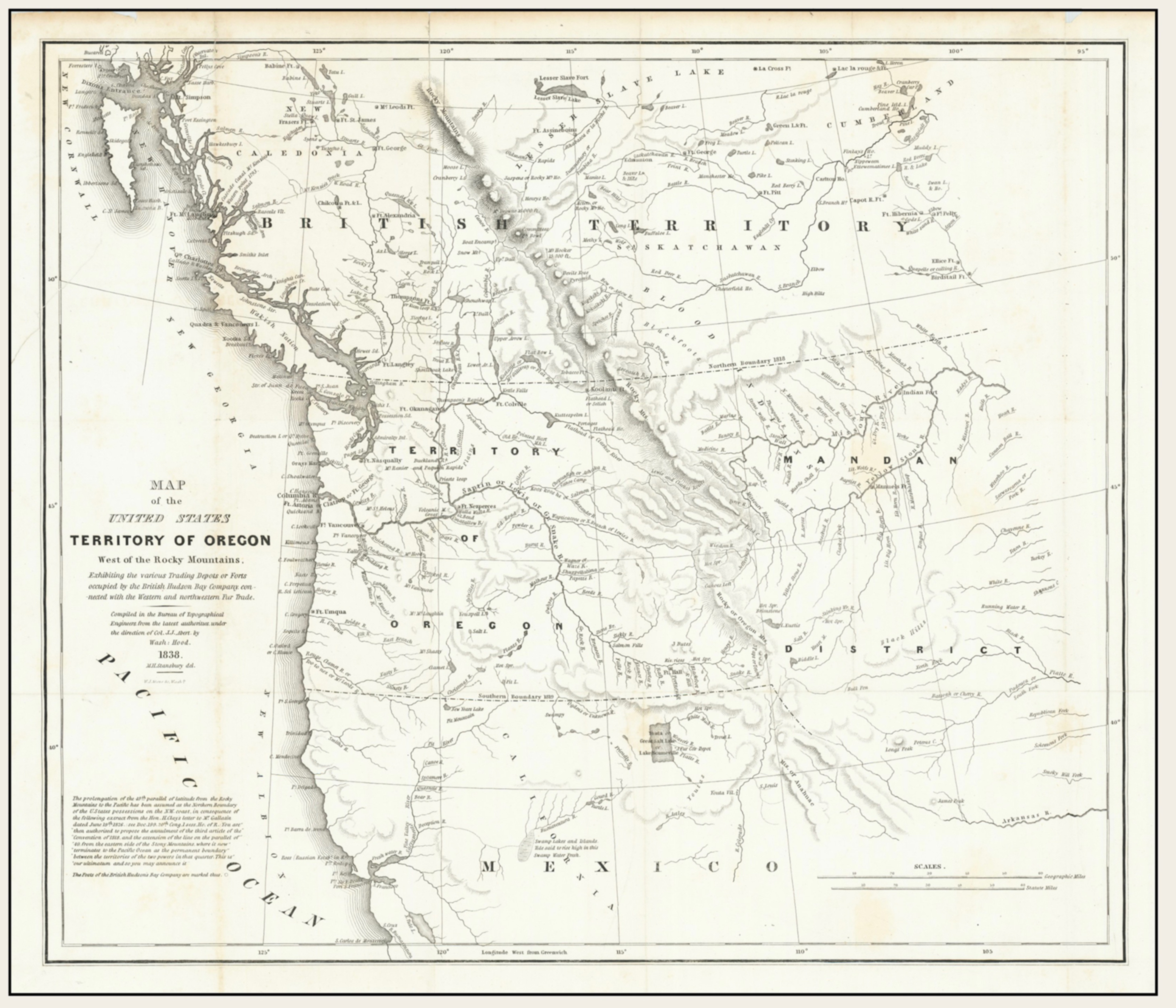
The De Smet Range is a mountain range of the Canadian Rockies located northwest of Highway 16 and Jasper Lake in Jasper National Park, Canada. The range is named after its highest point Roche de Smet, which in turn was named by Iroquois working in the fur trade industry. The Iroquois named the peak after Pierre-Jean De Smet, a Belgian missionary who had worked with the indigenous peoples in the 1840s in Rupert’s Land, the North-Western Territory, the Oregon Country and the United States.

Includes:
Roche De Smett
Mount Cumnock
Mount Bistre
Mount Greenock

References:

Roche De Smet

Alberta. Rock
N of Snaring
53.1342 N 118.1164 W — Map 083E01 — GoogleGeoHack
Name officially adopted in 1956
Topo map from Canadian Geographical Names
The Reverend Pierre-Jean De Smet. c. 1860-65, by Mathew Brady

The Reverend Pierre-Jean De Smet. c. 1860-65, by Mathew Brady Wikipedia

Shown on Palliser Map 1863 as Roche Suette.

The De Smet Range is a mountain range of the Canadian Rockies located northwest of Highway 16 and Jasper Lake in Jasper National Park. The range is named after its highest point Roche de Smet, which in turn was named by Iroquois working in the fur trade industry. The Iroquois named the peak after Pierre-Jean De Smet [1801–1873], a Belgian missionary who had worked with the indigenous peoples in the 1840s in Rupert’s Land, the North-Western Territory, the Oregon Country and the United States.

References:

Bush River

British Columbia. River: Columbia River drainage
Flows S into Bush Arm (Columbia Reach), Kinbasket Lake
51.8067 N 117.3664 W — Map 082N14 — GoogleGeoHack
Name officially adopted in 1974
Official in BCTopo map from Canadian Geographical Names
Descriptive name, referring to the dense forest to the water’s edge.

Adopted in the 10th Report of the Geographic Board of Canada, 30 June 1911. The channel labelled “North Fork Bush River” on BC map 1EM confirmed as the main channel of Bush River, and the channel labelled “South Branch Bush River” on BC-Alberta Boundary sheet 19, 1918, was named Valenciennes River in the 18th Report, 31 March 1924. Lower reaches of Bush River have since been flooded behind Mica Dam.

References:

Mount Lyell

Alberta-BC boundary. Mount
NE of Bush Arm Kinbasket Lake
51.9567 N 117.1033 W — Map 082N14 — GoogleGeoHack
Name officially adopted in 1911
Official in BCTopo map from Canadian Geographical Names
This mount appears on:
Palliser Map 1863
Named in 1858 by James Hector [1834–1907], after Sir Charles Lyell [1797–1875], noted British geologist.

Also Lyell Glacier and Icefield.

In 1972, five distinct peaks on Mt. Lyell (formerly referred to as only Lyell 1 through 5 or L1 through L5), were named after Swiss mountain guides who settled in Golden, British Columbia in 1912. Running south to north along the interprovincial boundary, these peaks are: Christian Peak (L5), Walter Peak (L4), and Ernest Peak (L3), named after Christian Hässler, Walter Feuz and Ernest Feuz. Located entirely in Alberta are Edward Peak (L2) and Rudolph Peak (L1), named after Edward Feuz Jr. and Rudolph Aemmer.

References:

  • Hector, James [1834–1907]; Palliser, John [1817–1887]; Spry, Irene Mary Biss [1907–1998], editor. The papers of the Palliser Expedition 1857-1860. Toronto: Publications of the Champlain Society XLIV, 1968. Internet Archive [accessed 4 March 2025]
  • Wikipedia. Lyell, Mount

Mount Kerkeslin

Alberta. Mount
S of Jasper, E of Athabasca River
52.6486 N 117.8267 W — Map 083C12 — GoogleGeoHack
Name officially adopted in 1956
Topo map from Canadian Geographical Names
This mount appears on:
Palliser Map 1863
This mountain was named by James Hector [1834–1907] in 1859. The origin of the name is uncertain, although it is similar to the what Hector reported as the Native name for the wolverine,which he mentioned on his trip to Jasper House along the Athabasca River:

January 22nd [1859] — At noon to-day we halted to cache another bag of pemican, which we did by building logs over it, carefully fitting them together by notches. The great danger to a caché is from the wolverine, a small rough-haired animal, like a miniature bear, but much stronger in proportion to his size than any other animal in the country. He is posessed of great cunning also, and it is very difficult to defeat his marauding propensities. Their Indian name is ker-kes-shu, and many wonderful yarns are told about them round the camp fire. For instance, that a man once left his gun, with the leather cover on, leaning against a tree, while he went to skin a deer he had killed, on his return his gun was gone, and no trace of anything to be seen in the snow excepting the track of a wolverine, that seemed to have gone to where the gun had been left. Following the animal’s track, he found after more than 300 yards, the mark of his gun trailing in the snow as the animal had dragged it along, but for this distance it must have carried it clear of the ground, a matter of some difficulty to a little beast not higher than a fox. [1]

References:

  • 1. Hector, James [1834–1907]; Palliser, John [1817–1887]; Spry, Irene Mary Biss [1907–1998], editor. The papers of the Palliser Expedition 1857-1860. Toronto: Publications of the Champlain Society XLIV, 1968, p. 365. Internet Archive [accessed 4 March 2025]