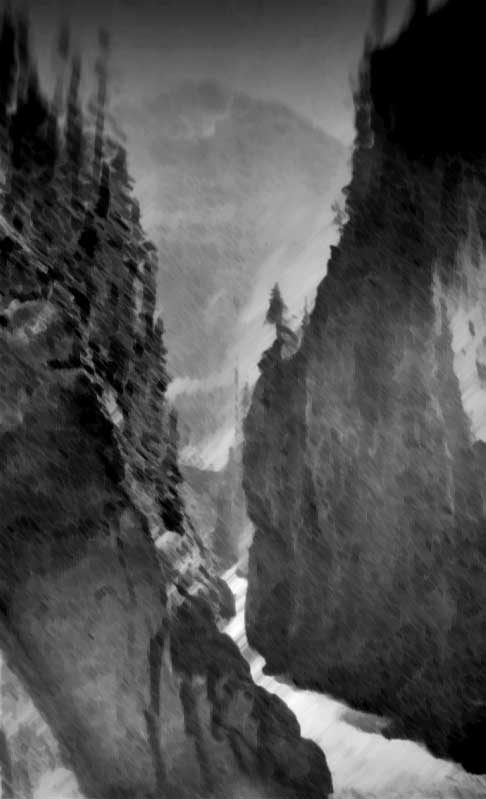
Headwaters of Raush River
52.6833 N 119.7333 W — Map 83D/12 — Google — GeoHack
Name officially adopted in 1962
Official in BC – Canada
In 1963 the Alpine Club of Canada requested permission from the British Columbia Provincial Parks Branch to build a climbing hut on Mount Robson. The Club stated that shelters placed in well chosen locations will minimize the danger of exposure to mountaineers entering this area, and assist the rescue teams when they are needed in these areas. “Safety is the major reason why we wish to establish shelters and for which we expect cooperation from your department.”
BC Parks issued a Park Use Permit for erection of the shelter The costs of structure and erection were borne by the ACC, but the permit did not give the club sole use or control of use of the cabin. The original dome-shaped hut was built in 1966, replaced by a Pan Abode hut in 1969.
The hut was named for Ralph Forster, who made a generous contribution toward the construction of the new hut. Forster was a long-time member of the ACC, a Fellow of the Royal Geographical Society and of the Alpine Club (London). A native Albertan, he became a chartered accountant after graduating from the University of Alberta. After joining the ACC in 1932, he served as Honorary Auditor until 1952. Although he was ill, he was flown to the hut when materials were being taken up on the first day of construction. He died in 1971 at the age of 74.
Indicated on the map that Arthur Oliver Wheeler [1860–1945] composed after the 1911 Alpine Club of Canada–Smithsonian Robson Expedition.
“Topographical Map Showing Mount Robson and Mountains of the Continental Divide North of Yellowhead Pass” shows the line of the Grand Trunk Pacific Railway.
Rainbow was among railway depots that were left vacant on the abandoned Grand Trunk Pacific Railway grade in 1917. Rainbow (GTP) was relocated to Red Pass junction in 1917.
Site of an internment camp for Canadians of Japanese descent during World War Two.
Surveyor James McEvoy [1862–1935] of the Geological Survey of Canada traversed the Yellowhead Pass from the east in 1898, exploring as far as Cranberry Lake before returning to Edmonton.
On the return journey, some further work was done on the north side of the Fraser valley above Moose Lake, to ascertain the position of a band of rusty quartzite which weathers out to a brilliant red colour. Viewed from a distance, these mountains have a gorgeous appearance of red and yellow, and suggest the name of Rainbow Mountains. (1)
During the 1911 Alpine Club of Canada–Smithsonian Robson Expedition, Arthur Oliver Wheeler [1860–1945] wrote:
The Moose River flows from the heart of this range, of which Mount Robson is the king pin. The mountains are formed of rocks showing brilliant colours of crimson, red, and yellow, and these, mingled with the blues and greens of Nature’s everyday garb, present from distant points a highly prismatic effect that has given rise to the name. (2)
One of the 13 official Rainbow Creeks in Canada (five in British Columbia).
Arthur Oliver Wheeler [1860–1945], who headed the 1911 Alpine Club of Canada–Smithsonian Robson Expedition, wrote:
”Moose River emerges from a canyon directly beside the railway. It is very fine and will be a most attractive feature to the travelling public. The canyon is not more than two hundred yards in length and about 150 feet deep. There are two falls near the head, of which the upper drops 50 feet and the lower 20 feet. Here the grandeur and awe of the spectacle culminates; the gorge is at its wildest, the sheer rock walls at their steepest; you are between the two falls; flying mist and spray fill the available space and eddy and circle continuously. On sunny days baby rainbows play hide and seek. I counted, at one and the same time, half a dozen at various points of view. The name Rainbow Falls and Canyon is suggested as attractive and appropriate; the more so that the mountain group, of which Robson is the dominating mass, is known as the Rainbow Mountains. The canyon is an exceptionally fine study of the action and effect of a powerful glacial torrent.”
Origin of the name unknown.