46 miles west of the Yellowhead Pass on the Canadian National Railway
Mile 46 from Yellowhead Pass, between Rearguard (railway point) and Tête Jaune station. Mile 18 in Téte Jaune Subdivision, CNR.
Mile 46 from Yellowhead Pass, between Rearguard (railway point) and Tête Jaune station. Mile 18 in Téte Jaune Subdivision, CNR.
It was necessary to construct a tunnel near Rider to facilitate traffic through the mountain. The tunnel was actually closer to Legrand than Rider even though it was called the “Rider Tunnel.” The geography in that location was such that the hillside was prone to landslides which frequently covered the railway tracks. For many years a tunnel watchman was employed to monitor conditions to ensure safe rail travel. In her book The Robson Valley Story, Marilyn Wheeler records that Ed Walsh, the orchardist from Legrand, was the “tunnel keeper” at Rider.
— Olson
“In Scotland and Northern England, a wynd is a narrow lane between houses. The word derives from Old Norse venda (“to turn”), implying a turning off a main street, without implying that it is curved. In fact, most wynds are straight. In many places wynds link streets at different heights and thus are mostly thought of as being ways up or down hills.” [2]
Among depots that were left vacant on the abandoned Grand Trunk Pacific Railway grade in 1917. Rainbow (GTP railway point) was relocated to Red Pass Junction in 1917 and Yellowhead (railway point) burned down about 1918.
The stations at Fitzwilliam, Grant Brook and Lucerne (GTP railway point) were rehabilitated in 1924, when that section of the line was re-opened.

Mountain Region – Yellowhead Division
Albreda Subdivision
Jasper to Blue River – 132 miles
CNRHA
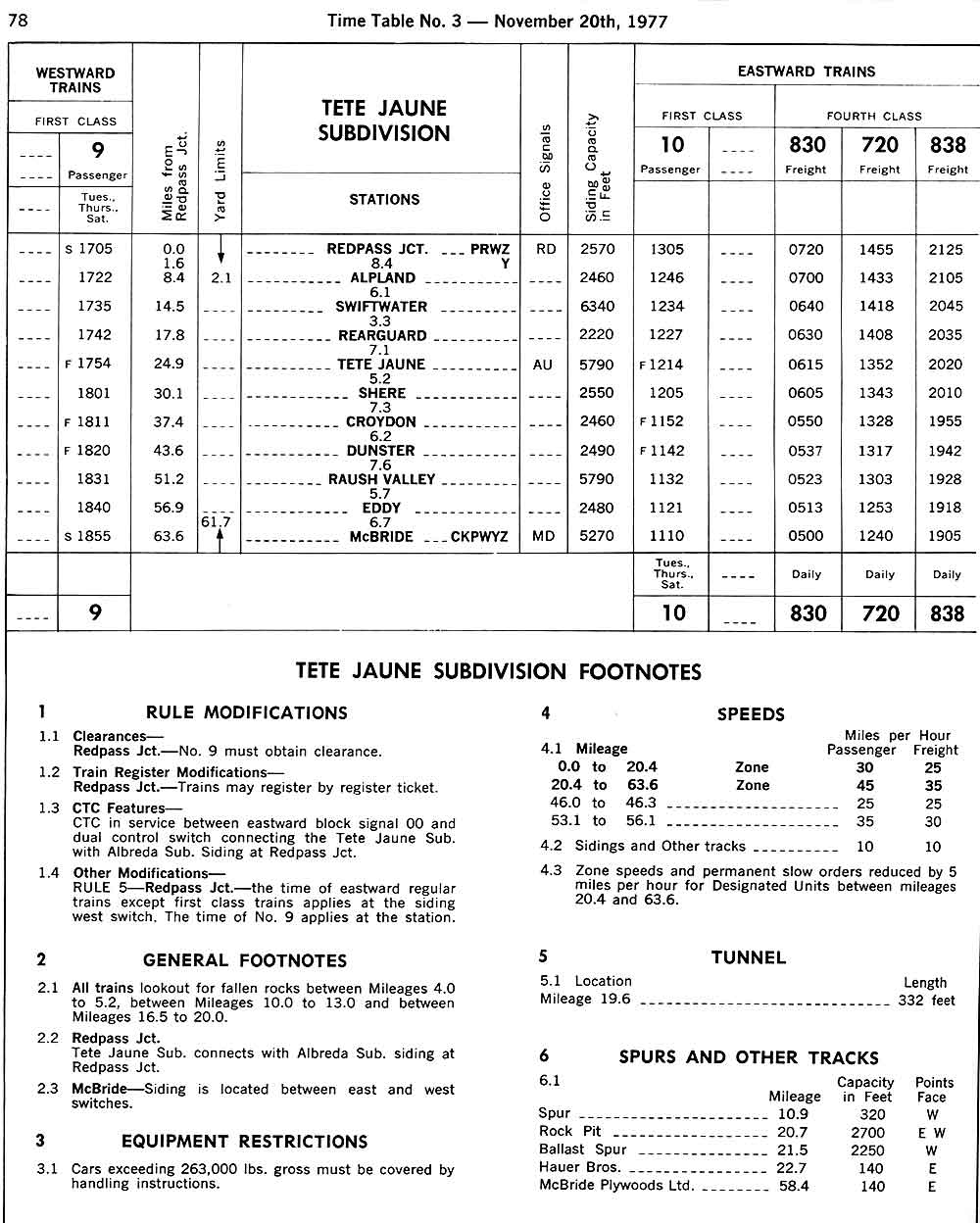
Mountain Region – BC North Division
Tete Jaune Subdivision
Redpass to McBride – 63.9 miles
CNRHA
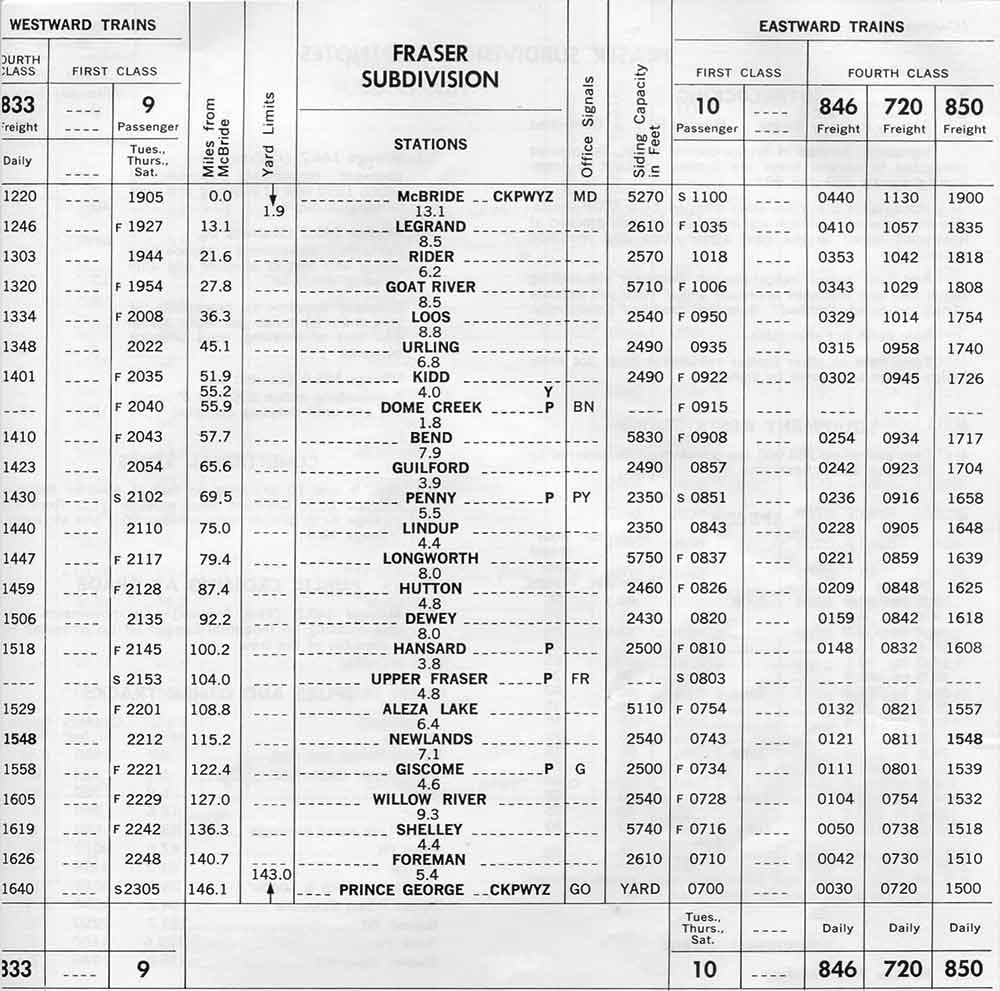
Mountain Region – BC North Division
Fraser Subdivision
McBride to Prince George – 146 Miles
CNRHA
“Prince George” appears on the 1914 Grand Trunk Pacific timetable, at Mile 234 from the Yellowhead Pass. The city was incorporated on 6 March 1915. Originally Fort George, a trading post founded in 1807 by Simon Fraser of the North West Company and named after King George III of Great Britain.
Adopted in 2016 on as required for water licensing. The mouth is located at Crescent Spur so name seems fitting.

Jasper — Grand Trunk Pacific Railway. Photo: William Topley, 1914 Library and Archives Canada
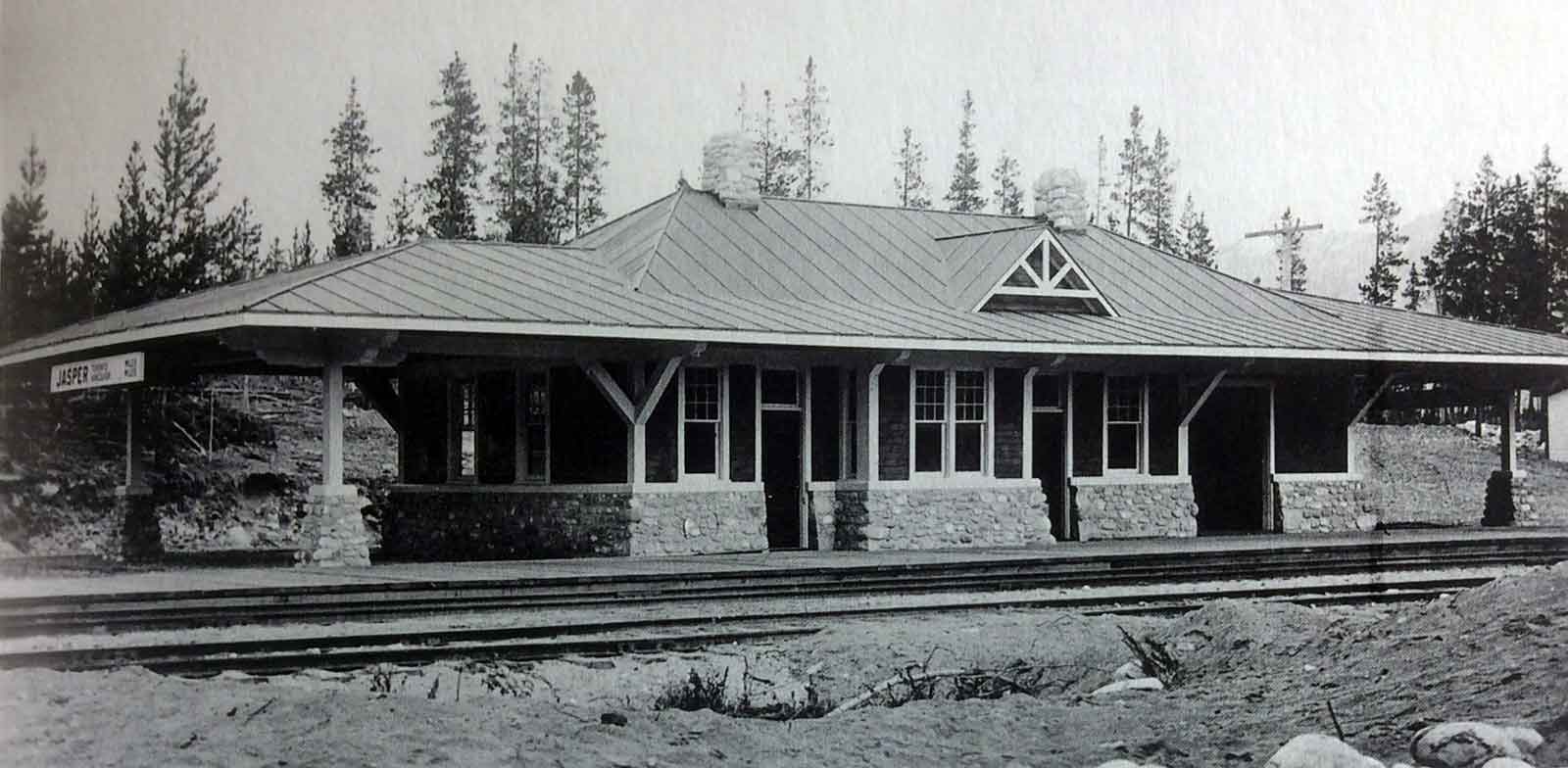
Canadian Northern Railway station at Jasper, ca. 1916
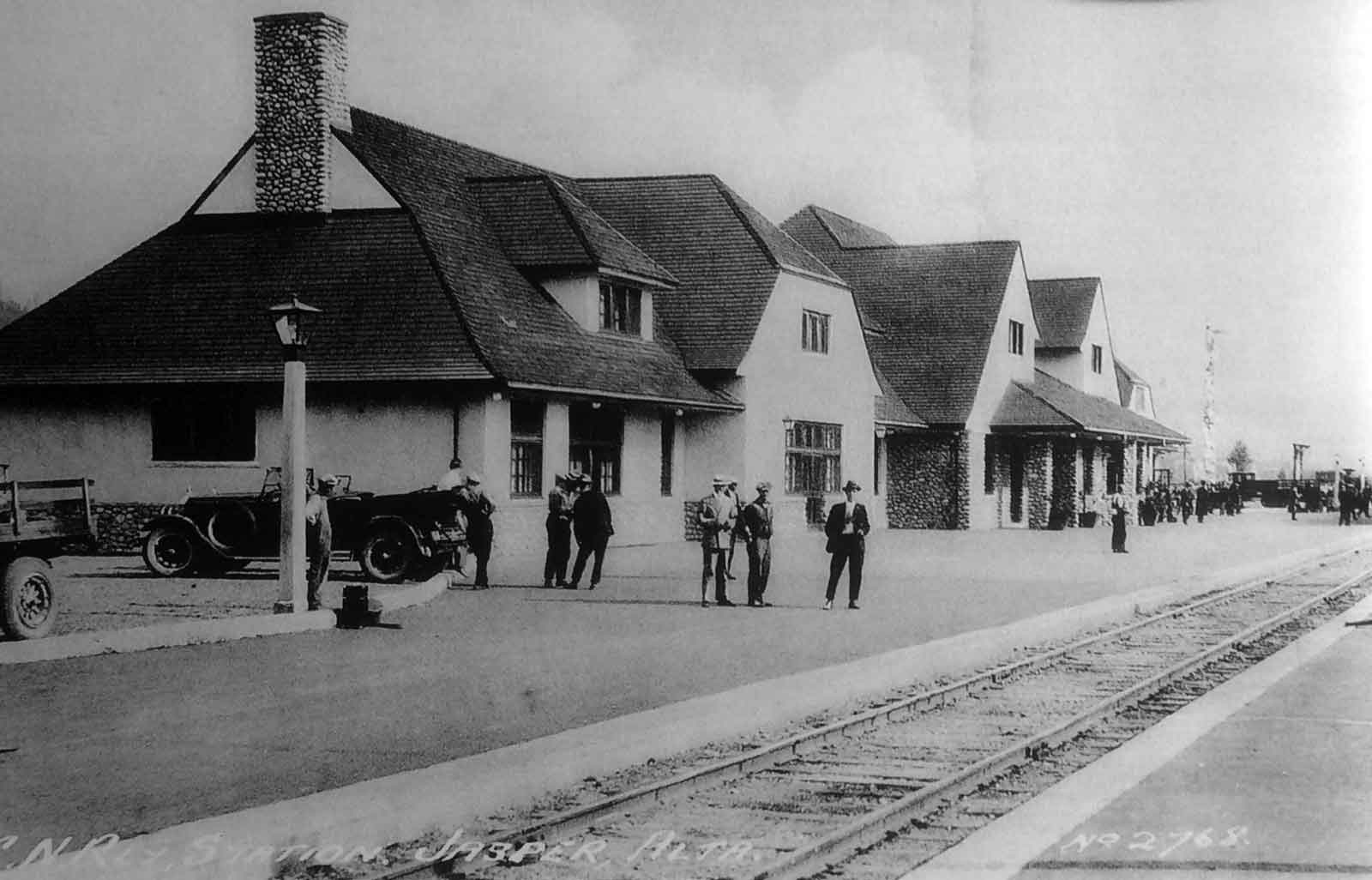
Canadian National Railways station at Jasper, late 1920s
The town of Jasper is named after a
North West Company fur brigade post established in 1813 on Brûlé Lake. It was first mentioned in by Gabriel Franchère [1786–1863] in his Relation d’un voyage à la Côté du Nord-Ouest de l’Amérique Septentrionale (1820). The post was a “provision depot with the view of facilitating the passage of the mountains through Athabasca Pass.” Franchère called the post “Rocky Mountain House,” managed by François Décoigne, whom some have identified with Pierre Bostonais dit “Tête Jaune” [d. 1827].
In 1817, the position was filled by Jasper Hawse, whose name was adopted to distinguish the post from the new Rocky Mountain House established on the North Saskatchewan River. In 1821, the Hudson’s Bay Company and the North West Company amalgamated and by 1824, Michael Clyne was in charge of the post. In 1829, Clyne built a new post at the junction of the Athabasca River and the Snake Indian River. From 1835 to 1849, Colin Fraser [1805–1867] ran the post.
In the early 1850s, it was closed as it was losing money. It was then reopened by Henry John Moberly [1835–1831] and then closed in the late 1850s.
The Jasper Forest Reserve, later Jasper Forest Park, was named for the original fur brigade post. The confluence of the Miette and Athabasca rivers was selected by the Grand Trunk Pacific Railway as the location for their divisional point. This crew-changing station was given the name “Fitzhugh” in 1911, after a prominent Grand Trunk Pacific official. The following years, the name was changed to assume that of the new national park in which it was situated.
Bohi:
The Grand Trunk Pacific and Canadian Northern railways serviced many resorts in the West. Not surprisingly, the GTP utilized standard structures at these locations, for example at Nakina, Ontario; Watrous, Saskatchewan; Cooking Lake, Wabamun, and Jasper, Alberta. In contrast, many CNoR resorts had special depots. In 1910 R. B. Pratt designed a simple station for Westside, Manitoba, later renamed James. It was comprised of a single storey building canopies on each end. Inside was a large waiting room, a small office with a bay window, and a freight and baggage room. This became the prototype for at least four other depots, including the one built at Jasper in 1915, shown above. The Jasper station virtually repeated Westsides floor plan, but was finished to a higher standard, with a stone plinth and metal roofing. [p. 37]
The former Grand Trunk Pacific station at Jasper burned down late 1924. In keeping with its reputation as world-class tourist destination, Canadian National Railway Architect Schofield designed a replacement station that was a masterpiece. Its massing borrowed freely from English rural residential architecture and featured a plinth of local cobblestones capped with a course of Tyndall stone. The walls above were of brick, finished on the exterior with rough-cast stucco. The plaster and oak-beamed, vaulted ceiling in the general waiting room was naturally lighted by clerestory glazing. Other services included a restaurant and a dining room, with a feature fireplace and massive cobble chimney. Living accommodation for station staff was provided on the second level. The Jasper station was restored under the auspices of Parks Canada in 2001. [p. 42]
