Category Archives: Place

Blackstone Creek

British Columbia. Creek: North Thompson River drainage
Flows SW into head of North Thompson River, SW of Valemount
52.6333 N 119.65 W — Map 83D/12 — GoogleGeoHack
Earliest known reference to this name is 1939
Name officially adopted in 1963
Official in BCCanada
This creek appears on:
Zillmer maps of Cariboo 1939-1948 [1939]

Ray Zillmer [1887–1960] wrote of his exploration of the source of the North Thompson River:

It was my purpose [in 1939] to travel up the Thompson Valley to its source, explore its source, determine its relation to the Raush, and cross the range, if possible, going out by way of the Canoe River.…

We had two other alternatives. One was to climb the moun­tain E. of where we then stood, by following a ridge alongside and S. of a creek that came into the Thompson a little N. of us, named Blackstone Creek by Miss Frye. Above timberline we would get to a large icefield which fed this creek and which we called Blackstone Glacier.

Ella Frye was a trapper on the North Thompson for many years.

References:

  • Zillmer, Raymond T. [1887–1960]. “The exploration of the source of the Thompson River in British Columbia.” American Alpine Journal, Vol. 4, No. 1 (1940):69–81. American Alpine Club

Wolverine Pass

Alberta-BC boundary. Former unofficial name
Smoky and Fraser drainages
Carcajou Pass
53.2333 N 119.2667 W GoogleGeoHack
Not currently an official name.

“Nearly midway between Bess Pass and Robson Pass is a pass of the watershed which is locally known as Wolverine Pass,” wrote boundary surveyor Arthur Wheeler [1860-1945 ]. The pass had been named by Donald Phillips [1884–1938]. “There is another Wolverine Pass in a more southerly part of the Canadian Rockies, so the pass under discussion is here referred to as Carcajou Pass, a synonym for Wolverine.”

References:

  • Wheeler, Arthur Oliver [1860–1945], and Cautley, Richard William [1873–1953]. Report of the Commission appointed to delimit the boundary between the Provinces of Alberta and British Columbia. Part II. 1917 to 1921. From Kicking Horse Pass to Yellowhead Pass.. Ottawa: Office of the Surveyor General, 1924. Whyte Museum

Pierre Elliott Trudeau, Mount

British Columbia. Mount
S of McLennan River in the Premier Range
52.8028 N 119.4253 W — Map 083D14 — GoogleGeoHack
Name officially adopted in 2006
Official in BCTopo map from Canadian Geographical Names
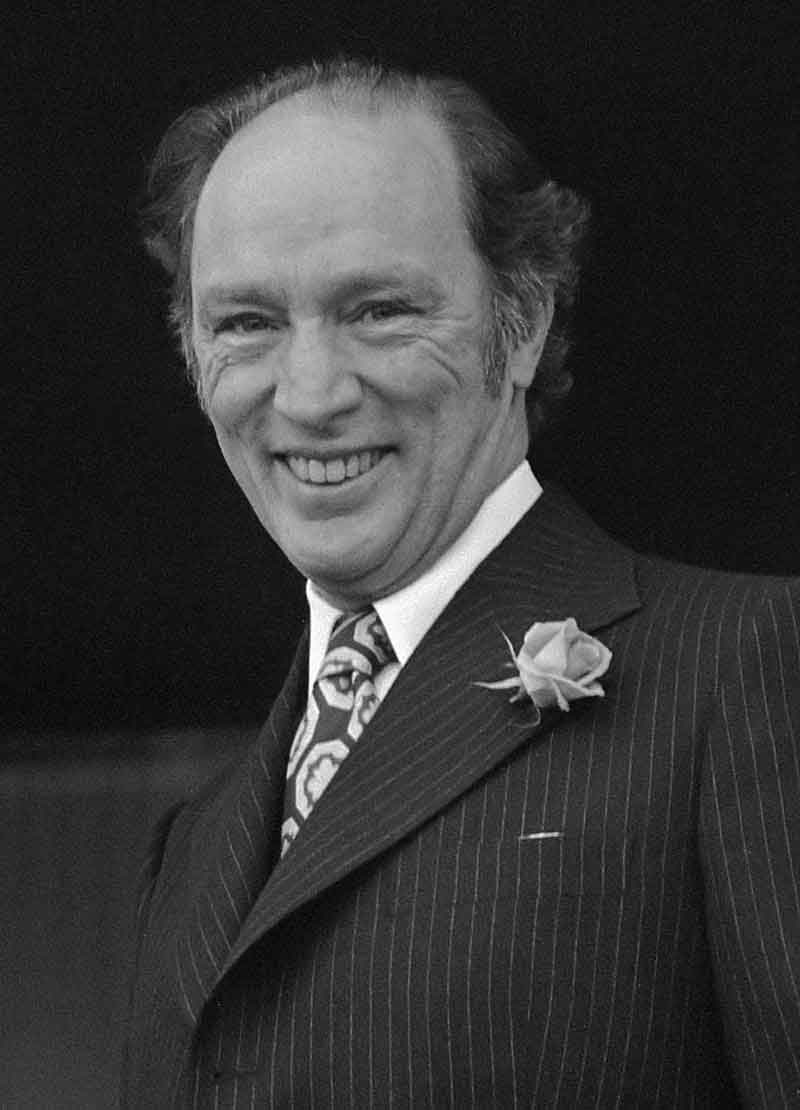
Prime Minister Pierre Trudeau

Prime Minister Pierre Trudeau Wikipedia

Named in 2006 after the Pierre Elliott Trudeau (1919-2000), Canada’s 15th Prime Minister, 1968-79 and 1980-84.

Upon Trudeau’s death, then-Prime Minister Jean Chrétien floated the idea of renaming Mount Logan, Canada’s highest peak, for Trudeau; when this met with resistance, this formerly unnamed peak was given the designation on June 10, 2006, in a ceremony held at Valemount and attended by Trudeau’s eldest son, Justin.

Elsewhere in the Premier Range, mountains 10,000 feet (3000m) or higher have been named for former prime ministers; this particular mountain, while only 8661 feet elevation, is the most prominent feature on the near horizon overlooking Valemount, is accessible from the Yellowhead Highway, and offers climbing and exploring opportunities for outdoors enthusiasts.

References:

Mica Creek

British Columbia. Former name: Fraser River drainage
Former name for McLennan River
52.9681 N 119.4611 W GoogleGeoHack
Not currently an official name.

“The stream here called McLennan River, its real source, is also known as Mica Creek,” wrote Walter Alfred Don Munday [1890–1950] in 1925.

References:

  • McEvoy, James [1862–1935]. “Map Showing Yellowhead Pass Route From Edmonton To Tête-Jaune Cache.” (1900). Natural Resources Canada
  • Munday, Walter Alfred Don [1890–1950]. “In the Cariboo Range – Mt. David Thompson.” Canadian Alpine Journal, Vol. 15 (1925):130-136, p. 136. Alpine Club of Canada

Cariboo Range

Feature type: Mountain Range
Province: British Columbia
Location: Former name for Cariboo Mountains

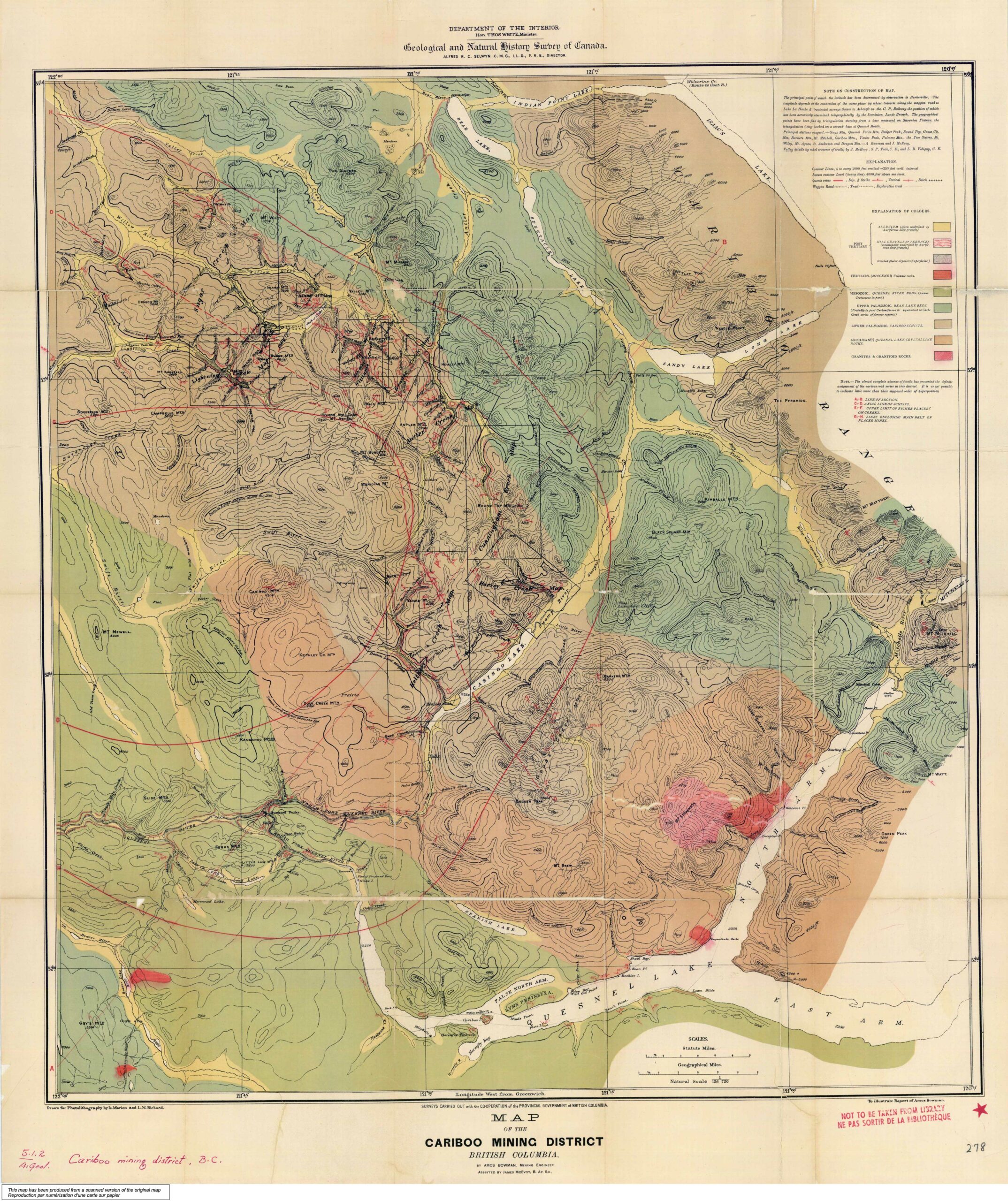
Map of the Cariboo Mining District to illustrate the report of Amos Bowman

Map of the Cariboo Mining District to illustrate the report of Amos Bowman
Cariboo Gold Rush

This former name for the Cariboo Mountains originally included all of that range, but early mountaineers restricted “Cariboo Range” to “that higher portion of the Cariboo Range which is E. of the Raush River and the headwaters of the Azure River, and E. and N. of the North Thompson River” (Zillmer 1944).

Amos Bowman’s 1887 map of the Cariboo Mining District labelled these mountains as “Cariboo Range,” but the name “Cariboo Mountains” was instead officially adopted in 1918. Neither “Cariboo Range” (nor “McLennan Range”) are official names.

Both Munday (1948) and Thorington (1949) state that “[the Cariboo range] is now officially the McLennan Range,” referring to the restricted area along the headwaters of the McLennan River. Zillmer (1950) contradicted that with reference to communications with the Canadian Board on Geographical Names and Chief Cartographer of British Columbia.

References:

  • Bowman, Amos [1839–1894]. Maps of the principal auriferous creeks in the Cariboo mining district, British Columbia. Ottawa: Geological Survey of Canada, 1895. Hathi Trust
  • Bowman, Amos [1839–1894]. Map of the Cariboo Mining District, British Columbia, to illustrate the report of Amos Bowman. Cariboo Gold Rush
  • Zillmer, Raymond T. [1887–1960]. “Explorations in the Southern Cariboos.” Canadian Alpine Journal, Vol. 27 (1939):48-61. Alpine Club of Canada
  • Zillmer, Raymond T. [1887–1960]. “The Exploration of the Cariboo Range from the East.” American Alpine Journal, 5:2 (1944):261-274. American Alpine Club
  • Munday, Walter Alfred Don [1890–1950]. “That terrible snow-peaked range.” Canadian Alpine Journal, Vol. 31 (1948):77-. Alpine Club of Canada
  • Zillmer, Raymond T. [1887–1960]. “The first crossing of the Cariboo Range.” Canadian Alpine Journal, Vol. 31 (1948):26–37. Alpine Club of Canada
  • Thorington, James Monroe [1895-1989]. “Canada, Cariboo Range.” American Alpine Journal, 7:2 (1949). American Alpine Club
  • Zillmer, Raymond T. [1887–1960]. “Cariboo Range.” Canadian Alpine Journal, Vol. 27 (1950):120. Alpine Club of Canada
Kakwa River

British Columbia and Alberta. River: Smoky River drainage
Flows NE across BC-Alberta boundary into Smoky River, E of Jarvis Lakes
54.0997 N 120.0011 W — Map 93I/1 — GoogleGeoHack
Name officially adopted in 1925
Official in BCCanada

Name appears on BC-Alberta Boundary Atlas sheet No. 39, 1924. The river was labeled “Porcupine River” on 1912 map of BC Northern Interior (publisher not cited), and on BC Lands 1913 Preliminary Forest Map, and on BC Lands 1917 map of the Forest Stand Types in British Columbia.

Explorer Samuel Prescott Fay [1884–1971], who spent the summers of 1912 to 1914 tracking big game in this area, suggested that the name “Porcupine” be changed [or revert (?)] to “Kakwa”, the Cree word for porcupine.

“Kakwa” is listed at the Indigenous Geographical Names dataset as a word of Cree language.

References:

  • Fay, Samuel Prescott [1884–1971]. “Mount Alexander.” Canadian Alpine Journal, Vol. 6 (1914–1915):121
  • Fay, Samuel Prescott [1884–1971]. “Note on Mount Alexander Mackenzie and Mount Ida.” Alpine Journal, Vol. 36 (1924):421, p.55
  • Andrews, Gerald Smedley [1903–2005]. Métis outpost. Memoirs of the first schoolmaster at the Métis settlement of Kelly Lake, B.C. 1923-1925. Victoria: G.S. Andrews, 1985. Internet Archive
  • British Columbia Geographical Names. Kakwa River

Kakwa Lake

British Columbia. Lake: Smoky River drainage
Head of Kakwa River
54.0164 N 120.1678 W — Map 93I/1 — GoogleGeoHack
Name officially adopted in 1925
Official in BCCanada

The name was adopted in 1925 as labelled on BC-Alberta boundary sheet 39, 1924. Named in association with Kakwa River.

References: