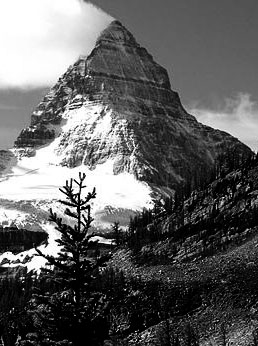
Above Howse River near continental divide
51.8597 N 116.9317 W — Map 082N15 — Google — GeoHack
Name officially adopted in 1924
Official in Canada
Elevation: 3609 m
The highest mountain in Alberta. It takes its name from the Columbia River. In 1872, Robert Gray, an American sea captain, discovered the river’s mouth, between present-day Washington and Oregon, and named it after his ship, “Columbia.”
In 1892 Arthur Philemon Coleman [1852–1939] called this peak Pyramid Mountain. The current name was bestowed in 1919 by the Alberta-British Columbia Boundary Commission .

Mt. Cheadle and upper part of Garnet River, North Thompson River. Benjamin F. Baltzly, 1871
McCord Stewart Museum
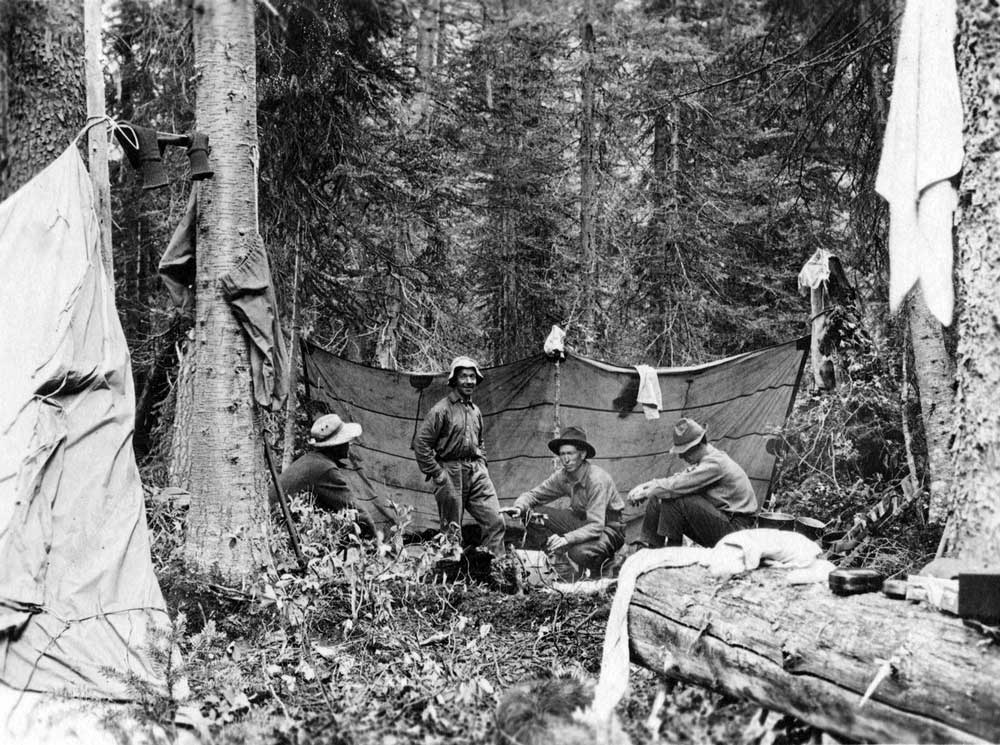
Cheadle accompanied Milton on a journey across Canada in 1862–63. They crossed the Rocky Mountains through Yellowhead Pass, almost starved in the North Thompson country, and eventually straggled into Kamloops. They visited the Cariboo gold fields before returning to England by ship from Victoria. Cheadle, the older and more resourceful of the two, assumed most of the responsibility for their journey. He spelled out their story in two books, Journal of a Trip across Canada and The North West Passage by Land, which has gone through ten editions.
In 1865, Cheadle resumed medical practice in London, and married in the following year. He met with great success in his career, and served as dean of St. Mary’s Medical School from 1869 to 1873. In the face of much opposition, he stood among the early supporters of women’s claims to a right to practice medicine.

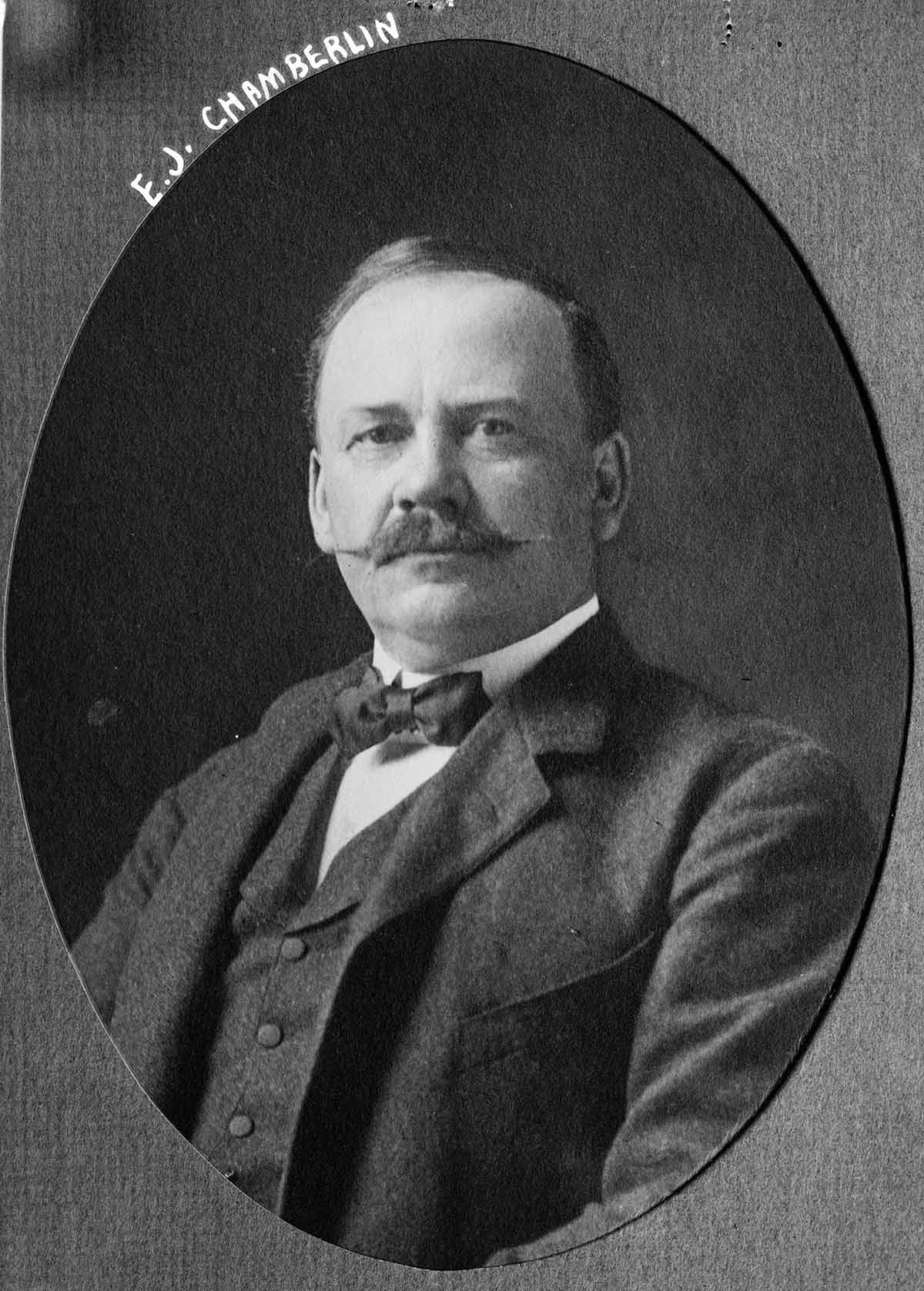
Edson Joseph Chamberlin
Wikipedia
Name adopted by the Geographic Board of Canada in 1917 after Edson Joseph Chamberlin [1852-1924], president of the Grand Trunk Pacific Railway at the time. Edson Chamberlin is also the namesake of the town of Edson, Alberta.
In 1909 Chamberlin became general manager and then vice president of the Grand Trunk. In 1912 he became the president when Charles Melville Hays lost his life on the RMS Titanic. Chamberlin’s presidency differed from Hays’s in that he led the Grand Trunk to expand westward as part of the Canadian transcontinental railway. He remained president until he retired in 1917. Chamberlin died at Pasadena, California, in 1924.
Edson Chamberlin is not related to Rollin Thomas Chamberlin [1881–1948], the American geologist who is namesake of Chamberlin Peak and Chamberlin Glacier, in the Cariboo Mountains about 50 kilometres to the south.
In 1924, Rollin T. Chamberlin, Allen Carpé, and A. L. Withers made a number of first ascents in the Cariboo Mountains, including Mount Titan (now Mount Sir Wilfred Laurier) and Mount Challenger (now Mount Stanley Baldwin).

Rollin T. Chamberlin, L. E. “Slim” Goodell, Allen Carpe, A. L. Withers. Photo George Burns
University of Chicago
The name was adopted at the suggestion of the Alpine Club of Canada following a proposal by the 1949 mountaineering party of Sterling Brown Hendricks [1902–1981] and Andrew John Kauffman [1920–2002].(2)
Mount Assiniboine, also known as Assiniboine Mountain, is a mountain located on the Great Divide, on the British Columbia/Alberta border in Canada.At 3,618 m (11,870 ft), it is the highest peak in the Southern Continental Ranges of the Canadian Rockies. Due to Assiniboine’s pyramidal shape, it has been unofficially named the “Matterhorn” of North America. Mt. Assiniboine rises nearly 1,525 m (5,003 ft) above Lake Magog.
Mt. Assiniboine was named by George M. Dawson in 1885. When Dawson saw Mt. Assiniboine from Copper Mountain, he saw a plume of clouds trailing away from the top. This reminded him of the plumes of smoke emanating from the teepees of Assiniboine Indians.