Author Archives: Swany

Pacific Lake

British Columbia. Lake: Fraser River drainage
Expansion of Bad River (James Creek) at its headwaters
54.3833 N 121.6 W — Map 93I/5 — GoogleGeoHack
Name officially adopted in 1959
Official in BCCanada

In 1793 the expedition of Alexander Mackenzie [1764–1820] crossed the Continental Divide through the unnamed pass that contains this lake, crossing from Parsnip River, in the Arctic drainage, to Bad River (James Creek), in the Pacific drainage. They crossed from east to west on June 12:

We embarked on this lake [Pacific Lake], which is in the same course, and about the same size as that which we had just left [Portage Lake], and from whence we passed into a small river [James Creek or Bad River], that was so full of fallen wood, as to employ some time, and require some exertion, to force a passage. At the entrance, it afforded no more water than was just sufficient to bear the canoe.

References:

  • Mackenzie, Alexander [1764–1820]. Voyages from Montreal on the River St. Lawrence through the Continent of North America to the Frozen and Pacific Oceans in the Years 1789 and 1793 with a Preliminary Account of the Rise, Progress, and Present State of the Fur Trade of That Country. London: T. Cadell, Jun., and W. Davies, 1803. Internet Archive

Arctic Lake

British Columbia. Lake: Mackenzie River drainage
S of headwaters of Parsnip River
54.4167 N 121.6833 W — Map 93I/5 — GoogleGeoHack
Earliest known reference to this name is 1910
Name officially adopted in 1959
Official in BCCanada

Wednesday, 12. The weather was the same as yesterday, and we proceeded between three and four in the morning. We took up the net which we had set the preceding evening, when it contained a trout, one white fish, one carp, and three jub. The lake is about two miles in length, East by South, and from three to five hundred yards wide. This I consider as the highest and Southern-most source of the Unjigah, or Peace River, latitude, 54. 24. North, longitude 121. West of Greenwich, which, after a winding course through a vast extent of country, receiving many large rivers in its progress, and passing through the Slave Lake, empties itself into the Frozen Ocean, in 70. North latitude, and about 135 West longitude.

So wrote Alexander Mackenzie [1764–1820] in June 1793 , crossing the continental divide on his way to the Pacific Ocean. His latitude was precise; longitude is more difficult, especially if you’ve lost your watch.

The lake was named in 1910 by British Columbia land surveyor T. H. Taylor, who was employed that year by the BC Government to explore and survey the Parsnip River and the McGregor River. “This lake is at the Pacific-Arctic Divide; the water is clear as crystal.” (Extract from Reports of British Columbia Land Surveyors, Cariboo District, 1891-1927.)

References:

Arctic Pacific Lakes Park

British Columbia. Provincial Park
Fraser River and Peace River drainages
Surrounding Bad River (James Creek), between Parsnip River and McGregor River
54.3844 N 121.5556 W — Map 93I/5 — GoogleGeoHack
Name officially adopted in 2000
Official in BCCanada

In 1793 Alexander Mackenzie [1764–1820] crossed the Continental Divide through what is now this park, on his way to the Pacific OceN. Simon Fraser [1776–1862] followed the same route in 1805.

Arctic Lake drains north into the Parsnip River, and through the Peace River and the Mackenzie River reaches the Arctic Ocean.

Pacific Lake (and Portage Lake) are at the headwaters of Bad River (James Creek), which drains into Herrick Creek, thence McGregor River, which empties into the Fraser River on to the Pacific Ocean.

The park also encloses Little Lake on Bad River.

The lakes are a beautiful turquoise colour, and situated in a very scenic area, with alpine peaks and ridges as a distant backdrop. Situated in an area of limestone bedrock, some watercourses drain underground. Valley bottoms alongside the lakes support wet meadows and mixed forest. Valley sides include extensive avalanche chutes and small, picturesque waterfalls.

The park, established in 2000, protects high value fall and spring grizzly habitat, and year-round caribou habitat. Lakes and streams support diverse fish populations, and provide excellent opportunities for fishing. Diverse fish populations including lake trout, bull trout, rainbow trout, kokanee, dolly varden, mountain whitefish, redside shiner, lake char, and chinook salmon, and arctic grayling in Arctic Lake.

There appears to be a resource road leading to the Parsnip side of the pass, starting at Bear Lake on the Hart Highway.

References:

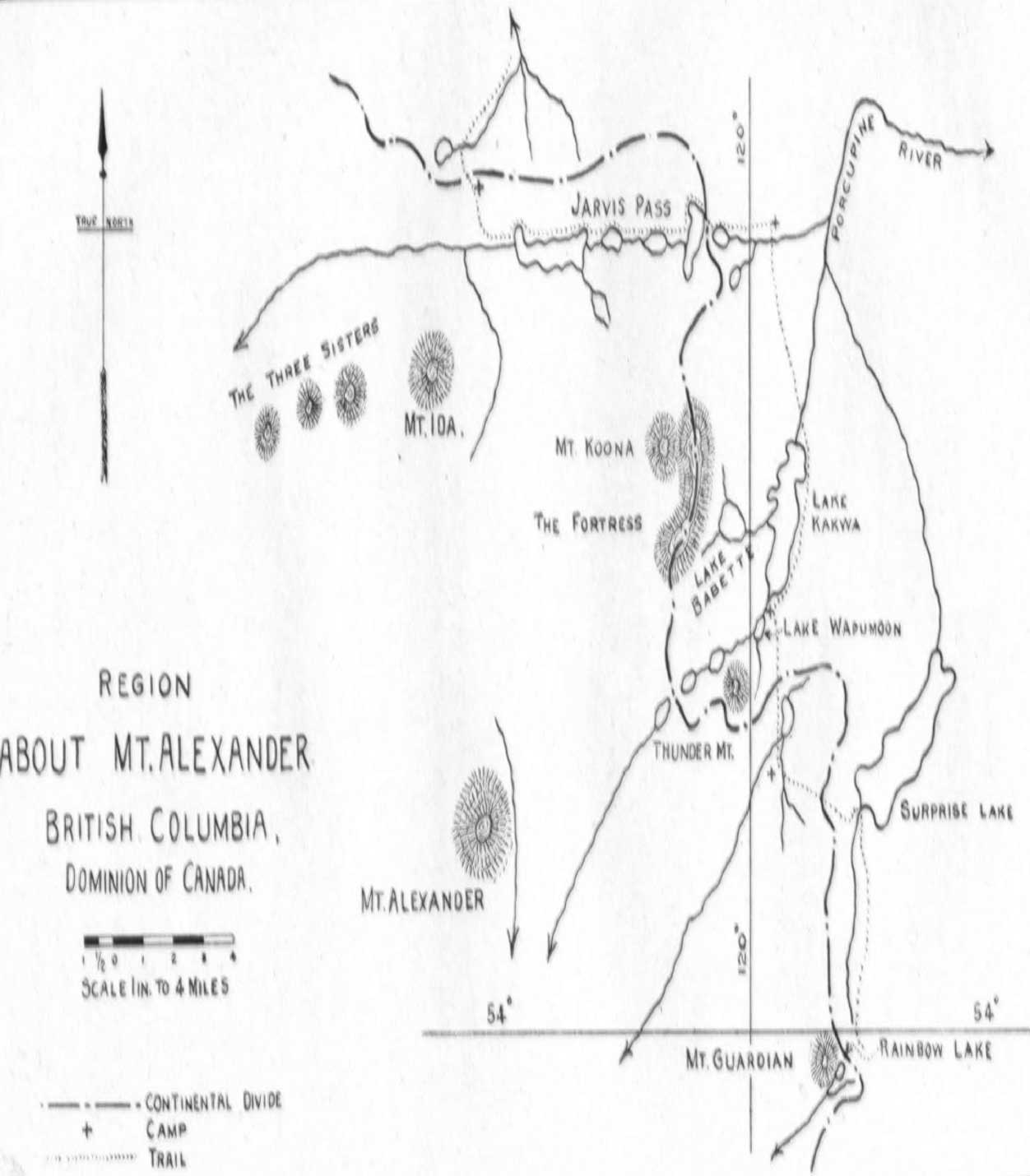
Jarvis Pass

Alberta-BC boundary. Pass
Fraser River and Mackenzie River drainages
Between Jarvis Creek and Hanington Creek
54.0906 N 120.1583 W — Map 93I/1 — GoogleGeoHack
Earliest known reference to this name is 1915
Name officially adopted in 1982
Official in BCCanada
E. W. Jarvis — Christmas, 1872

E. W. Jarvis — Christmas, 1872

The name was adopted by the Geographic Board of Canada in 1917 in recognition of surveyor Edward Worrell Jarvis [1846–1894].

“E.W. Jarvis, CE, and Major C. F. Hanington of Ottawa made an adventurous winter journey across the Rockies in 1875. The pass through which they crossed the mountains was named Jarvis Pass by the Geographic Board of Canada and the name Jarvis is also borne by a mountain on the south side of the pass opposite Mount Hanington. The exploration was undertaken to see if this route across the mountains would be a practicable one for the Canadian Pacific Railway. The elevation of the pass, about 5,000 feet, proved too high. The starting point of the journey was Quesnel, which was left on December 9, 1874, and a 1,000-mile journey, mostly on foot, occupying five and a half months, was concluded at Winnipeg on May 21, 1875.” (extract from Natural Resources Canada, Ottawa, June 1927)

References:

  • Hanington, Charles Francis [1848–1930]. Journal of Mr. C.F. Hanington from Quesnelle through the Rocky Mountains, during the winter of 1874-5. 1875. Internet Archive
  • McBride, Sam. “Edward Worrell Jarvis in Western Canada.” Manitoba History, Number 78 (Summer 2015). Manitoba Historical Society
  • British Columbia Geographical Names. Jarvis Pass

Mount Jarvis

Alberta-BC boundary. Mount: Fraser River drainage
N of Kakwa Lake near BC-Alberta boundary
54.0736 N 120.1669 W — Map 93I/1 — GoogleGeoHack
Earliest known reference to this name is 1877 (CPR Report)
Name officially adopted in 1917
Official in BCCanada

Adopted by the Geographic Board of Canada in 1917, as identified in the 1877 Canadian Pacific Railway report. Edward Worrell Jarvis [1846–1894], with his assistant Charles Francis Hanington [1848–1930], explored the region in 1875 in connection with CPR surveys.

References:

Encampment Creek

British Columbia. Creek: Columbia River drainage
Flows E into Columbia Reach, Kinbasket Lake
52.15 N 118.5167 W — Map 83D/2 — GoogleGeoHack
Name officially adopted in 1939
Official in BCCanada

Adopted in 1939 for BC Lands’ map 5D, Revelstoke-Golden, “flowing E into Columbia River at junction with Canoe River”. Location description and coordinates of mouth subsequently adjusted after flooding behind Mica Dam.

Camp Creek labelled on BC Reference Map 42 was likely adjusted to Encampment Creek to avoid duplication and to retain a historic reference: this creek originally flowed into the apex of the great bend [Big Bend] of the Columbia River at approximately 52°8′ N 118°27’15” W opposite Boat Encampment, the place where David Thompson [1770–1857] wintered in 1811. Following flooding of these valleys behind Mica Dam, this creek now flows into Kinbasket Lake.

References:

Canoe Encampment

British Columbia. Locality: Columbia River drainage
Confluence of Canoe River and Columbia River (now submerged in Kinbasket Lake)
52.1167 N 118.4333 W — Map 83D01 — GoogleGeoHack
Earliest known reference to this name is 1811 (David Thompson)
Not currently an official name.
This locality appears on:
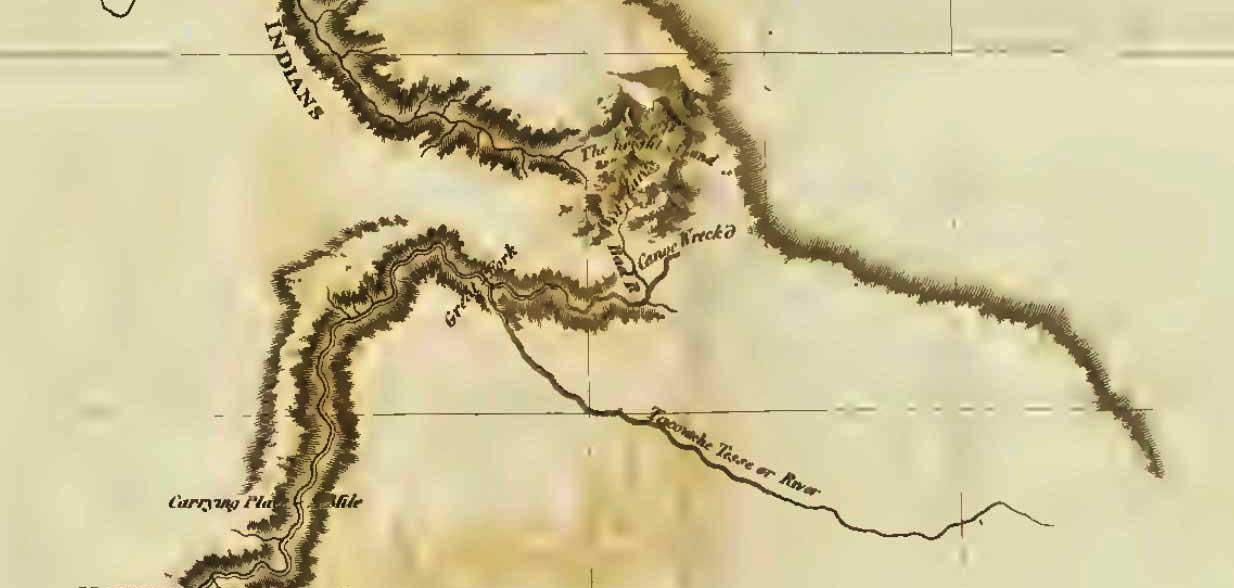
Map North America 1817 [A NWC post indicated here]
John Arrowsmith’s map BC 1859

On John Arrowsmith’s 1859 map of British Columbia, “Canoe Encampment” is the name for the Boat Encampment established by David Thompson [1770–1857] in 1811.

Milton and Cheadle

Our party across the mountains. Milton and Cheadle

Our party across the mountains. Milton and Cheadle
The North-West Passage by Land. [accessed 2 November 2021]


George A. Walkem [left], Dr. Walter Cheadle [seated], Viscount Milton [right, with hat in left hand], photographed in San Francisco, 1863

George A. Walkem [left], Dr. Walter Cheadle [seated], Viscount Milton [right, with hat in left hand], photographed in San Francisco, 1863
British Columbia Archives

Milton and Cheadle

William Wentworth Fitzwilliam Milton [1839–1877] was a British nobleman, explorer, and Liberal Party politician. Walter Butler Cheadle [1835–1910] was an English paediatrician. They travelled across Canada in 1862-1863. Departing from Quebec City in July, they wintered near Fort Carlton in present-day Saskatchewan. In 1863 they became the first “tourists” to travel through the Yellowhead Pass. After a challenging and at times humorous summer, they reached Victoria, British Columbia.

They chronicled their trip in The North-West Passage by Land. Being the narrative of an expedition from the Atlantic to the Pacific, undertaken with the view of exploring a route across the continent to British Columbia through British territory, by one of the northern passes in the Rocky Mountains (1865).

Works pertinent to the Mount Robson region of which Milton and Cheadle were authors or co-authors:

  • Cheadle, Walter Butler [1835–1910], and —   Cheadle’s Journal of Trip Across Canada 1862-63. Ottawa: Graphic Publishers, 1931. University of British Columbia Library
  • — and Milton, William Wentworth Fitzwilliam [1839–1877]; Cheadle, Walter Butler [1835–1910]. The North-West Passage by Land. Being the narrative of an expedition from the Atlantic to the Pacific, undertaken with the view of exploring a route across the continent to British Columbia through British territory, by one of the northern passes in the Rocky Mountains. London: Cassell, Petter and Galpin, 1865. Internet Archive [accessed 3/10/2025]
  • — and Milton, William Wentworth Fitzwilliam [1839–1877]; Cheadle, Walter Butler [1835–1910]. Voyage de l’Atlantique au Pacifique, à travers le Canada, les montagnes Rocheuses et la Colombie anglaise. Paris: Hachette, 1872
Events in the Mount Robson region in which Milton and Cheadle was involved:

  • 1863 Milton and Cheadle through YHP
References:

  • Zillmer, Raymond T. [1887–1960]. “The location of Mt. Milton and the restoration of the names ‘Mt. Milton and Mt. Cheadle’.” American Alpine Journal, Vol. 5, No. 1 (1943). American Alpine Club