Author Archives: Swany

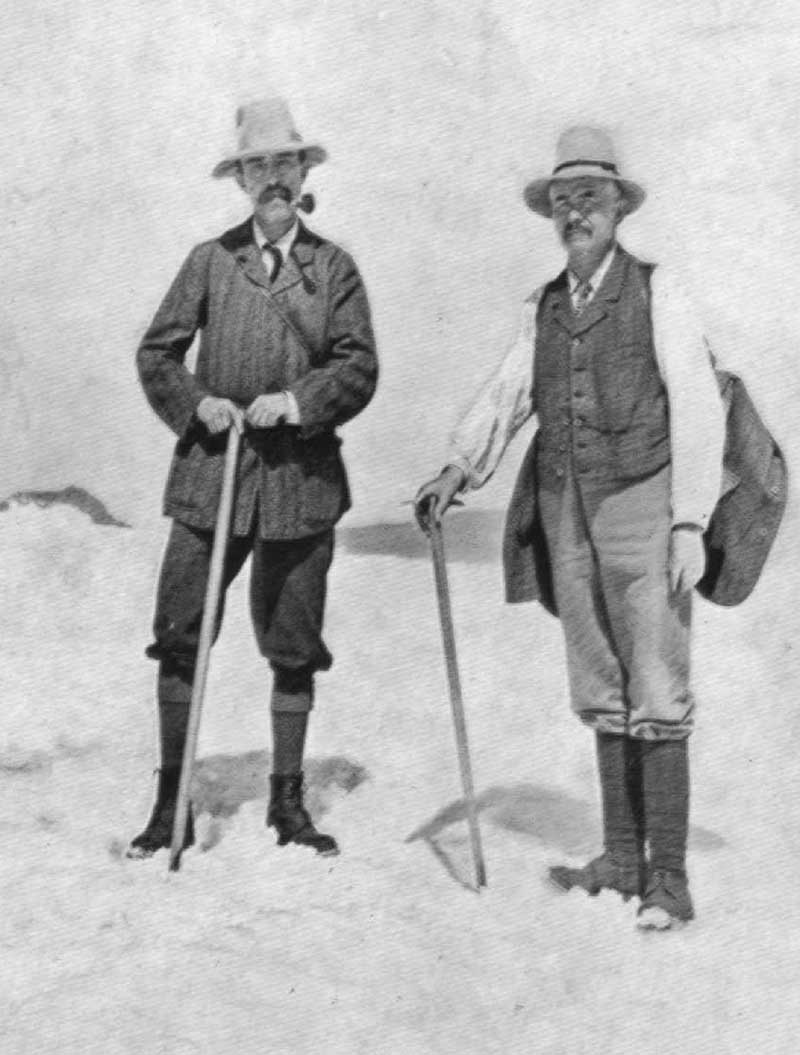
Conrad Kain

Conrad Kain [1883–1934]

b. 1883 — Nasswald, Austria
d. 1934 — Cranbrook, British Columbia, Canada

Kain was an Austrian mountain guide who guided extensively in Europe, Canada, and New Zealand, and was responsible for the first ascents of more than 60 routes in British Columbia. He is particularly known for pioneering climbs in the Purcell Mountains and the first ascents of Mount Robson (1913), Mount Louis (1916) and Bugaboo Spire (1916).

Sources of biographical information about Kain:

  • Thorington, James Monroe [1895–1989]. “Conrad Kain, In memoriam.” Canadian Alpine Journal, Vol. 22 (1933):184-187
  • Kain, Conrad [1883–1934], and Thorington, James Monroe [1895–1989], editor. Where the Clouds Can Go. New York City: American Alpine Club, 1935
  • Wikipedia Conrad Kain
Kain is the namesake of the following places in the Mount Robson region:

Events in the Mount Robson region in which Kain was involved:

  • 1911 ACC-Smithsonian Robson expedition (guide)
  • 1913 ACC Camp – Mount Robson (guide)
  • 1924 Thorington to Tonquin Valley (guide)
  • 1924 ACC Camp – Mount Robson (guide)
Works pertinent to the Mount Robson region of which Kain was author or co-author:

  • —   Banff: Whyte Museum Archives. Die Erstbesteigung des Höchsten Giflei der Rockies, Mt. Robson (1913).
  • —   “The ascent of Mt. Robson.” Alpine Journal, Vol. 28 (1914):35
  • —   “The first ascent of Mt. Robson, the highest peak of the Rockies.” Canadian Alpine Journal, Vol. 6 (1914–1915):22-
  • —   “First ascent of Mt. Whitehorn.” Canadian Alpine Journal, Vol. 6 (1914–1915):42-43
  • —  and Thorington, James Monroe [1895–1989], editor. Where the Clouds Can Go. New York City: American Alpine Club, 1935

1911 Alpine Club of Canada–Smithsonian Robson Expedition

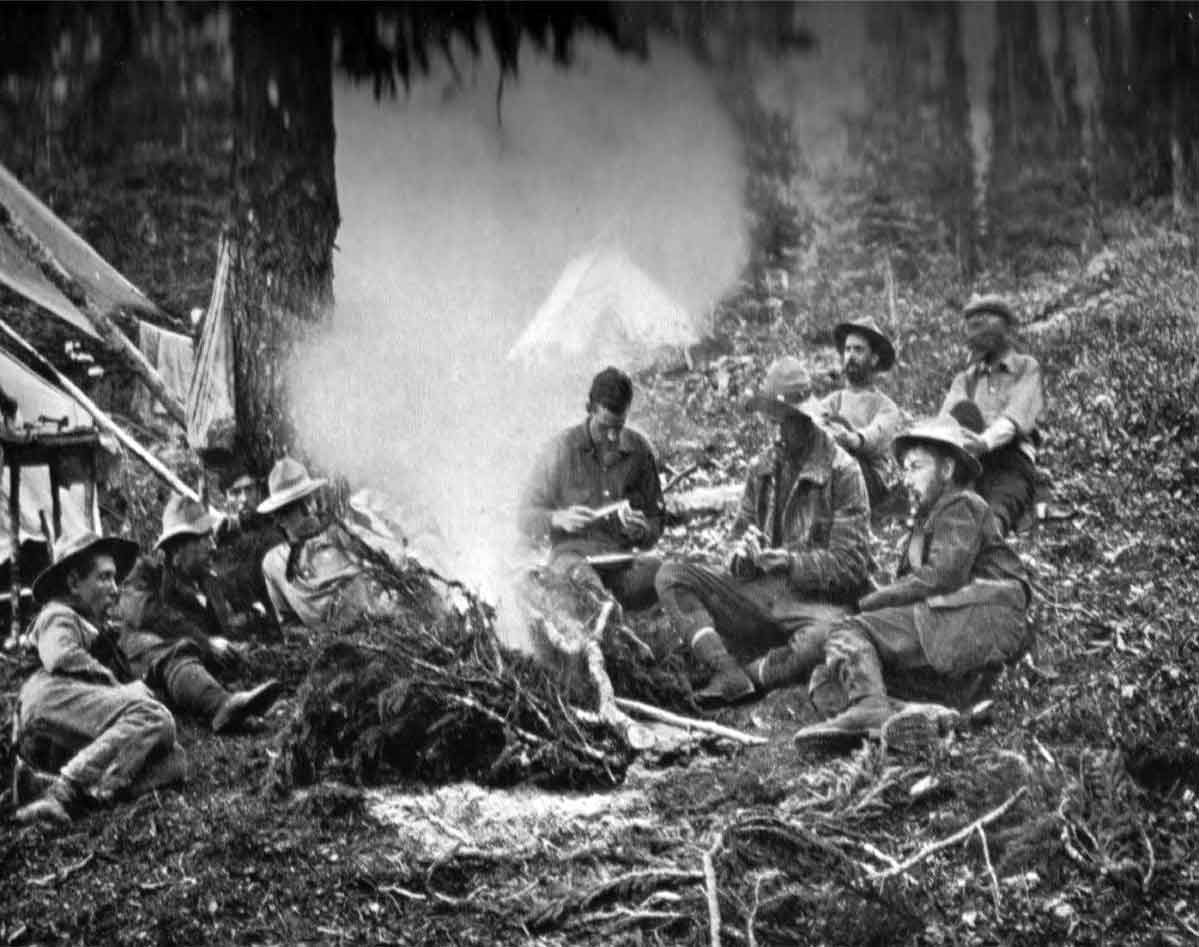
Camp on Calumet Creek, below Moose Pass. James Shand-Harvey, George Kinney, Conrad Kain, Donald

Camp on Calumet Creek, below Moose Pass. James Shand-Harvey, George Kinney, Conrad Kain, Donald “Curly” Phillips, Charles Walcott Jr., Harry H. Blagden, Ned Hollister, J. H. Riley and A. O. Wheeler. Smithsonian-Alpine Club of Canada Robson Expedition (1911 )Photo: Byron Harmon, 1911. Canadian Alpine Journal 1912, p. 34. Original negative: Whyte Museum of the Canadian Rockies
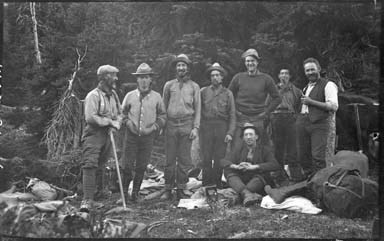

A.O. Wheeler, Donald “Curly” Phillips, Harry Blagden, Ned Hollister, Charles Walcott Jr., James Shand-Harvey, Casey Jones and Rev. George B. Kinney, near Maligne Lake, Smithsonian-ACC Robson Expedition Photo: Byron Harmon, 1911

A.O. Wheeler, Donald “Curly” Phillips, Harry Blagden, Ned Hollister, Charles Walcott Jr., James Shand-Harvey, Casey Jones and Rev. George B. Kinney, near Maligne Lake, Smithsonian-ACC Robson Expedition
Photo: Byron Harmon, 1911 Whyte Museum of the Canadian Rockies

July 1 – September 16, 1911

The 1911 Alpine Club of Canada–Smithsonian joint expedition to the Mount Robson region was initiated by Arthur Oliver Wheeler [1860–1945], director of the Alpine Club of Canada. In his report Wheeler wrote:

Mount Robson is undoubtedly the highest peak of the region… so when the Grand Trunk Pacific Railway pushed the advancing steel in sight of the main range, it was decided by the Alpine Club of Canada to organize an expedition and make direct investigations on its own behalf and in accordance with the propaganda laid down in its constitution, viz., the encouragement of mountain craft and the opening of new regions as a national playground.

Subsequent co-operation and financial assistance by the British Columbia, Alberta and Dominion Governments made it possible to enlarge the scope of the expedition, and an investigation of the fauna, flora, and geology was added to the topographical work first planned. An attempt was made to interest Canadian scientists in the expedition, but without success, so the matter was submitted to Dr. Charles Walcott, Secretary of the Smithsonian Institute of Washington, who collaborate most heartily and sent a party of four to join and work with the Alpine Club. [1]

Charles Doolittle Walcott [1850–1927], secretary of the Smithsonian Institution, agree to conduct scientific studies “under the permit of the geology, flora and fauna of the area,” and planned to attend personally, but his wife died in a rail accident shortly before the event. The Smithsonian called its participation the Biological Survey of the Canadian Rockies, recognizing it as an excellent opportunity to gather specimens from the region. The Alpine Club of Canada also helped to pay for a portion of the Smithsonian’s costs for sending staff. Official Smithsonian staff included N. (Ned) Hollister, Assistant Curator in the Division of Mammals (leader); and Joseph Harvey Riley, Aid in the Division of Birds. They were assisted by Charles D. Walcott, Jr. (son of the Secretary of the Institution) and H. H. Blagden. All specimens collected came to the Smithsonian, including mammals, birds, reptiles, batrachians, fishes, invertebrates, and plants. In 1912 Walcott conducted his own investigations in the Mount Robson area.[2]

Wheeler continued:

Mountaineering was not the primary object and the ascent of Robson Peak for the second time had not even received consideration. The intention was to investigate the facilities for holding one of the Club’s big camps close to the great monolith and, while doing so, to make topographical survey of such area as might fall within the scope of the expedition, using photo-topographic methods a as a basis of the work. Notwithstanding, some thirty peaks were climbed, ranging in altitude from 7,000 to 11,000 feet above sea-level.

The expedition was made possible through the co-operation of the Grand Trunk Pacific Railway, which contributed handsomely towards the expenses. The railway company proposed to open up the northern section of the mountains in a manner similar a to that being done by the Canadian Pacific Railway in the southern section, and was naturally interested in the publicity that would ensue.

The original party consisted of the writer in charge, Konrad Kain, the Club’s professional guide, Byron Harmon, the Club’s official photographer, a and a cook, with the transport and outfitting in the hands of Donald Phillips. Later, George B. Kinney was added as an assistant. Subsequent co-operation and financial assistance by the British Columbia, Alberta and Dominion Governments made it possible to enlarge the scope of the expedition, and an investigation of the fauna, flora, and geology was added to the topographical work first planned. An attempt was made to interest Canadian scientists in the expedition, but without success, so the matter was submitted to Dr. Charles Walcott, Secretary of the Smithsonian Institute of Washington, who collaborate most heartily and sent a party of four to join and work with the Alpine Club.

The general line of travel may be described as follows: Commencing at Henry House, the eastern extremity of the survey, the route lay up the valleys of the Athabasca and Miette rivers to the summit of the Continental Divide at the Yellowhead Pass. Thence down the valley of Yellowhead Lake and Fraser River for seventeen miles to the junction of the Moose River with the Fraser. Then up the Moose River Valley to the Moose Pass, where the Continental Divide was again crossed, and down the valley of Calumet Creek (local name Pipestone Creek), to the Smoky River Valley. The Smoky River Valley was next ascended to the Robson Pass where, re-crossing the Continental Divide, the valley of the Grand Fork River was followed to the Fraser Valley, which was ascended to the junction of the Moose River Valley. By this means complete irregular circuit of very nearly 100 miles was made round Mt. Robson, the first that ever has been made, and all the enclosed territory was surveyed as well as a considerable area outside of it.

Nunerous articles about the expedition were published in the Canadian Alpine Journal, Volume 4, 1911. Beginning with Wheeler’s own report, quoted above, accompanied by his topographic map of Mount Robson, there were articles from the Smithsonian party on mammals[3], birds [4], and plants [5], as well as two reports on the return trip to Laggen (Lake Louise) by packhorse.[6, 7]

People involved with the expedition

References:

  • 1. Wheeler, Arthur Oliver [1860–1945], and Smithsonian Institution [founded 1846]. “The Alpine Club of Canada’s expedition to Jasper Park, Yellowhead Pass and Mount Robson region, 1911.” Canadian Alpine Journal, Vol. 4 (1912):9-80. Alpine Club of Canada [accessed 2 April 2025]
  • 2. Smithsonian Institution [founded 1846]. Expedition History, 1911 (1911). Smithsonian Institution Archives
  • 3. Hollister, Ned [1876–1924], and Smithsonian Institution [founded 1846]. “Mammals of the Alpine Club Expedition to the Mount Robson Region.” Canadian Alpine Journal, Vol. 4 No. 2 (1912):1-46. Alpine Club of Canada [accessed 2 April 2025]
  • 4. Riley, Joseph Harvey [1873–1941], and Smithsonian Institution [founded 1846]. “Birds Collected or Observed on the Expedition of the Alpine Club of Canada to Jasper Park, Yellowhead Pass and Mount Robson Region.” Canadian Alpine Journal, Vol. 4 No. 2 (1912):47-75. Alpine Club of Canada [accessed 2 April 2025]
  • 5. Standley, Paul C., and Smithsonian Institution [founded 1846]. “Plants of the Alpine Club Expedition to the Mount Robson Region.” Canadian Alpine Journal, Vol. 4 No. 2 (1912):76-. Alpine Club of Canada [accessed 2 April 2025]
  • 6. Kinney, George Rex Boyer [1872–1961]. “Trail From Maligne Lake To Laggan. Report of the Rev. G. Kinney to the Alpine Club of Canada.” Canadian Alpine Journal, Vol. 4 (1912):81. Alpine Club of Canada [accessed 2 April 2025]
  • 7. Phillips, Donald “Curly” [1884–1938]. “Fitzhugh to Laggan. Report by Donald Phillips to A. O. Wheeler, Director of the Alpine Club, Canada.” Canadian Alpine Journal, Vol. 4 (1912):83-86. Alpine Club of Canada [accessed 2 April 2025]
Meadow Creek

Alberta. Creek: Athabasca River drainage
Flows N into Miette River
52.8672 N 118.2492 W — Map 083D16 — GoogleGeoHack
Name officially adopted in 1978
Topo map from Canadian Geographical Names

The name was “suggested by the Topographical Survey due to its proximity to the Meadows Fire Ranger Station” — the Alberta-British Columbia Boundary Commission surveyors.

References:

  • Karamitsanis, Aphrodite [1961–]. Place names of Alberta. Volume 1: Mountains, Mountain Parks and Foothills. Calgary: University of Calgary Press, 1991. Internet Archive

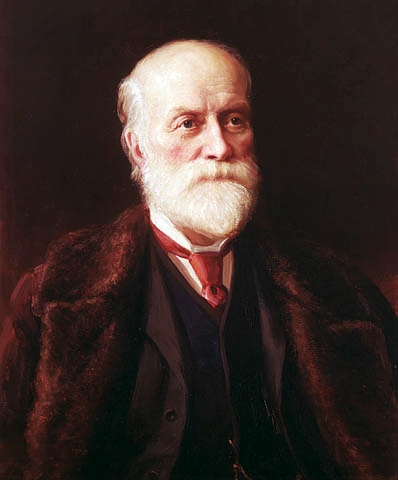
Sandford Fleming

Portrait of Sir Sandford Fleming by John Wycliffe Lowes Forster, 1892

Portrait of Sir Sandford Fleming by John Wycliffe Lowes Forster, 1892
Wikipedia [accessed 15 October 2025]

Sir Sandford Fleming, FRSC KCMG
b. 7 January 1827 — Kirkcaldy, Scotland
d. 22 July 1915 — Halifax, Nova Scotia

Fleming was a Scottish Canadian engineer and inventor. He emigrated to colonial Canada at the age of 18. He promoted worldwide standard time zones, a prime meridian, and use of the 24-hour clock as key elements to communicating the accurate time, all of which influenced the creation of Coordinated Universal Time. He designed Canada’s first postage stamp, produced a great deal of work in the fields of land surveying and map making, engineered much of the Intercolonial Railway and the first several hundred kilometers of the Canadian Pacific Railway, and was a founding member of the Royal Society of Canada and founder of the Canadian Institute (a science organization in Toronto).

By 1871, the strategy of a railway connection was being used to bring British Columbia into federation and Fleming was offered the chief engineer post on the Canadian Pacific Railway. Although he hesitated because of the amount of work he had, in 1872 he set off with a small party to survey the route, particularly through the Rocky Mountains, finding a practicable route through the Yellowhead Pass. One of his companions, George Monro Grant, wrote an account of the trip, which became a best-seller. In June 1880, Fleming was dismissed by Sir Charles Tupper, with a $30,000 payoff. It was the hardest blow of Fleming’s life, though he obtained a promise of monopoly, later revoked, on his next project, a trans-pacific telegraph cable. Nevertheless, in 1884 he became a director of the Canadian Pacific Railway and was present as the last spike was driven.

Works pertinent to the Mount Robson region of which Fleming was author or co-author:

  • —   Progress Report on the Canadian Pacific Railway Exploratory Survey. Ottawa: Canadian Pacific Railway, 1872. Canadiana
  • —   Report of progress on the explorations and surveys up to January 1874. Ottawa: Canadian Pacific Railway, 1874. Toronto Public Library
  • —   Memorandum in reference to the construction of the Canadian Pacific Railway and Settlement of the North-West Territory.. Ottawa: 1874. Government of Canada
  • —   Memorandum on the Canadian Pacific Railway. Ottawa: M. B. Taylor, 1874. Canadiana
  • —   Report on surveys and preliminary operations on the Canadian Pacific Railway up to January 1877. 1877. Canadiana [accessed 2/3/2025]
  • —   Report and Documents in Reference to the Canadian Pacific Railway
    . Ottawa: 1880. Canadiana
  • —   “Memories of the Mountains: The Yellow Head Pass.” Canadian Alpine Journal, Vol. 1 (1907):11. Alpine Club of Canada [accessed 4/2/2025]
Events in the Mount Robson region in which Fleming was involved:

  • 1872 Fleming / Grant cross YHP
References:

Mary Jobe

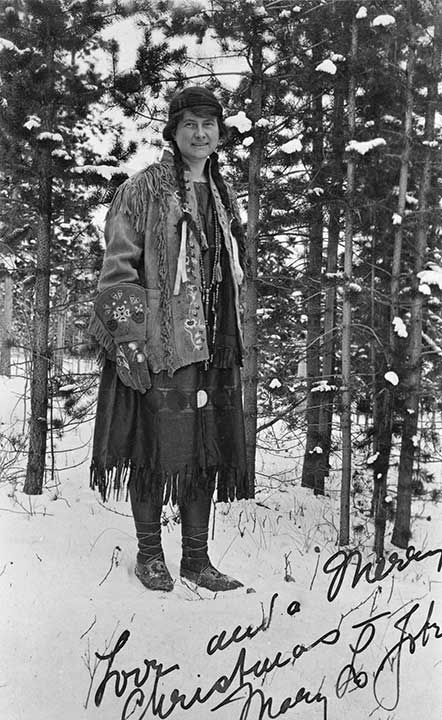
Mary Jobe posed in winter amoungst trees in beaded buckskin clothing. n.d.

Mary Jobe posed in winter amoungst trees in beaded buckskin clothing. n.d.
Whyte Museum of the Canadian Rockies

Mary Lenore Jobe Akeley [1878–1966]

b. 1878 — Tappan, Ohio, USA
d. 1966 — Mystic, Connecticut, USA

Jobe Akeley was an American explorer, author, mountaineer, and photographer. She undertook expeditions in the Canadian Rockies and in the Belgian Congo. She worked at the American Museum of Natural History creating exhibits featuring taxidermy animals in realistic natural settings. She worked on behalf of conservation efforts, including being one of the first advocates for the creation of game preserves. She also founded Camp Mystic, an outdoor camp for girls.

Jobe Akeley explored the Mount Sir Alexander area in 1914 and 1915, on expeditions guided by Donald “Curly” Phillips [1884–1938] of Jasper.

In 1924, Mary Jobe became the second wife of Carl Akeley (1864–1926), an explorer, natural scientist, sculptor, inventor, and “father of modern taxidermy”. On their first visit to Africa in 1926, Akeley died of disease in the remote mountains of the Congo. Jobe remained to take charge of his work, collecting specimens, and when she returned to the United Stated in 1927 she succeeded her husband as advisor in the development of the African Hall at the American Museum of Natural History in New York. In the same year, King Albert of Belgium awarded her with the Cross of the Knight, Order of the Crown, in recognition of her courage and service.

She revisited the Congo in 1946 to study the development of the parks system. Between her travels she lectured and wrote several books on her African experiences. She died in 1966, never returning to the mountains of western Canada.

Sources of biographical information about Jobe Akeley:

  • Smith, Cyndi. Off the Beaten Track. Women adventurers and mountaineers in western Canada. Jasper: Coyote Books, 1989
  • Taylor, William C. Tracks across my trail. Donald “Curly” Phillips, guide and outfitter. Jasper: Jasper-Yellowhead Historical Society, 1984
  • Wikipedia. Mary Jobe Akeley
Jobe Akeley is the namesake of the following places in the Mount Robson region:

Events in the Mount Robson region in which Jobe Akeley was involved:

  • 1914 Jobe-Phillips expedition Mt. Kitchi
  • 1915 Jobe-Phillips to Kitchi
  • 1915 Jobe’s second expedition to Mount Sir Alexander (leader)
  • 1917 Jobe trip to Wapiti
Works pertinent to the Mount Robson region of which Jobe Akeley was author or co-author:

  • —   “The expedition to ‘Mt. Kitchi:’ A new peak in the Canadian Rockies.” Canadian Alpine Journal, Vol. 6 (1914–1915):135-143
  • —   “Mt. Kitchi: A New Peak in the Canadian Rockies.” Bulletin of the American Geographical Society, Volume 47, No. 7 (1915):481-497. JSTOR
  • —   “Mt. Alexander Mackenzie.” Canadian Alpine Journal, Vol. 7 (1916):62–73
  • —   “A winter journey to Mt. Sir Alexander and the Wapiti.” Canadian Alpine Journal, Vol. 9 (1918):58-65

Fort Chipewyan

Alberta. Former fur trade post
Western tip of Lake Athabasca
58.7144 N 111.1583 W — Map 074L11 — GoogleGeoHack
Name officially adopted in 1954
Topo map from Canadian Geographical Names

Sir Alexander Mackenzie [1764–1820] set out from Fort Chipewyan on his expeditions down the Mackenzie River and to the west coast [1].

Fort Chipewyan is Fort No. 109 in Ernest Voorhis [1859–1933], “Historic forts and trading posts” [2]:

North West Co. fort on lake Athabaska. The first fort in this region was built by Peter Pond on Athabaska river about 50 miles above the outlet, on west side. Athabaska river and lake were called Elk river and Lake of the Hills. This fort was built in 1778 and was known as The Old Establishment and Athabaska House and Pond’s House. Athabaska means “Meeting place of many waters.” In 1788 Pond’s fort was abandoned and a new fort built on south shore of lake Athabaska, about 8 miles from mouth of Athabaska river, 38 miles from the old fort, at the south-western end of the lake, on a rocky point projecting into the lake. This fort was built by Roderick Mackenzie of the North West Co. Fort

Chipewyan was styled the “Emporium of the North” and “Little Athens of the Hyperborean regions”. In 1804 this site was abandoned and a new fort (the third) was erected by the North West Co. on a rocky point on the north shore of the lake, the present site. The old fort on the south shore continued to be of us for some years, but in 1815 it was rapidly decaying and was finally abandoned in 1820. The new fort 0n the north shore was “surrounded by rocks and swamps”.

It was the most important North West Co. fort in the far north. After the coalition of 1821, the Hudson’s Bay Co. operated this fort to the present date. Dr. Macoun described the fort In 1875 as follows: “All the buildings are of most substantial character, all shingled and whitewashed, and of imposing appearance. Two large stores with glass windows, each 61 ins. by 31 ins. by 17 ins. high, stand next the landing. Eight houses are occupied by employees of the Company. In the rear is the clerk’s house, 40 x 30 x 17 ft., well plastered and warm. Then the general store and the factor’s house”. The X. Y. Co. constructed a fort in 1800 one mile north of Fort Chipewyan near site of the present R. C. mission. The Hudson’s Bay Co. built Nottingham house in 1802 and Fort Wedderburn 1815. See Forts Athabasca, Nottingham, and Wedderburn.

References:

  • 1. Wikipedia. Fort Chipewyan
  • 2. Voorhis, Ernest [1859–1933]. Historic forts and trading posts of the French Régime and of the English Fur Trading Companies. Ottawa: Department of the Interior, 1930, p. 52. University of British Columbia Library [accessed 3 January 2026]

Arnold Louis Mumm

A. L. Mumm and guide Moritz Inderbinen. Mount Robson Camp on Snowbird Pass.
Photo by Frank W. Freeborn, 1913

A. L. Mumm and guide Moritz Inderbinen. Mount Robson Camp on Snowbird Pass.
Photo by Frank W. Freeborn, 1913
Canadian Alpine Journal 1915

Arnold Louis Mumm [1859–1927]

b. 1859 — London, England
d. 1927 — Bay of Biscay, Atlantic Ocean

Mumm, a London publisher, first came to Canada in 1909, at the invitation of Alpine Club of Canada director Arthur Oliver Wheeler [1860–1945]. After attending the 1909 ACC camp at Lake O’Hara, Mumm, along with Leopold Charles Maurice Stennett Amery [1873–1955], Geoffrey Hastings [1860–1941], and Moritz Inderbinen [1856–1926], made an attempt on Mount Robson. On their way to the mountain, they met George R. B. Kinney [1872–1961], who reported that he and Donald “Curly” Phillips [1884–1938] had been successful on their own attempt (a claim later disputed). Mumm’s party, hobbled by difficulties of the route and lack of time, was not successful.

Mumm returned with British professor John Norman Collie [1859–1942] in July, 1910, when the Grand Trunk Pacific Railway’s steel had been laid as far as Wolf Creek, about one hundred miles east of theYellowhead Pass. The party spent some time about Mount Robson, but there was so much snow on the mountains and the weather was so stormy that climbing was out of the question, and they were able to ascend only some of the lesser peaks.

The next summer, 1911, Collie and Mumm made another trip, the first to go north of the Athabasca to explore and climb. They ascended the Stoney River, crossed a high pass to the Smoky River, then up Glacier Creek, which they ascended to Mount Bess.

In 1913 Mumm decided to climb Mount Geikie, which three years earlier, when on Yellowhead Mountain, he had seen rising far above its fellows. He was turned back by a storm. Mumm made many climbs in the Alps, Canada, Japan and New Zealand, in addition to accompanying Tom George Longstaff [1875–1964] to the Himalayas.

Sources of biographical information about Mumm:

  • Wheeler, Arthur Oliver [1860–1945]. “A. L. Mumm — An Appreciation.” Canadian Alpine Journal, Vol. 16 (1927–1927):173-175
Mumm is the namesake of the following places in the Mount Robson region:

Events in the Mount Robson region in which Mumm was involved:

  • 1906 ACC organized, Mount Robson attempt proposed
  • 1909 English party at Robson
  • 1909 ACC Camp – Lake O’Hara (guest)
  • 1910 Mumm and Collie at Robson
  • 1911 Collie and Mumm Mt Bess
  • 1913 Mumm explores Whirlpool River, Athabasca Pass
  • 1913 ACC Camp – Mount Robson
Works pertinent to the Mount Robson region of which Mumm was author or co-author:

  • —   “An attempt on Mount Robson.” Alpine Journal, Vol. 25 (1910–1911):90
  • —   “An expedition to Mount Robson.” Canadian Alpine Journal, Vol. 2, No. 2 (1910):10-20
  • —   “Mount Robson District. Mumm and Collie’s 1910 Journey.” Alpine Journal, Vol. 25 (1910–1911):466
  • —   “A trip up the Whirlpool River.” Alpine Journal, Vol. 28 (1914):355

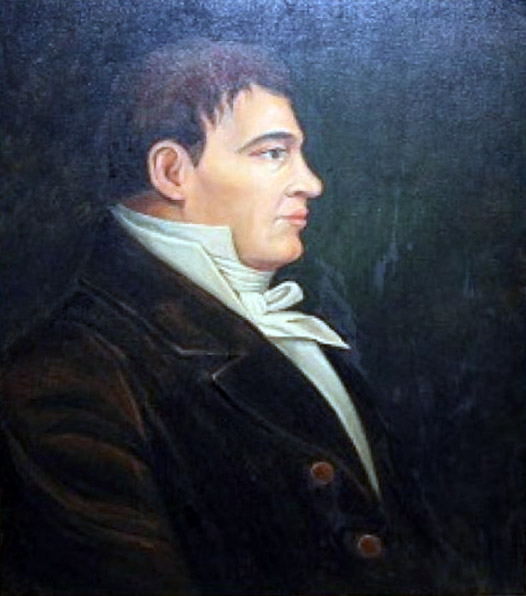
Simon Fraser

Simon Fraser

Simon Fraser

Simon Fraser
b. 20 May 1776 — Mapletown, New York, USA
d. 18 August 1862 — St. Andrews West, Ontario

Fraser opened the fur trade west of the Rocky Mountains, and was the first person of European descent to descend the Fraser River to its mouth. Fraser was came to Québec with his mother after his father, a Loyalist officer, died as a prisoner of war during the American Revolution. Fraser joined the North West Company [1779–1821] in 1792 and was sent to the Athabasca department. He became a partner in the company in 1801. He founded the New Caledonia posts of McLeod Lake (1805), Stuart Lake (later Fort St. James, 1806), Fraser Lake (1806) and Fort George (1807).

During May and June of 1808, with a party of nineteen French Canadian voyageurs, two clerks, and two Native Americans, Fraser made his journey down the Fraser River from just upstream of present-day Prince George to present-day Vancouver. It was a bitter disappointment for him to discover that the river was not the Columbia, and that it was not a practical canoe route to the coast.

Works pertinent to the Mount Robson region of which Fraser was author or co-author:

  • —  and Lamb, William Kaye [1904–1999], editor. The letters and journals of Simon Fraser, 1806-1808. Toronto: MacMillan, 1960. Internet Archive [accessed 3/10/2025]
Fraser is credited with naming the following places:

Events in the Mount Robson region in which Fraser was involved:

  • 1805 Fraser into New Caledonia
  • 1807 Fraser founds Fort George
  • 1808 Fraser descends Fraser
References:

  • Fraser, Simon [1776–1862], and Lamb, William Kaye [1904–1999], editor. The letters and journals of Simon Fraser, 1806-1808. Toronto: MacMillan, 1960. Internet Archive [accessed 10 March 2025]
  • Wikipedia. Simon Fraser