Author Archives: Swany

Basil S. Darling

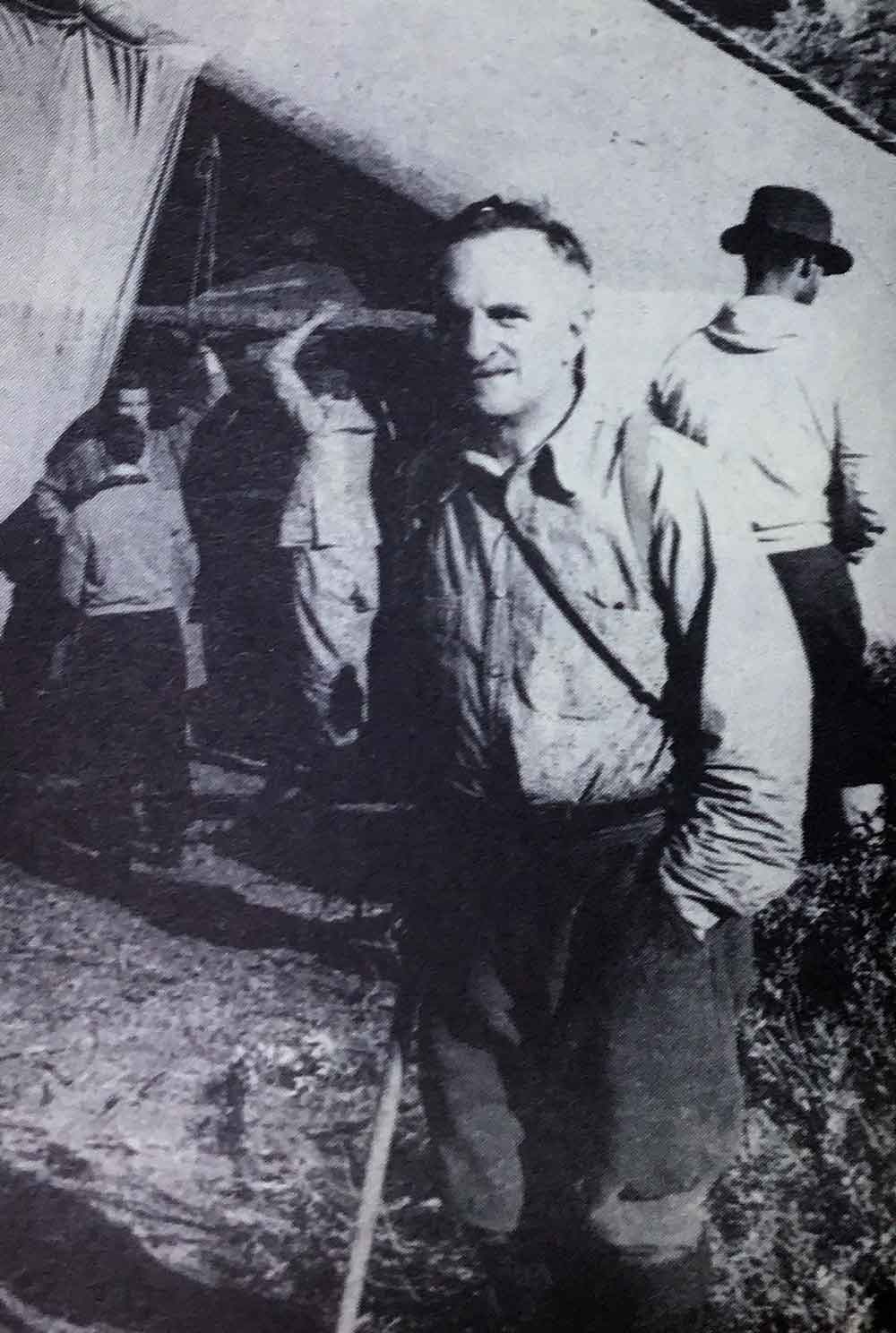
Attempt of Mt. Robson by West Arête. L To R: B. S. Darling, H. H. Prouty, Walter Schauffelberger. Photo C. H. Mitchell, 1913

Attempt of Mt. Robson by West Arête.
L To R: B. S. Darling, H. H. Prouty, Walter Schauffelberger.
Photo C. H. Mitchell, 1913 Canadian Alpine Journal 1915

Darling, Basil Stewart
b. 1885 — Toronto, Ontario, Canada
d. 1962 — Victoria, British Columbia, Canada

During the Robson Camp of 1913 three attempts were made to climb Mount Robson, one of which resulted in the ascent and traverse of the great mountain, an exploit performed with a judgment, dash and finish that should place it in the category of historic climbs. Too much credit cannot be given to W. W. Foster, A. H. MacCarthy and that prince of guides, Conrad Kain, for this fine achievement; probably the most notable piece of mountaineering ever accomplished in Canada. An account of it will be found elsewhere in these pages. It has fallen to me to write of the other attempts, in both of which I had the good fortune to take part. The description of them may be of some interest to other explorers, seeing that new routes were followed and the summit almost attained on each occasion.

The successful ascent on the 31 st July, made the Director ambitious to have another route explored, so on the afternoon of Sunday, August 3rd, he despatched H. H. Prouty and myself, under Walter Schauffelberger’s guidance, to attack the west arête.
[1]

After two nights on the mountain, they were forced by weather to turn back about 100m from the summit.

Works pertinent to the Mount Robson region of which Darling was author or co-author:

  • —   “Passion for Mountain Climbing.” B.C. Magazine, 1910 (1910)
  • —   “The practical side of mountaineering. Some of the rules and requirements of the climber’s craft.” Man-to-Man Magazine, Vol 6, No. 9 (1910)
  • —   “Winter mountaineering at the coast.” Canadian Alpine Journal, Vol. 2, No. 2 (1910):136. Alpine Club of Canada [accessed 4/2/2025]
  • —   “Up the Bow and down the Yoho.” Canadian Alpine Journal, Vol. 3 (1911):107-115. Alpine Club of Canada [accessed 4/2/2025]
  • —   “First attempt on Robson by the West Arête.” Canadian Alpine Journal, Vol. 6 (1914–1915):29-34
  • —  and MacCarthy, Albert H. [1876–1956]. “An ascent of Mt. Robson from the Southwest.” Canadian Alpine Journal, Vol. 6 (1915):34-42
Events in the Mount Robson region in which Darling was involved:

  • 1913 ACC Camp – Mount Robson
Also see

References:

  • 1. Darling, Basil Stewart [1885–1962]. “First attempt on Robson by the West Arête.” Canadian Alpine Journal, Vol. 6 (1914–1915):29-34

Arthur Oliver Wheeler

Arthur Oliver Wheeler [1860–1945]

b. 1860 Kilkenny, Ireland
d. 1945

Wheeler was born in Ireland and immigrated to Canada in 1876 at the age of 16. He became a land surveyor and surveyed large areas of western Canada, including photo-topographical surveys of the Selkirk Mountains and the British Columbia-Alberta boundary along the continental divide through the Canadian Rockies. In 1906, he and journalist Elizabeth Parker [1856–1944] were the principal founders of the Alpine Club of Canada [1906–]). He was its first president, from 1906 to 1910, and editor of the Canadian Alpine Journal from 1907 to 1930. He remained Honorary President of the ACC from 1926 until his death in 1945.

Sources of biographical information about Wheeler:

  • “Arthur O. Wheeler. Details of his career.” Canadian Alpine Journal, Vol. 27 (1940)
  • Wikipedia. Arthur Oliver Wheeler
Events in the Mount Robson region in which Wheeler was involved:

  • 1906 ACC organized, Mount Robson attempt proposed
  • 1909 ACC Camp – Lake O’Hara (director)
  • 1911 Wheeler re Summit City
  • 1911 ACC-Smithsonian Robson expedition (leader)
  • 1913 Interprovincial Boundary Commission formed
  • 1913 ACC Camp – Mount Robson (director)
  • 1914 ACC Camp – Upper Yoho Valley
  • 1917 IBC survey Yellowhead Pass
  • 1922 Lambart survey
  • 1923 Bdy survey completed to Robson
  • 1924 ACC Camp – Mount Robson (director)
Works pertinent to the Mount Robson region of which Wheeler was author or co-author:

  • —   Whyte Museum Archives. A. O. Wheeler diaries (1885–1944).
  • —   “Report of 1909 Camp [Lake O’Hara].” Canadian Alpine Journal, Vol. 2, No. 2 (1910):147–159
  • —   Whyte Museum Archives. Letter to Kinney (1910).
  • —   “Report on Mountaineering [1910 camp, Consolation Valley].” Canadian Alpine Journal, Vol. 3 (1911):134-139
  • —   “The mountains of the Yellowhead Pass.” Alpine Journal, Vol. 26, No.198 (1912):382
  • —   “The Alpine Club of Canada’s expedition to Jasper Park, Yellowhead Pass and Mount Robson region, 1911.” Canadian Alpine Journal, Vol. 4 (1912):9-80
  • —   “Topographical Map Showing Mount Robson and Mountains of the Continental Divide North of Yellowhead Pass to accompany the Report of the Alpine Club of Canada’s Expedition 1911. From Photographic Surveys by Arthur O. Wheeler; A.C.C. Director.” Canadian Alpine Journal, Vol. 4 (1912):8-81
  • —   “The Mount Robson Camp of the Alpine Club of Canada.” Alpine Journal, 27 (1913)
  • —   Boundary survey between the provinces of British Columbia and Alberta. Victoria: Government of British Columbia, 1913
  • —   Boundary survey between the provinces of British Columbia and Alberta. Victoria: Government of British Columbia, 1914
  • —   “The camps of the Alpine Club of Canada in 1913 and Mr. A.O. Wheeler’s exploratory work.” Alpine Journal, Vol. 28, No.198 (1914):78
  • —   Boundary survey between the provinces of British Columbia and Alberta. Victoria: Government of British Columbia, 1915
  • —   “Report of Mt. Robson camp (1913).” Canadian Alpine Journal, Vol. 6 (1914–1915):179–180
  • —   “Report of Cathedral Mt. Camp (1913).” Canadian Alpine Journal, Vol. 6 (1914–1915):175-
  • —   “Robson Glacier.” Canadian Alpine Journal, Vol. 6 (1914–1915):104-107
  • —   “Report of Upper Yoho (1914).” Canadian Alpine Journal, Vol. 6 (1914–1915):181-187
  • —   Survey of the boundary between the provinces of Alberta and British Columbia. Victoria: Government of British Columbia, 1916
  • —   “Report of Ptarmigan Lake Camp.” Canadian Alpine Journal, Vol. 7 (1916):89-96
  • —  and Cautley, Richard William [1873–1953]. Report of the Commission Appointed to Delimit the Boundary between the Provinces of Alberta and British Columbia. Part I: From 1913 to 1916. Ottawa: Office of the Surveyor General, 1917
  • —   Survey of the boundary between the Provinces of Alberta and British Columbia.. Victoria: Government of British Columbia, 1917
  • —   “The location of Mts. Brown and Hooker.” Canadian Alpine Journal, Vol. 12 (1921–1922):123-129
  • —  and Lambart, Howard Frederick John [1880–1946]. “Mountain reconnaissance by airplane.” Canadian Alpine Journal, Vol. 13 (1923):112-118
  • —  and Cautley, Richard William [1873–1953]. Report of the Commission appointed to delimit the boundary between the Provinces of Alberta and British Columbia. Part II. 1917 to 1921. From Kicking Horse Pass to Yellowhead Pass.. Ottawa: Office of the Surveyor General, 1924. Whyte Museum
  • —  and Cautley, Richard William [1873–1953]. Report of the Commission Appointed to Delimit the Boundary between the Provinces of Alberta and British Columbia. Part iii-a. topographical surveys of the watershed. 1922, 1923, 1924. Ottawa: Office of the Surveyor General, 1925. Whyte Museum
  • —  and Cautley, Richard William [1873–1953]. Report of the Commission Appointed to Delimit the Boundary between the Provinces of Alberta and British Columbia – Part III – from 1918 to 1924. Ottawa: Office of the Surveyor General, 1925
  • —   “A. L. Mumm — An Appreciation.” Canadian Alpine Journal, Vol. 16 (1927–1927):173-175
  • —   “Passes of the Great Divide.” Canadian Alpine Journal, Vol. 16 (1927–1927):117-135
  • —   “Mounts Brown and Hooker.” Canadian Alpine Journal, Vol. 17 (1928):66-68
  • —   “Professor Charles E. Fay, Litt. D..” Canadian Alpine Journal, Vol. 19 (1930):113
  • —   “In Memorian: ‘Curly’ Phillips.” Canadian Alpine Journal, Vol. 25 (1937):117
  • —   Banff: Whyte Museum Archives. M106/47 (1938).
  • —   “Stanley Hamilon Mitchell [In Memoriam}.” Canadian Alpine Journal, Vol. 27 (1939):92-95

Alexander Mackenzie

Sir Alexander Mackenzie 1800 portrait by Sir Thomas Lawrence

Sir Alexander Mackenzie
1800 portrait by Sir Thomas Lawrence
Wikipedia

Sir Alexander Mackenzie
b. c 1764 — Stornoway, Isle of Lewis, Scotland
d. 12 March 1820 — Dunkeld, Perthshire, Scotland

Mackenzie was a Scottish-Canadian explorer and fur trader known for accomplishing the first crossing of North America north of Mexico by a European in 1793.

As a leading member of the North West Company [1779–1821]y, he aspired to extend the Company’s operations into western Canada and selling those furs in China. His hopes thus were intrusions on the monopoly positions of both the Hudson’s Bay Company [Founded 1670 – dissolved 2025] and the East India Company.

Works pertinent to the Mount Robson region of which Mackenzie was author or co-author:

  • —   Voyages from Montreal on the River St. Lawrence through the Continent of North America to the Frozen and Pacific Oceans in the Years 1789 and 1793 with a Preliminary Account of the Rise, Progress, and Present State of the Fur Trade of That Country. London: T. Cadell, Jun., and W. Davies, 1803. Internet Archive [accessed 3/10/2025]
  • —   A map of America, between latitudes 40 and 70 North, and longitudes 45 and 180 West, exhibiting Mackenzie’s Track from Montreal to Fort Chipewyan and from thence to the North Sea in 1789 & to the West Pacific Ocean in 1793. London: T. Cadell, Jun., and W. Davies, 1803. Internet Archive
  • —   First Man West: Alexander Mackenzie’s Journal of His Voyage to the Pacific Coast of Canada in 1793. Edited by Walter Sheppe. Berkeley: University of California Press, 1962
  • —   The journals and letters of Sir Alexander Mackenzie. Edited by W. Kaye Lamb (1904–1999). Cambridge, U.K.: Published for the Hakluyt Society at the University Press, 1970
Mackenzie is the namesake of the following places in the Mount Robson region:

Events in the Mount Robson region in which Mackenzie was involved:

  • 1789 Mackenzie reaches Arctic Ocean and explores Slave & Mackenzie River
  • 1792 Mackenzie sets out
  • 1793 Mackenzie crosses divide
  • 1793 Mackenzie sees Sekani woman among Soda Cree
References:

  • Mackenzie, Alexander [1764–1820]. Voyages from Montreal on the River St. Lawrence through the Continent of North America to the Frozen and Pacific Oceans in the Years 1789 and 1793 with a Preliminary Account of the Rise, Progress, and Present State of the Fur Trade of That Country. London: T. Cadell, Jun., and W. Davies, 1803. Internet Archive [accessed 10 March 2025]
  • Mackenzie, Alexander [1764–1820]. A map of America, between latitudes 40 and 70 North, and longitudes 45 and 180 West, exhibiting Mackenzie’s Track from Montreal to Fort Chipewyan and from thence to the North Sea in 1789 & to the West Pacific Ocean in 1793. London: T. Cadell, Jun., and W. Davies, 1803. Internet Archive
  • Mackenzie, Alexander [1764–1820]. First Man West: Alexander Mackenzie’s Journal of His Voyage to the Pacific Coast of Canada in 1793. Edited by Walter Sheppe. Berkeley: University of California Press, 1962
  • Mackenzie, Alexander [1764–1820]. The journals and letters of Sir Alexander Mackenzie. Edited by W. Kaye Lamb (1904–1999). Cambridge, U.K.: Published for the Hakluyt Society at the University Press, 1970
  • Wikipedia. Alexander Mackenzie

North Croydon

British Columbia. Former locality
Across Fraser River from Croydon
53.078 N 119.7112 W GoogleGeoHack
Not currently an official name.

Samuel Clifton was more than just the ferry captain at North Croydon in the 1950s, he was a friend and neighbor to many people in the Robson Valley.

— “Prince George Citizen.” Prince George Citizen, 1950

Norum’s Gulf Service at North Croydon burned to the ground in December 1970.

References:

  • Robson Valley Courier. Weekly newspaper published by Pyramid Press of Jasper from 1968–88 (1968–1988).
Also see:

Whitehorse Mountain

British Columbia. Mountain
N side of Goat River opposite mouth of North Star Creek
53.4081 N 120.8036 W — Map 093H07 — GoogleGeoHack
Name officially adopted in 1923
Official in BCTopo map from Canadian Geographical Names

Adopted in 1923 as a well-established local name.

References:

Also see:

Dominion Pass

British Columbia. Unofficial name
Between Castle Creek and Cariboo River
53.0163 N 120.3732 W GoogleGeoHack
Not currently an official name.

Location approximate.

From 1871 to 1874, four expeditions searched the Cariboos to determine whether there was a practical route that could be used. In 1871, James A. Mahood, with a large party, left Quesnelle, crossed Dominion pass, and went down Castle river to the Fraser, where he wintered and continued his fruitless search the next year. Dominion pass is northwest of the higher portion of the Cariboos. This crossing with pack animals, may have been the first recorded crossing of a glacial pass in Canadian mountains..

— Zillmer

This pass does not currently seem to have a name. “Dominion Pass” is not currently recognized.

References:

  • Zillmer, Raymond T. [1887–1960]. “Explorations in the Southern Cariboos.” Canadian Alpine Journal, Vol. 27 (1939):48-61. Alpine Club of Canada

Wapiti River

British Columbia and Alberta. River: Smoky River drainage
Flows NE across BC-Alberta boundary into Smoky River
54.7333 N 120 W — Map 093I09 — GoogleGeoHack
Earliest known reference to this name is 1915
Name officially adopted in 1947
Official in BCTopo map from Canadian Geographical Names

Identified as “Callahoo River” on “Sketch map of region between Yellowhead Pass & Peace River” by Richardson and Hale, 1915 (received March 1920, LI 101402, file 34275-S).

References:

Also see: