Category Archives: Map

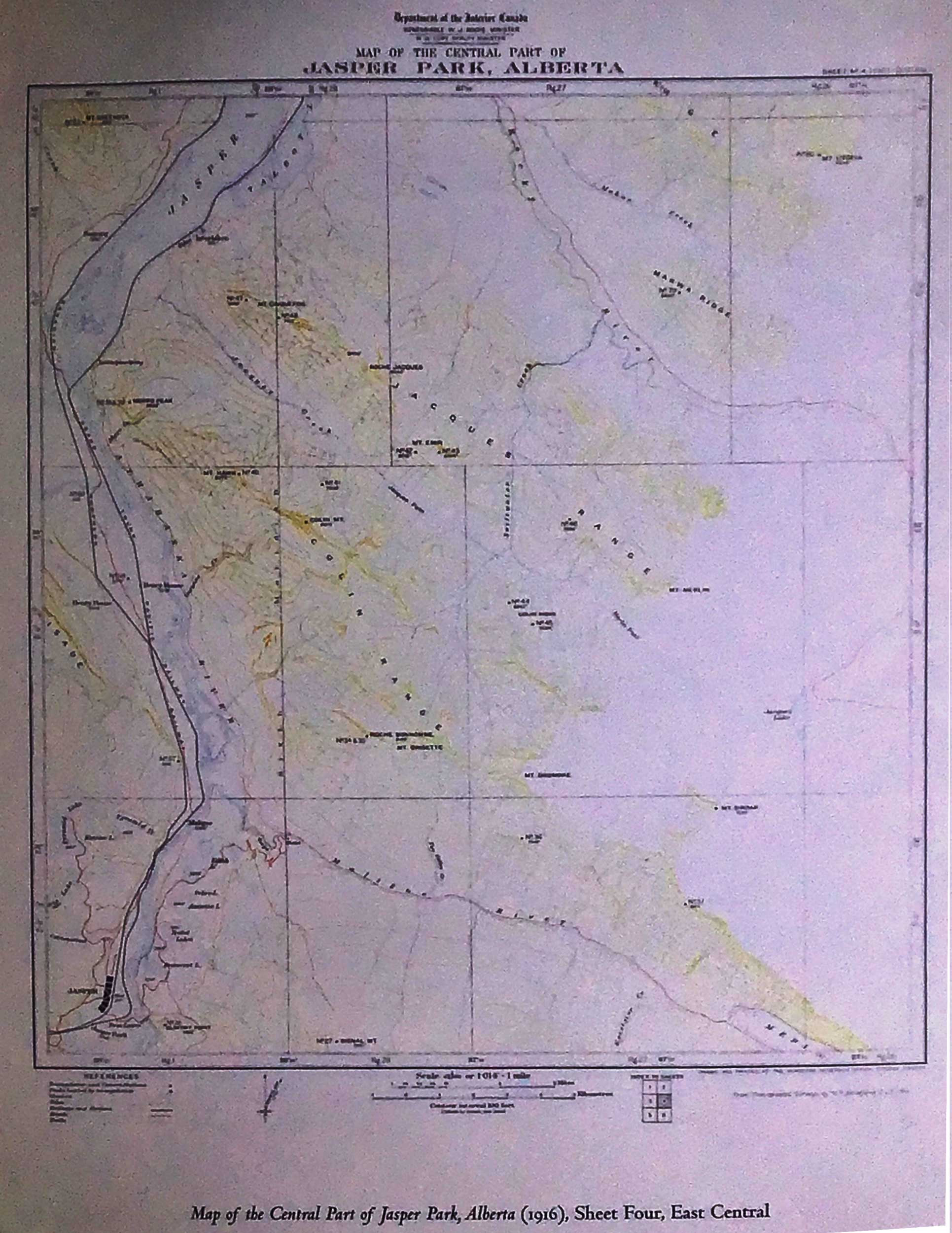
Map of Central Part of Jasper Park Sheet 4

Map of Central Part of Jasper Park, Alberta
Department of the Interior Canada
Sheet Four, East Central

Map of Central Part of Jasper Park, Alberta
Department of the Interior Canada
Sheet Four, East Central

Map of the Central Part of Jasper Park, Alberta
Department of the Interior Canada
From Photographic Surveys by M. P. Bridgland, D.L S. 1915
Sheet Four, East Central

References:

  • MacLaren, Ian S. Mapper of Mountains. M. P. Bridgland in the Canadian Rockies, 1902-1930. University of Alberta Press, 2005. Google Books
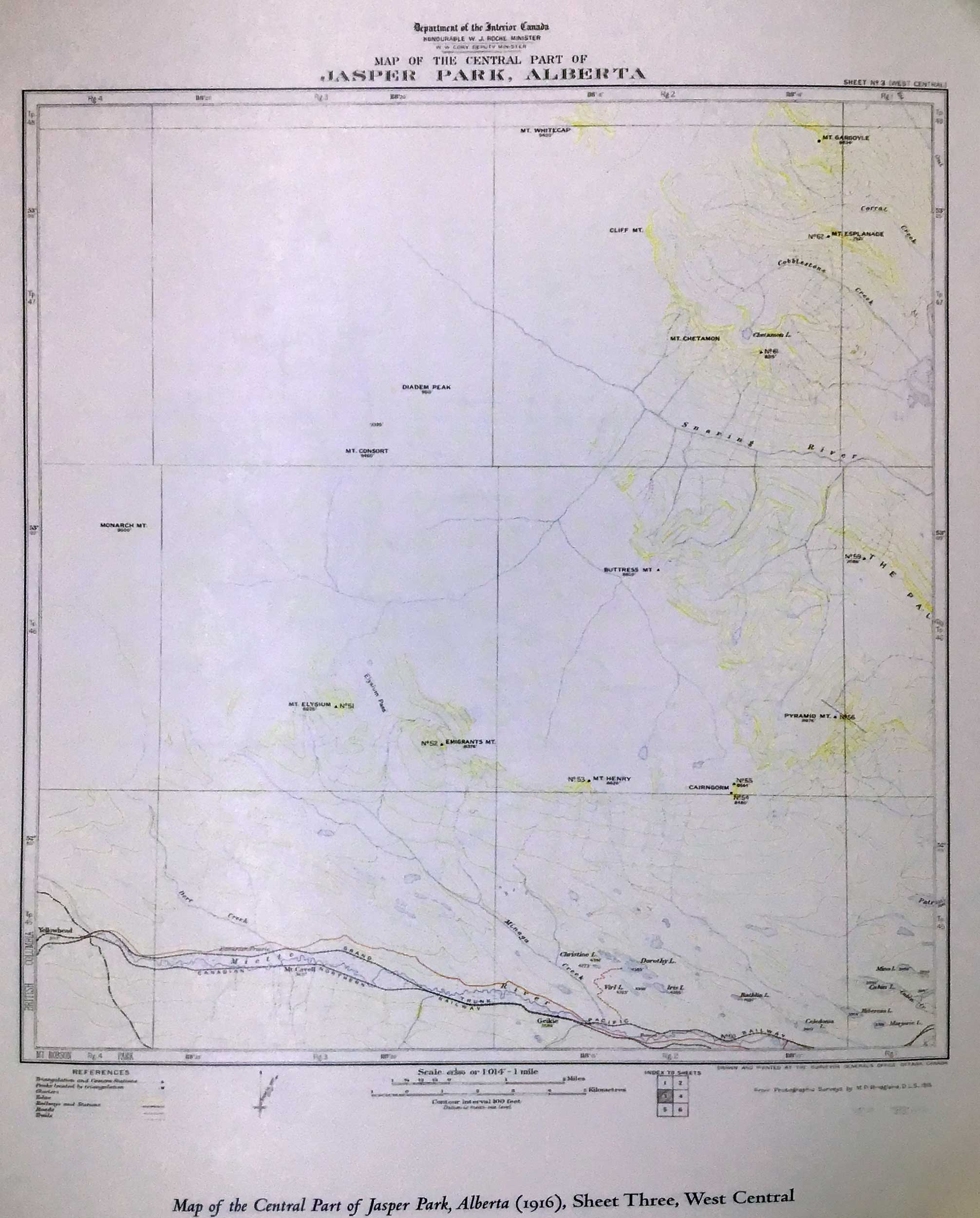
Map of Central Part of Jasper Park Sheet 3

Map of Central Part of Jasper Park, Alberta
Department of the Interior Canada
Sheet Three, West Central

Map of Central Part of Jasper Park, Alberta
Department of the Interior Canada
Sheet Three, West Central

Map of the Central Part of Jasper Park, Alberta
Department of the Interior Canada
From Photographic Surveys by M. P. Bridgland, D.L S. 1915
Sheet Three, West Central

References:

  • MacLaren, Ian S. Mapper of Mountains. M. P. Bridgland in the Canadian Rockies, 1902-1930. University of Alberta Press, 2005. Google Books
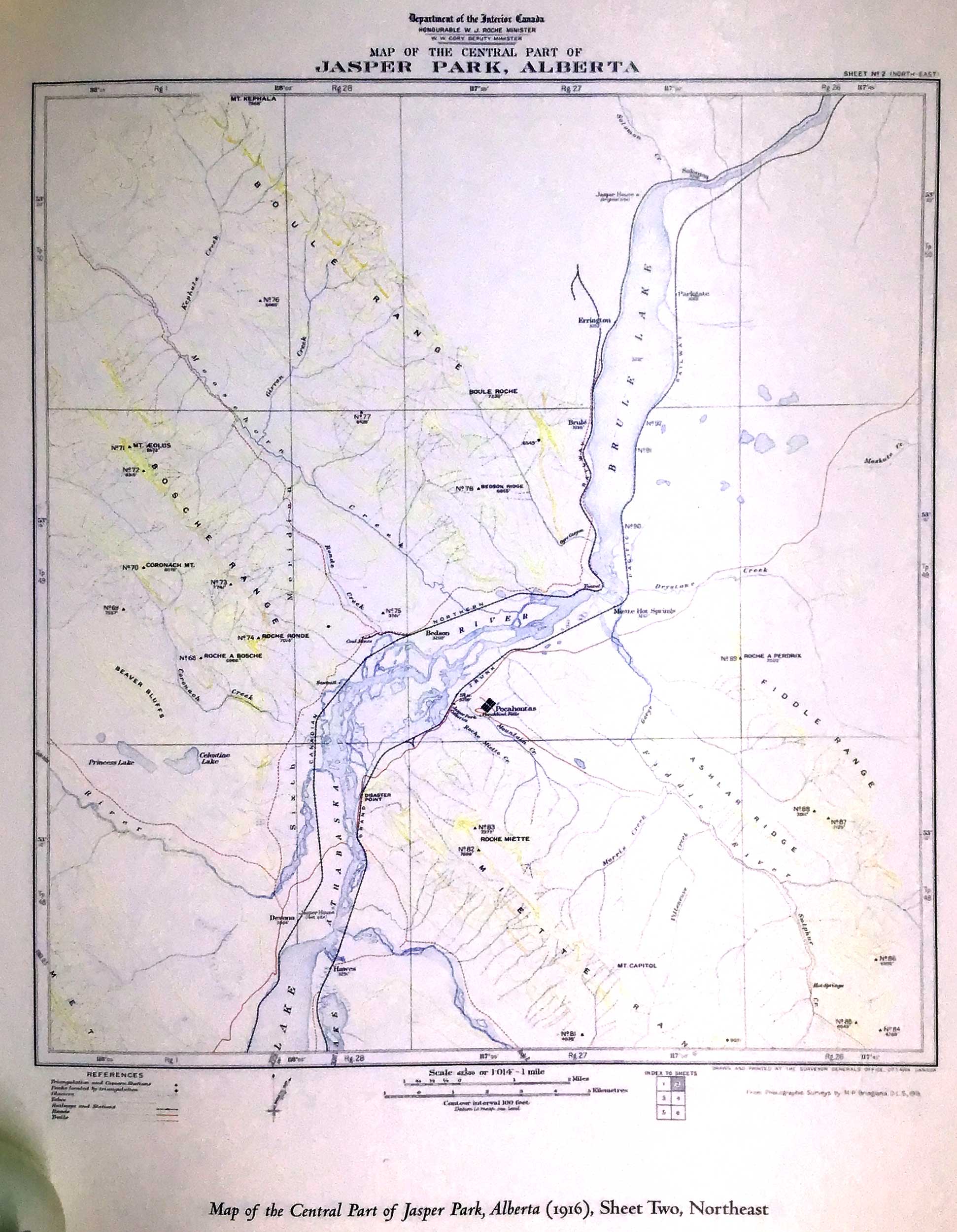
Map of Central Part of Jasper Park Sheet 2

Map of Central Part of Jasper Park, Alberta
Department of the Interior Canada
Sheet Two, Northeast

Map of Central Part of Jasper Park, Alberta
Department of the Interior Canada
Sheet Two, Northeast

Map of the Central Part of Jasper Park, Alberta
Department of the Interior Canada
From Photographic Surveys by M. P. Bridgland, D.L S. 1915
Sheet Two, Northeast

References:

  • MacLaren, Ian S. Mapper of Mountains. M. P. Bridgland in the Canadian Rockies, 1902-1930. University of Alberta Press, 2005. Google Books
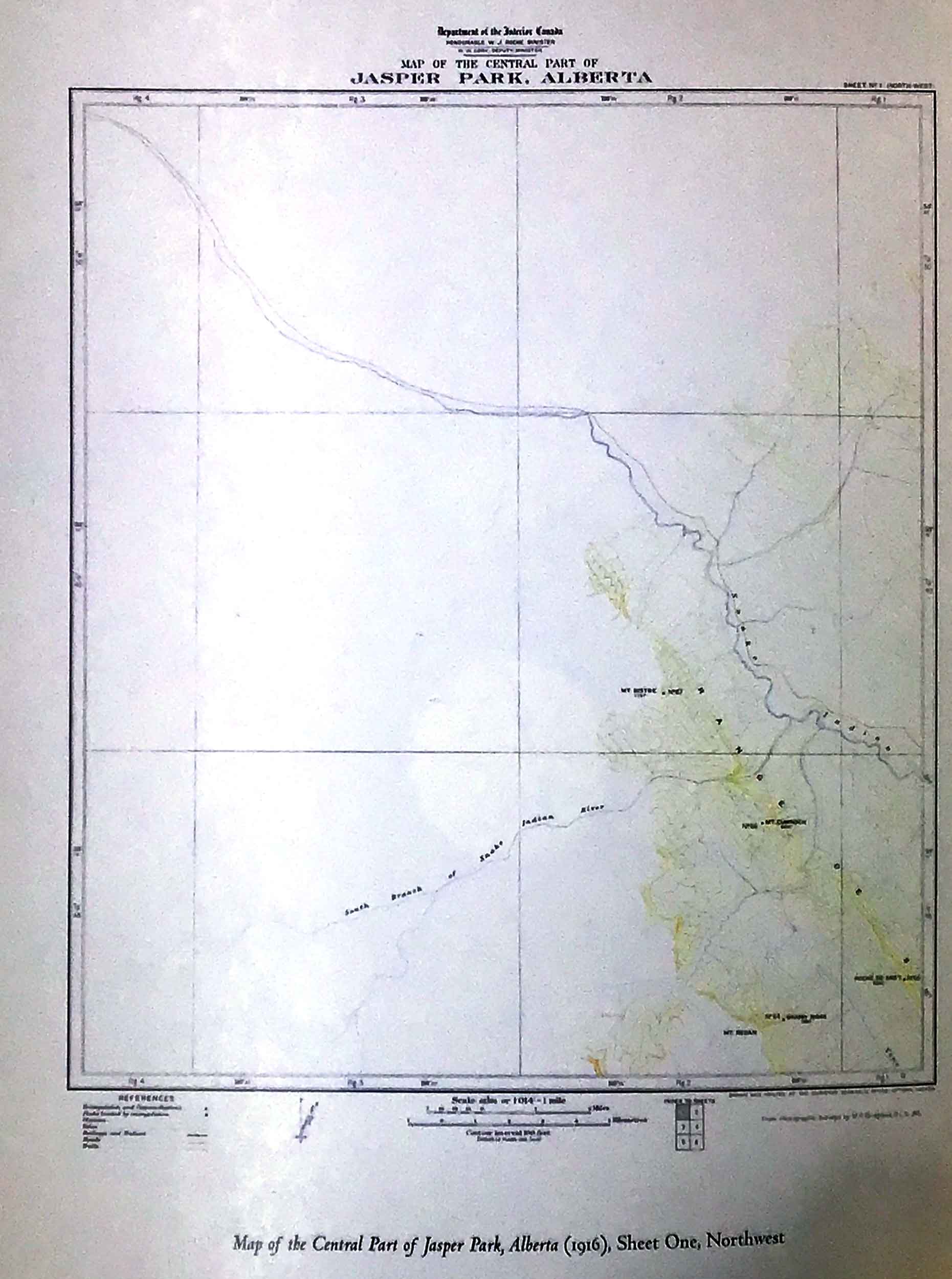
Map of Central Part of Jasper Park Sheet 1

Map of Central Part of Jasper Park, Alberta
Department of the Interior Canada
Sheet One, Northwest

Map of Central Part of Jasper Park, Alberta
Department of the Interior Canada
Sheet One, Northwest

Map of the Central Part of Jasper Park, Alberta
Department of the Interior Canada
From Photographic Surveys by M. P. Bridgland, D.L S. 1915
Sheet One, Northwest

References:

  • MacLaren, Ian S. Mapper of Mountains. M. P. Bridgland in the Canadian Rockies, 1902-1930. University of Alberta Press, 2005. Google Books
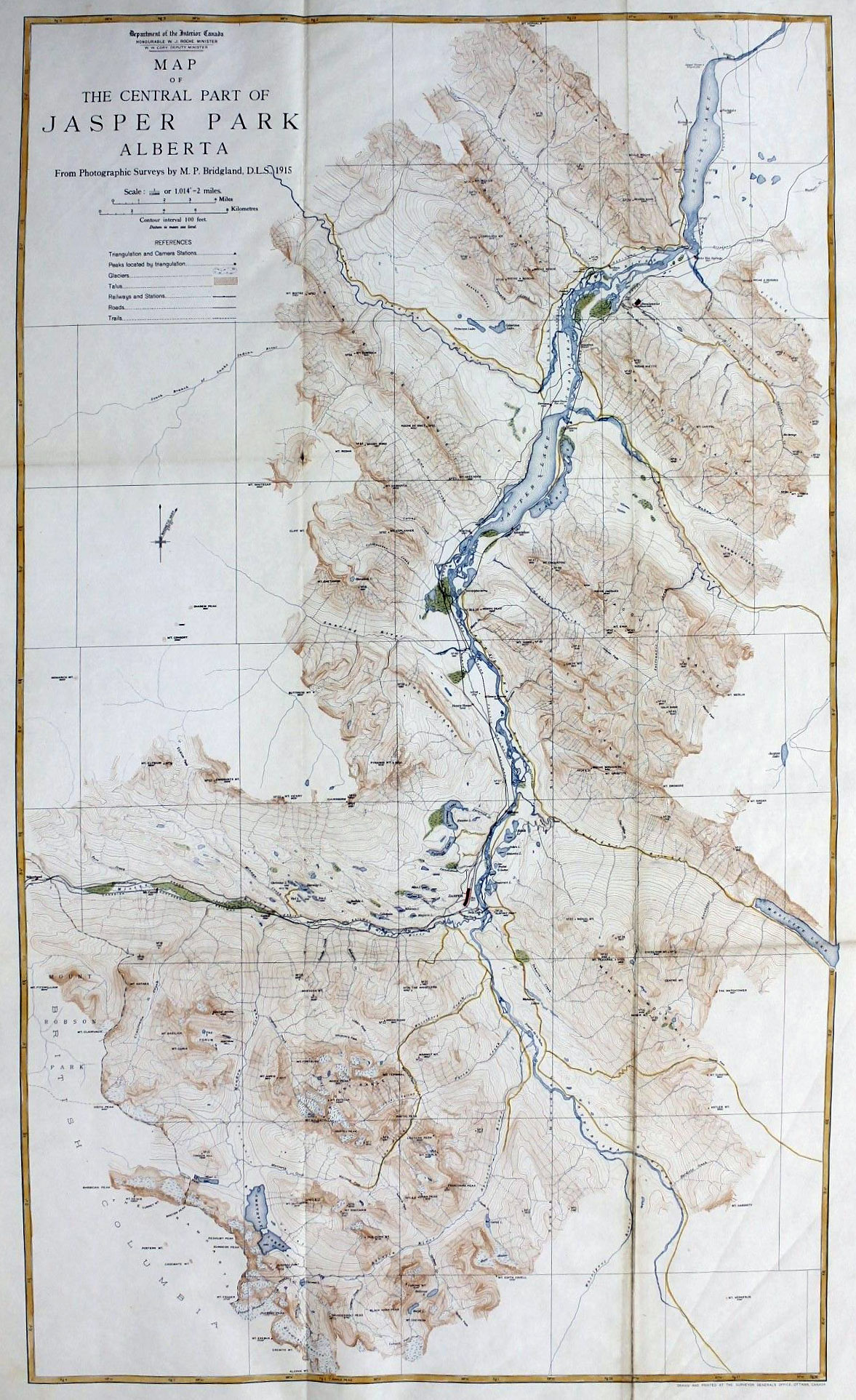
Map of Central Part of Jasper Park, Alberta

Map of Central Part of Jasper Park, Alberta
Department of the Interior Canada
Based on photographic surveys by M. P. Bridgland, D.L S., in 1915

Map of Central Part of Jasper Park, Alberta
Department of the Interior Canada
Based on photographic surveys by M. P. Bridgland, D.L S., in 1915
Whyte Museum

Map of the Central Part of Jasper Park Alberta
Department of the Interior Canada
From Photographic Surveys by M. P. Bridgland, D.L S. 1915


There is also a set of more detailed maps based on the 1915 survey led by Morrison Parsons Bridgland [1878–1948]:

Maps of Central Part of Jasper Park, Alberta.
Department of the Interior Canada, 1916
Sheet One, Northwest
Sheet Two, Northeast
Sheet Three, West Central
Sheet Four, East Central
Sheet Five, Southwest
Sheet Six, Southeast

References:

  • MacLaren, Ian S. Mapper of Mountains. M. P. Bridgland in the Canadian Rockies, 1902-1930. University of Alberta Press, 2005. Google Books
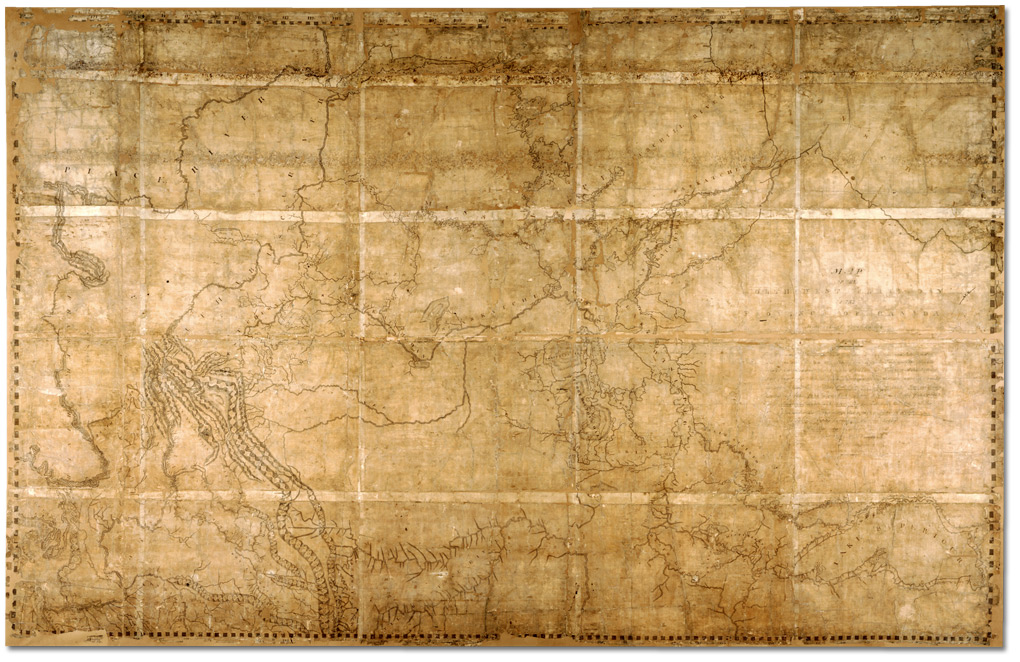
David Thompson’s map of the North-West Territory of the Province of Canada 1814

Map of the North-West Territory of the Province of Canada.David Thompson, 1814

Map of the North-West Territory of the Province of Canada.David Thompson, 1814 Archives of Ontario

Map of the North-West Territory of the Province of Canada from actual Survey during the years 1792-1812. This map made for the North West Company in 1813 and 1814 and delivered to the Honorable William McGillivray then agent Embraces the Region lying between 45 and 60 degrees North Latitude and 84 and 124 degrees West Longitude comprising the Survey’s and Discoveries of 20 years namely the Discovery and Survey of the Oregon Territory to the Pacific Ocean the Survey of the Athabasca Lake Slave River and Lake from which flows Mackenzie’s River to the Arctic Sea by Mr. Philip Turner the Route of Alexander Mackenzie in 1792 down part of Fraser’s river together with the Survey of this River to the Pacific Ocean by the late John Stuart of the North-West Company by David Thompson Astronomer and Surveyor.

Surveying for the North West Company, David Thompson [1770–1857] located the headwaters of the Mississippi River, crossed the Rocky Mountains and mapped the entire length of the Columbia River.
Thompson retired from the fur trade in 1812 and moved his family to Terrebonne near Montreal. He was given a special assignment to plot all the Company’s posts on a comprehensive map of the Canadian West using the astronomical observations he had carefully recorded.

Thompson’s map is approximately 213 centimetres (84″) high by 328 centimetres (129″) long. It gave an accurate depiction of the vast territory traversed by the fur trade and location of Company posts. [1]

References:

  • 1. Nesbit, Jack [1949–]. Mapmaker’s Eye: The Mapmaker’s Eye: David Thompson on the Columbia Plateau. Pullman: Washington State University Press, 2006

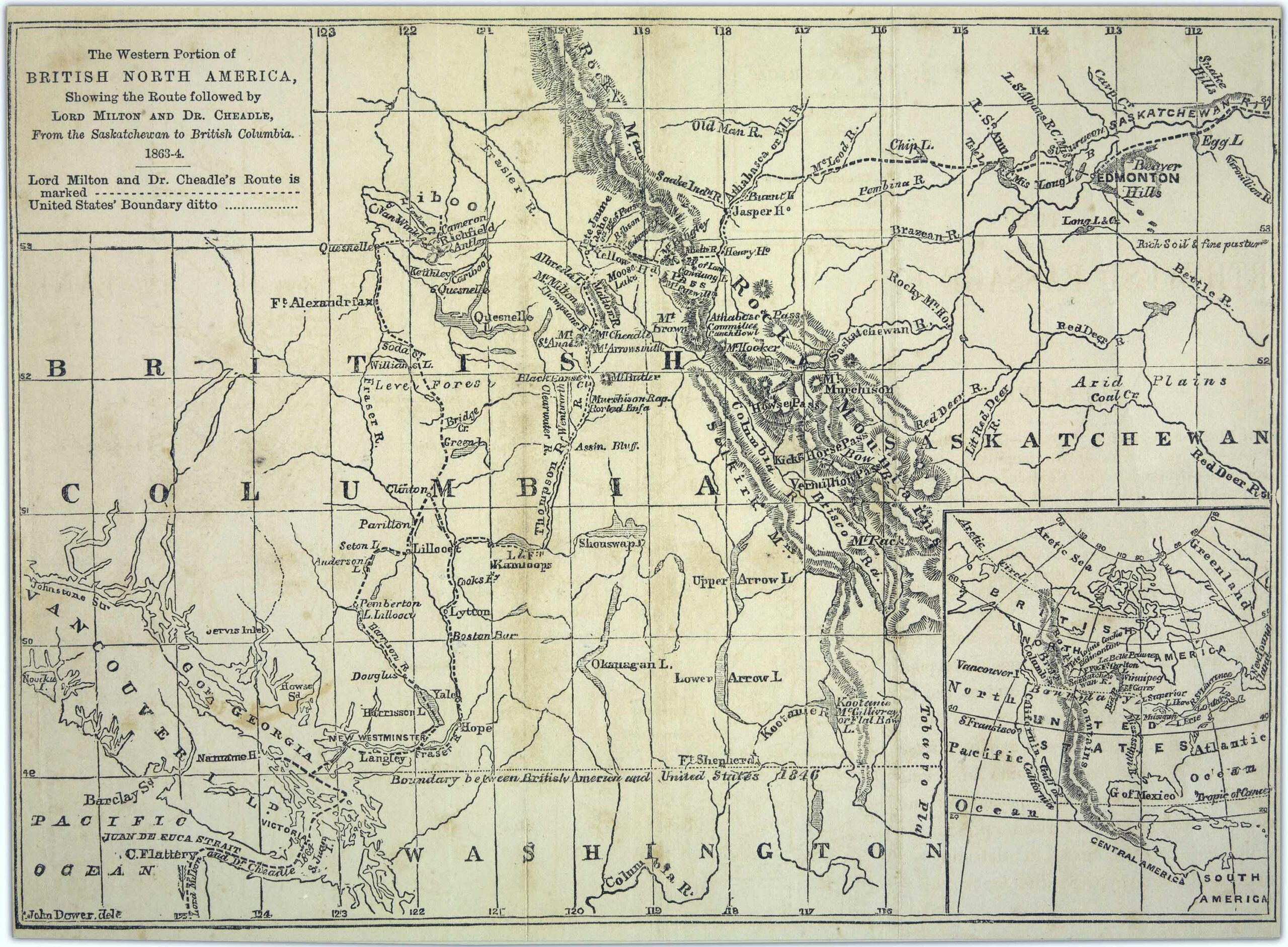
Milton and Cheadle 1865 Map

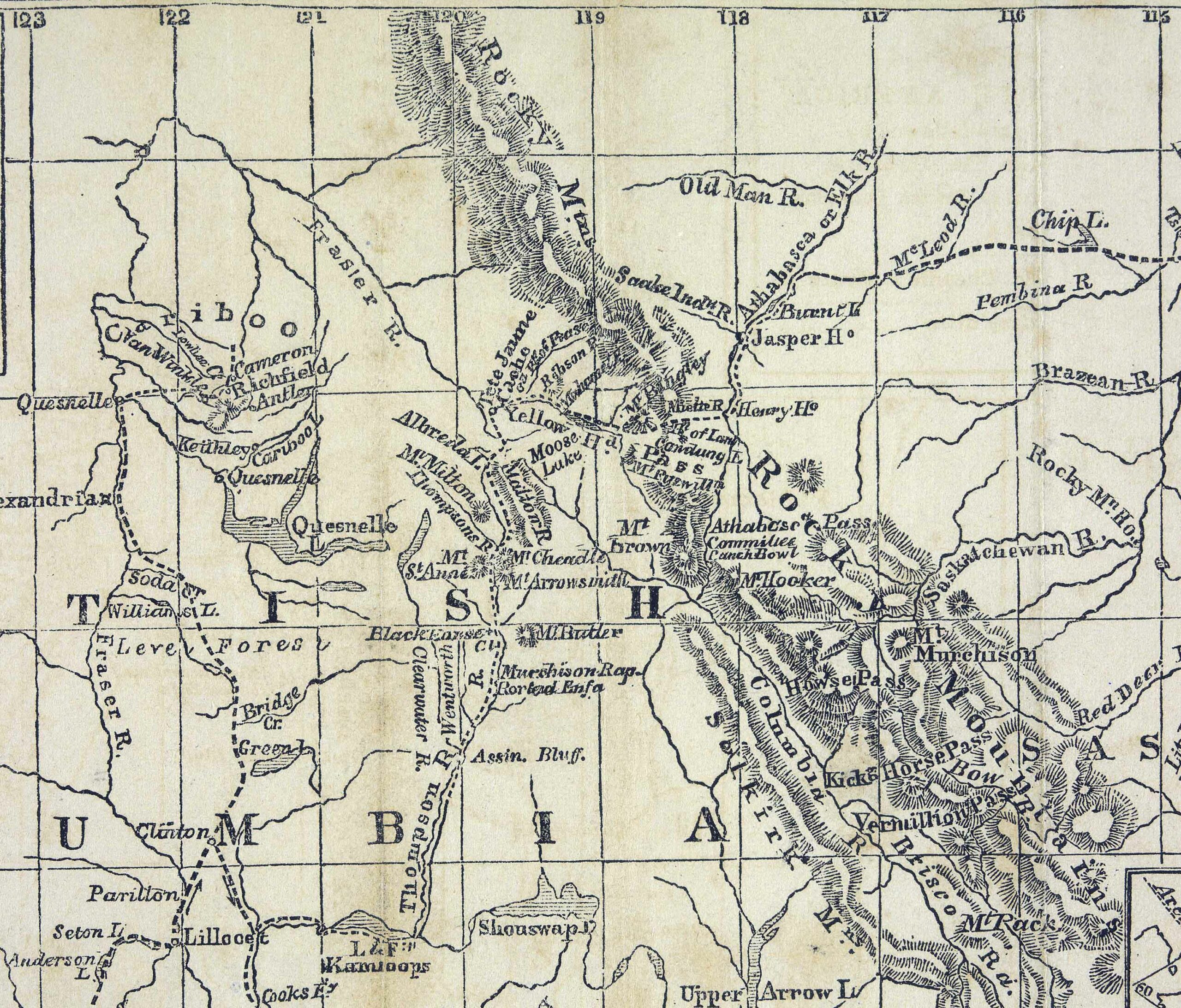
The Western Portion of British North America, showing the route followed by Lord Milton and Dr. Cheadle, from the Saskatchewan to British Columbia, 1863-4

The Western Portion of British North America, showing the route followed by Lord Milton and Dr. Cheadle, from the Saskatchewan to British Columbia, 1863-4
University of British Columbia Library


Detail of the route followed by Milton and Cheadle through the Yellowhead Pass.

Detail of the route followed by Milton and Cheadle through the Yellowhead Pass.
UBC Library Digital Collections


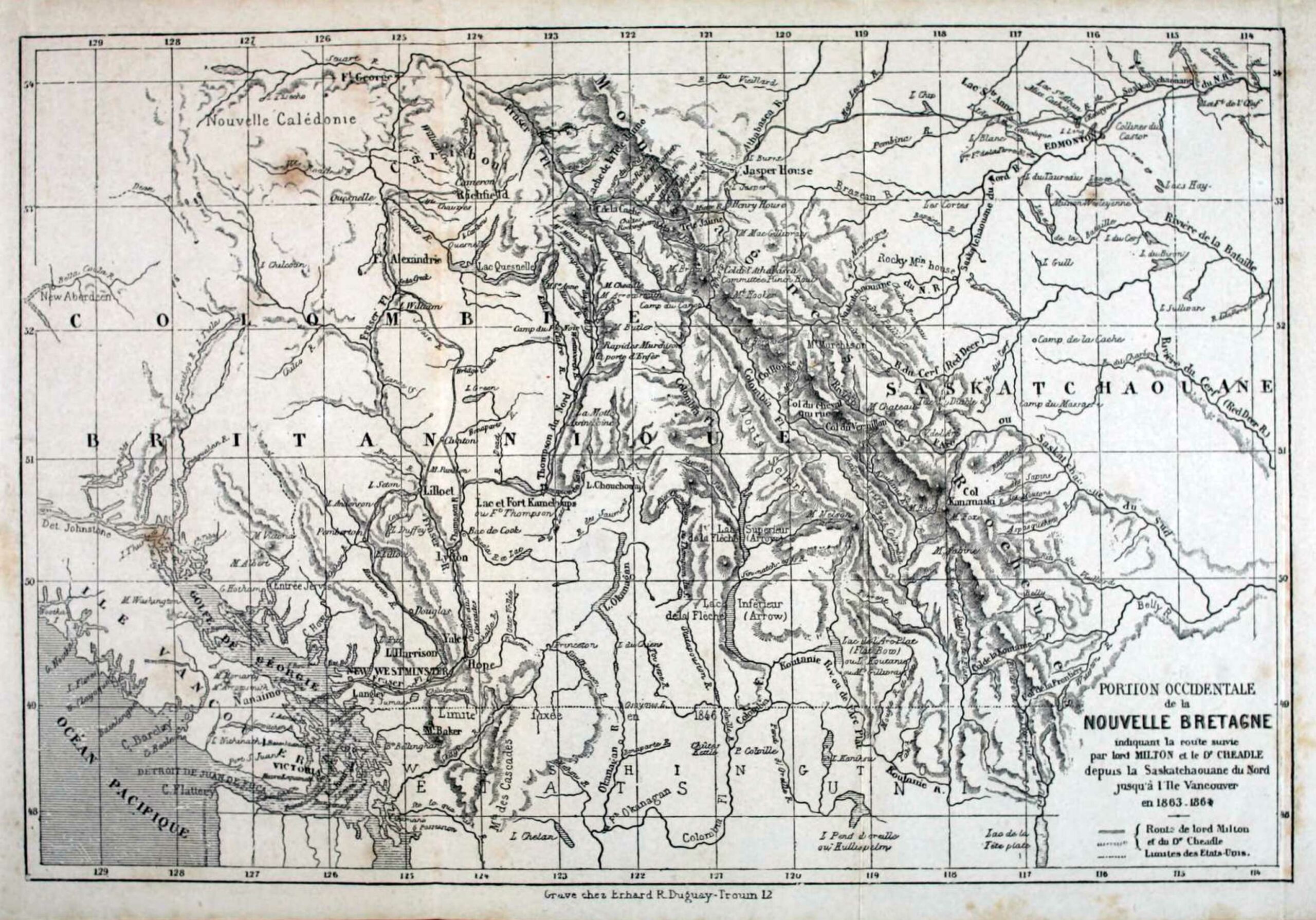
Portion Occidentale de la Nouvelle Bretagne indiquant la route survie par lord Milton et le Dr Cheadle.

Portion Occidentale de la Nouvelle Bretagne indiquant la route survie par lord Milton et le Dr Cheadle.
Voyage de l’Altantique au Pacifique [accessed 12 February 2026]

The Western Portion of
British North America,
Showing the route followed by Lord Milton & Dr. Cheadle, from the Saskatchewan to British Columbia, 1863-4

In lower left-hand corner: “John Dower” folllowed by illegible characters.

Milton and Cheadle travelled through the Yellowhead Pass in 1863. This map first appears in the 7th edition of Milton and Cheadle’s book North-West Passage by Land:

The Illustrations of this Work are taken almost entirely from photographs and sketches taken on the spot, and will, it is hoped, possess a certain value and interest, as depicting scenes never before drawn by any pencil, and many of which had never previously been visited by any white man, some of them not even by an Indian. Our most cordial thanks are due to Mr. E. P. Leitch, and Messrs. Cooper and Linton, for the admirable manner in which they have been executed; and to Mr. Arrowsmith, for the great care and labour he has bestowed on working out the geography of a district heretofore so imperfectly known [1].

John A. Arrowsmith [1790–1873] was a prominent British cartographer.

John James Dower [1825–1901] was a mapmaker, print seller, and publisher based in London.

References:

  • 1. Fitzwilliam, William Wentworth, Vicount Milton [1839–1877], and Cheadle, Walter Butler [1835–1910]. The North-West Passage by Land. Being the narrative of an expedition from the Atlantic to the Pacific, undertaken with the view of exploring a route across the continent to British Columbia through British territory, by one of the northern passes in the Rocky Mountains. London: Cassell, Petter and Galpin, 1865, p. xviii. Internet Archive [accessed 10 March 2025]

James Teit’s map Shuswap Territory 1909

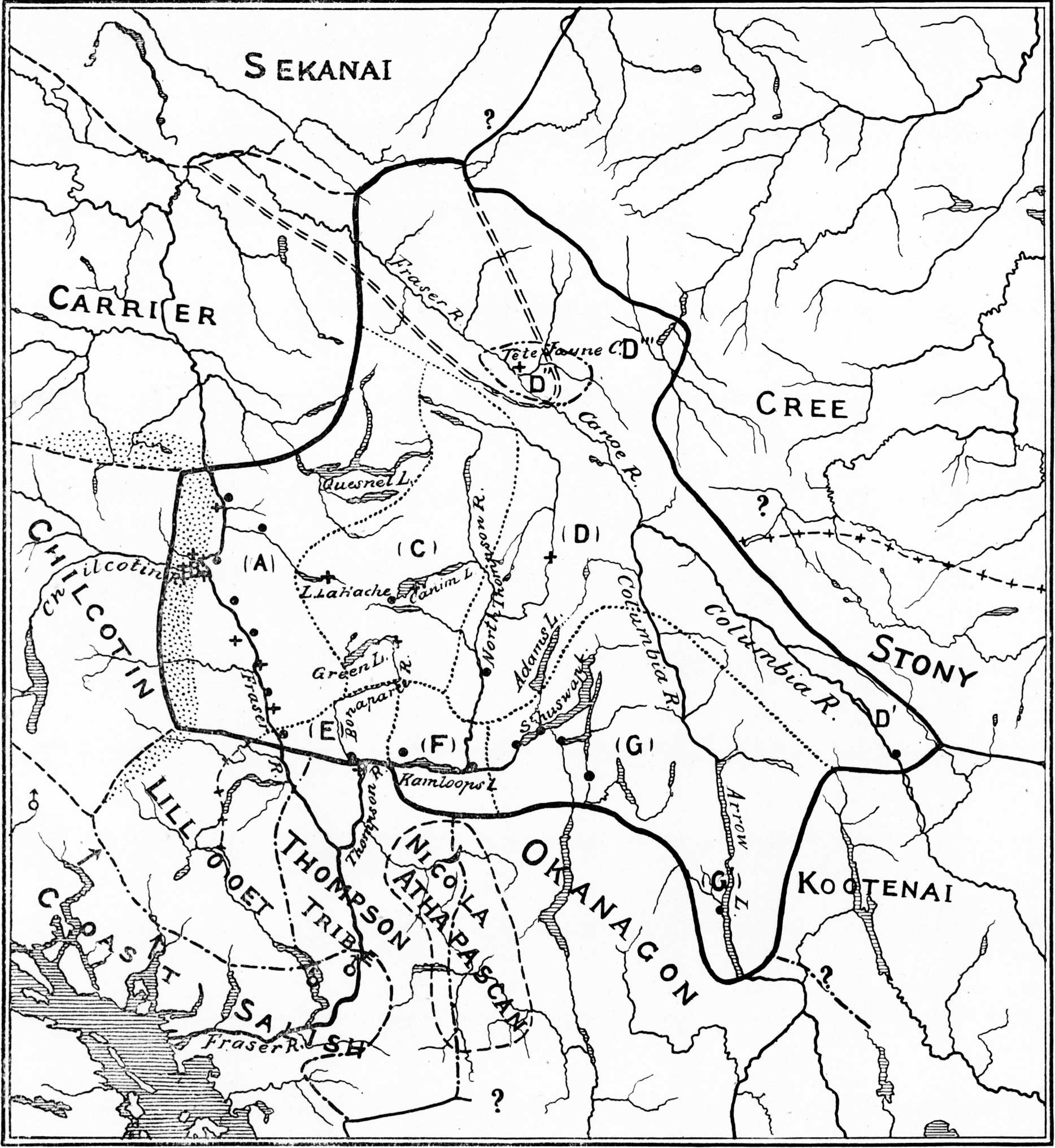
Map showing the Shuswap Territory. Figure 199, p. 450, Teit

Map showing the Shuswap Territory. Figure 199, p. 450, Teit

Fig. 199. Map showing the Shuswap Territory.

A – Fraser River Division
B – Cañon Division, territory now largely occupied by the Chilcotin
C – Lake Division
D – North Thompson Division

D’ – Kinbasket
D” – Former territory of the Iroquois Band
D”’ – Shuswap, Cree, and Iroquois mixed
E – Bonaparte Division

F – Kamloops Division.
G – Shuswap Lake Division.
G’ – Arrow Lake Band.
• – Villages.
+ – Former villages

Dotted area, territory recently occupied by the Chilcotin.
Area at head of Fraser River, enclosed by broken double lines, temporarily occupied by the Sekanai.

———

James Alexander Teit (1864 —1922) was an anthropologist, photographer and guide who worked with Franz Boas to study Interior Salish First Nations peoples in the late 19th and early 20th centuries. Accompanying Boaz, he was a member of the Jesup North Pacific Expedition, a major anthropological expedition to Siberia, Alaska, and the northwest coast of Canada. The purpose of the expedition was to investigate the relationships among the peoples at each side of the Bering Strait.

References:

  • Teit, James Alexander [1864–1922]. The Jesup North Pacific Expedition. Memoir of the American Museum of Natural History. Volume 2, Part 7. The Shuswap. New York: Stechert, 1909. American Museum of Natural History

Frederick Talbot’s map showing line of GTP 1910

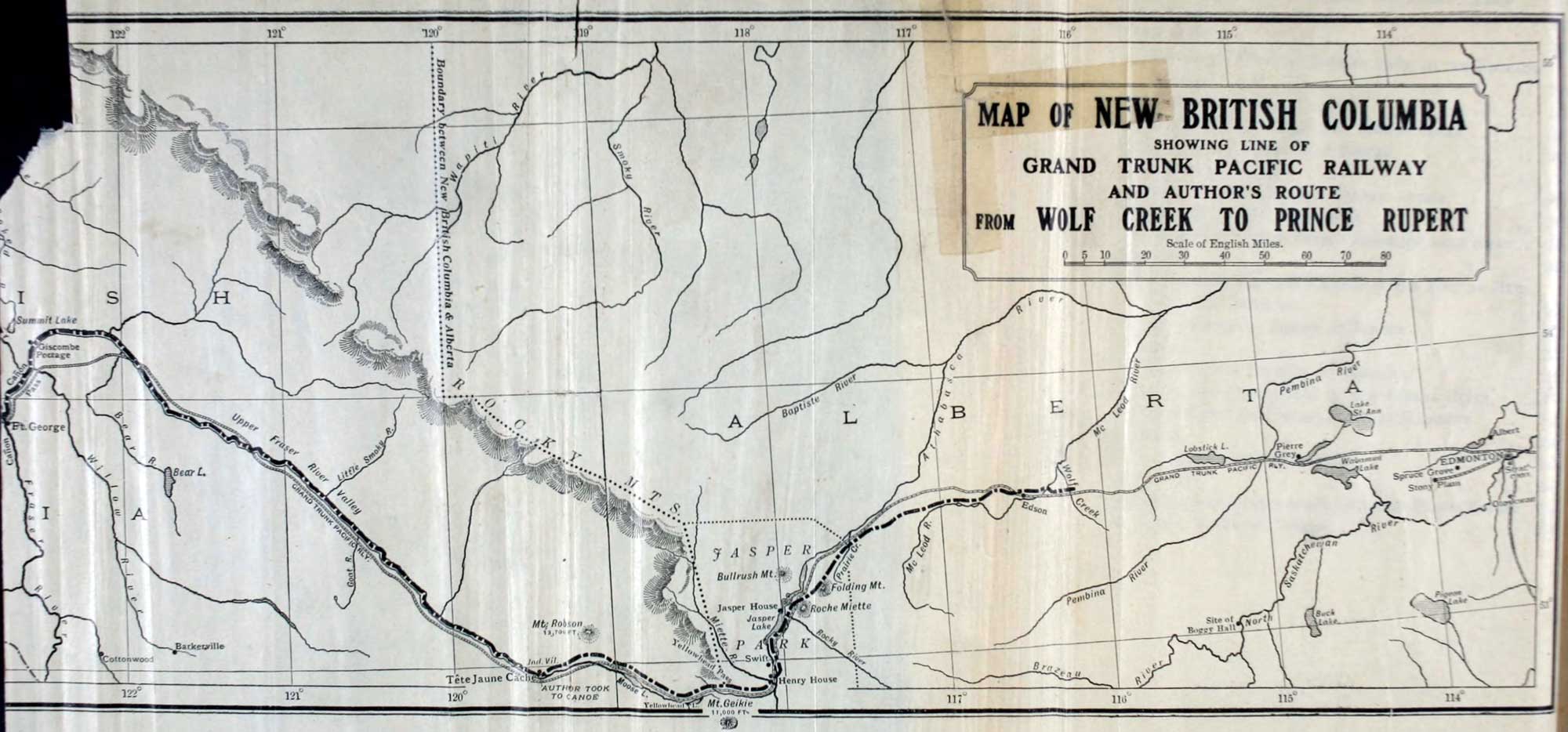
Map of New British Columbia
Showing Line of Grand Trunk Pacific Railway and Author's Route From Wolf Creek to Prince Rupert

Map of New British Columbia
Showing Line of Grand Trunk Pacific Railway and Author’s Route From Wolf Creek to Prince Rupert
F. A. Talbot, New Garden of Canada, 1911 [accessed 15 February 2025]

Map of New British Columbia
Showing Line of Grand Trunk Pacific Railway
and Author’s Route From Wolf Creek to Prince Rupert

British travel author Frederick Arthur Ambrose Talbot [1880–1924] traversed the Yellowhead Pass in 1910, one year ahead of the construction of the Grand Trunk Pacific Railway. Talbot was hired by the railway to cross Canada and report the potential of the areas being opened up. Two books, published in London, resulted from the trip: New garden of Canada: By Pack-horse and Canoe through Undeveloped New British Columbia, (1911), and The Making of a Great Canadian Railway (1912). In 1924, while living in Pointe-Claire, Québec, Talbot was sent to Calgary to make arrangements for the arrival of the Prince of Wales, Edward VIII, to ceremoniously travel the complete rail line. But at 44 years old, Talbot contracted pneumonia in Calgary and died.

Frederick Talbot was not the namesake of Mount Talbot or Talbot Lake.

References:

  • Talbot, Frederick Arthur Ambrose [1880–1924]. The new garden of Canada. By pack-horse and canoe through undeveloped new British Columbia. London: Cassell, 1911. Internet Archive [accessed 15 February 2025]
  • Talbot, Frederick Arthur Ambrose [1880–1924]. The making of a great Canadian railway. The story of the search for and discovery of the route, and the construction of the nearly completed Grand Trunk Pacific Railway from the Atlantic to the Pacific with some account of the hardships and stirring adventures of its constructors in unexplored country. London: Seely, 1912. Internet Archive [accessed 15 February 2025]
  • Schukov, Victor. “Meet Frederick Talbot, one of Pointe-Claire’s long forgotten celebrities.” Montreal Gazette, November 17 (2014). Montreal Gazette [accessed 15 February 2025]

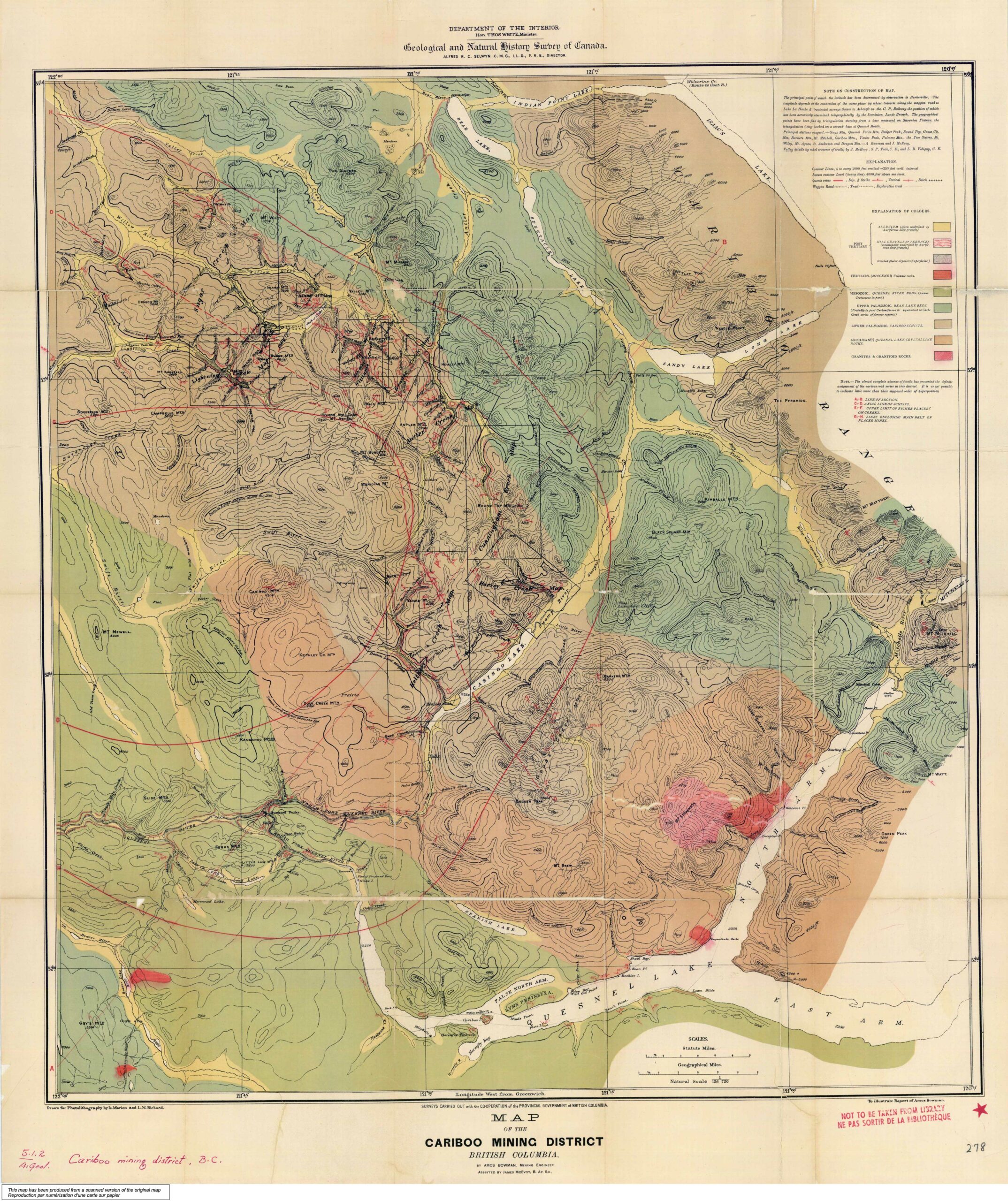
Bowman 1895 Map

Map of the Cariboo Mining District to illustrate the report of Amos Bowman

Map of the Cariboo Mining District to illustrate the report of Amos Bowman
Cariboo Gold Rush

Amos Bowman [1839–1894] surveyed the Cariboo mining region and prepared reports on many sections of British Columbia.

In 1885 and 1886 Mr. Amos Bowman was engaged in geologically examining the Cariboo mining district of British Columbia, the expense of the undertaking being borne jointly by the Geological Survey of Canada and the Government of British Columbia. Mr. Bowman was assisted by Mr. James McEvoy, and for a part of the time by Messrs. S. P. Tuck and L. R. Voligny. The year 1885 was necessarily given chiefly to geographical and topographical work, but in the following year Mr. Bowman devoted most of his own time to the geological and mining features. His general report was published by the Geological Survey in the volume for 1887-88, together with a geological map of the district on a scale of two miles to an inch, and maps on a large scale of Hixon Creek and Island Mountain and Mosquito Creek.

It was intended to follow the report above mentioned by a second, in which detailed descriptions should be given of the principal auriferous creeks of the district. Maps of these creeks were prepared by Mr. Bowman and lithographed, but as he had in the meantime been obliged to sever his regular connection with the Survey in favour of urgent private business, the final correction and printing of these maps was only completed after long delays, and in June, 1894, Mr. Bowman died, without having written any descriptive matter to accompany these mining maps.

— George M. Dawson, Geological Survey of Canada, April, 1895

Amos B. Bowman was born at Blair, Ontario, but soon after, his parents moved to Ohio. Later he had a very distinguished career as a renowned scientist in Canada and the United States. Following university studies in Germany, he graduated as a civil and mining engineer, and traveled in Europe writing articles for the New York Tribune.

An outstanding authority on geology, he had charge of a five-year California geological survey. He then joined an official Canadian geological survey, surveying the Cariboo mining region, and prepared reports on many sections of British Columbia.

Mr. Bowman promoted the interests of Fidalgo Island in British Columbia, whose possibilities impressed him. In recognition of his services, the town of Anacortes was named after his wife, Anna Curtis Bowman. He published a newspaper, and gave liberally in land to induce the building of a railroad up the Skagit Valley.

It was said of this outstanding scientist that “he often impoverished himself to enrich others.”

This map includes:
Cariboo Mountains
References:

  • Bowman, Amos B. [1839–1894]. Map of the Cariboo Mining District, British Columbia, to illustrate the report of Amos Bowman. 1895. Cariboo Gold Rush
  • Bowman, Amos B. [1839–1894]. Maps of the principal auriferous creeks in the Cariboo mining district, British Columbia. Ottawa: Geological Survey of Canada, 1895. Hathi Trust
  • Dawson, George Mercer, D.S. [1849–1901]. Report on the area of the Kamloops map-sheet British Columbia. Ottawa: Geological Survey of Canada, 1895. Canadiana