Connects to Highway 16 14 km west of McBride
53.3989 N 120.400 W Google — GeoHack
Roads are not in the official geographical names databases
Surveying the view to the west from Gendarme Mountain during the 1911 Alpine Club of Canada–Smithsonian Robson Expedition, Arthur Oliver Wheeler [1860–1945] wrote:
The valley is a very beautiful one with green alp-lands, shining silver streams and two large ponds visible beside them. It drains to a larger timbered valley trending N. W. and S.E. to the Smoky River. Phillips has named the stream in the valley below us “Wolverine Creek.
Donald “Curly” Phillips [1884–1938]
In French-speaking parts of Canada, the wolverine is referred to as carcajou, borrowed from the Innu-aimun or Montagnais kuàkuàtsheu. However, in France, the wolverine’s name is glouton (glutton).
Hector’s entry for February 13, 1859:
Tekarra’s foot is so much inflamed with his hunting exertions, that he will not be able to guide us up the valley to the Committee’s Punch Bowl, so changed my plan and followed up the main stream of the Athabasca instead. At noon we reached the mouth of Whirlpool River, which is the stream that descends from the Committee’s Punch Bowl, and I found the latitude 52° 46′ 54″
David Thompson [1770–1857] followed the Whirlpool River when he made the first recorded crossing of the Athabasca Pass in 1811. Working for the North West Company, he was in search of the mouth of the Columbia River.
Thompson makes a score of references to whirlpools in his narrative, but does not give that name to this river. He considered he was ascending to the head of the Athabasca River, whose headwaters actually lead as far south the Columbia Icefield.
In 1912 I found myself in a position to take an extended vacation during the summer and I immediately planned to re-visit the Canadian Rockies … I determined to take hunting trip north of the Yellowhead Pass. On August 8th I left a Hinton, a station on the Grand Trunk Pacific Ry., with Fred Brewster, from whom I obtained the outfit of horses. Our definite plans were to get as far as possible into the country beyond the Smoky River — a tributary of the Peace — and there hunt. The real object of our trip was to determine the species of sheep existing in the mountains between the Athabasca and Peace Rivers. After five weeks of travelling through badly fallen timber, which made our progress slow, we reached the head of Sheep Creek, a stream flowing into the Smoky River.
— S. P. Fay

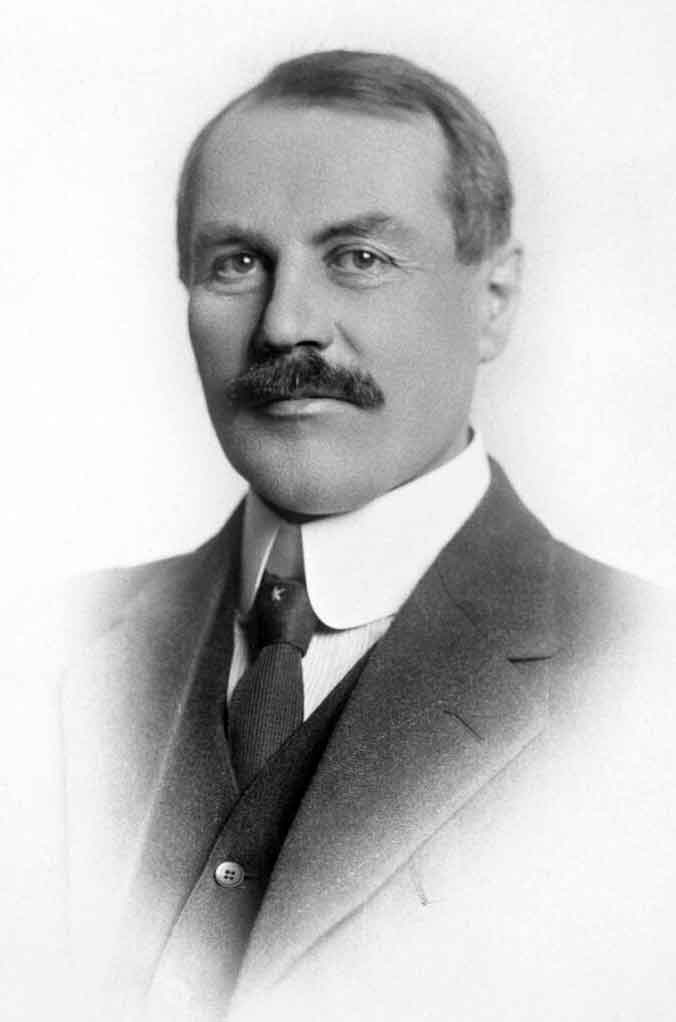
Jean Léon Côté, M.L.A., Edmonton. Ca. 1915
Wikipedia

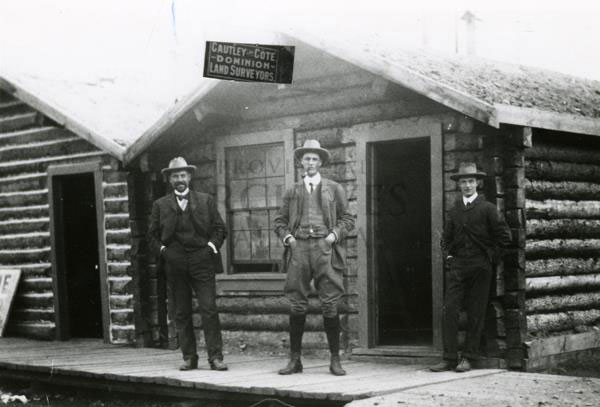
J. L. Côté and Reginald Cautley, Dawson, Yukon, ca. 1902
Provincial Archives of Alberta
Named for the French-Canadian politician Jean Léon Côté (1867-1924), born in Les Éboulements, Canada East. Côté was a surveyor and civil engineer by trade, and first visited the Edmonton area in 1886 as part of a survey crew. He returned to the East and trained as a Dominion Land Surveyor for the Department of the Interior, where he worked from 1893 to 1900. In 1899, Côté was sent by the Department to the Klondike gold rush, arriving in Dawson City that summer. Sometime after his arrival in Dawson City, Côté joined the Cautley brothers in a surveying partnership that lasted several years.
In the spring of 1909, Côté was induced to enter politics as a Liberal as he was well known in the Athabasca, Lesser Slave Lake, Peace River, and Fort McMurray areas through his numerous surveying activities. He was elected in the new Grouard riding in 1913 and re-elected by acclamation in 1918 and again in 1921. Côté was provincial secretary and Minister of Mines, Railways and Telephones. As Minister, Côté promoted the issue and approval by the Government of Alberta of an Order in Council establishing what would become known as the Alberta Research Council.
He died suddenly on September 24, 1924, at the age of 57 from peritonitis.
Adopted in 1965 on map 93H/16, as labelled on 1929 survey plan 10T264, “McGregor River area,” by Allen John Campbell [1882–1967], British Columbia Land Surveyor, and as identified in the 1953 BC Gazetteer. Presumably named by Campbell.
A pommel is the knob-like protuberance at the front of a saddle, and this feature is located at the end (and is the highest summit) of an undulating ridgeline extending southwesterly from Mount Sir Alexander.
Origin of the name unknown.