Author Archives: Swany

Collie’s map Yellowhead Pass 1912

Part of the Rocky Mountains North of the Yellowhead Pass, J. Norman Collie, 1910-11

Part of the Rocky Mountains North of the Yellowhead Pass, J. Norman Collie, 1910-11
The Geographical Journal 1912

This map accompanies “Exploration in the Rocky Mountains North of the Yellowhead Pass” by John Norman Collie [1859–1942], Ph.D., LL.D., F.R.S, F.R.G.S., etc., The Geographical Journal (London), 39 (1912):223-233.

Collie was a chemist and mountaineer who lived at London, England. Between 1897 and 1911, Collie pioneered climbing in the Canadian Rockies, making twenty-one first ascents including Mount Victoria and Mount Athabasca.

This Map is from a plane table survey by Professor J. Norman Collie, based upon the map of the “Yellow-head Pass Route,” by Mr. J. McEvoy, B.A.Sc., of the Canadian Government Survey, which accompanies Part D., Vol XI., of the Report of the Geological Survey of Canada, 1900. The positions of Roche Miette, Roche Jacques, Roche Suette, and the Athabasca and Stoney rivers were laid down exactly as they are on that map, and the plane table survey of the mountainous region to the north of the Yellowhead Pass and Moose Lake adjusted to them. A traverse with the plane table was first run up the Stoney river as far as its source and Mt. Hoodoo, and rays were drawn to peaks on either side of the valley which were intersected from other points later on. Numerous photographs were taken during the expedition, many of which were used in the construction of the plane table map, and provided means of testing its general accuracy.

The position of Mt. Robson as determined by Professor Collie differs only about one mile from that given by Professor A. P. Coleman.

The heights underlined are taken from McEvoy’s map, while those in brackets are rough estimations; all others are from Collie’s readings of an aneroid, which was checked frequently by comparison with a mercurial barometer. They were computed by Collie with a mean sea-level of 30 ins., and should be considered as approximate only. In all cases the heights are above sea level.

— Note by editor of The Geographical Journal (London)
References:

  • McEvoy, James [1862–1935]. Report on the geology and natural resources of the country traversed by the Yellowhead Pass route from Edmonton to Tête Jaune Cache comprising portions of Alberta and British Columbia. Ottawa: Geological Survey of Canada, 1900. Natural Resources Canada
  • Mumm, Arnold Louis [1859–1927]. “Mount Robson District. Mumm and Collie’s 1910 Journey.” Alpine Journal, Vol. 25 (1910–1911):466
  • Collie, John Norman [1859–1942]. “Exploration in the Rocky Mountains North of the Yellowhead Pass.” The Geographical Journal (London), 39 (1912):223-233. JSTOR
  • Collie, John Norman [1859–1942]. “On the Canadian Rocky Mountains north of the Yellowhead Pass.” Alpine Journal, Vol. 26 (1912):5-17
  • Collie, John Norman [1859–1942]. “Early Expeditions of the Rocky Mountains.” Alpine Journal, Vol. 33 (1920–1921):319

Mile 29

British Columbia. Railway point
About a mile west of Red Pass Junction
Earliest known reference to this name is 1913
Not currently an official name.
Police Barracks at Mile 29. Alan K. Bourchier, 1911 (Item 2009.5.3.48)

Police Barracks at Mile 29. Alan K. Bourchier, 1911 (Item 2009.5.3.48)
Northern British Columbia Archives

Boundary Commission 1924 Maps

Detail from Index sheets 2 and 3. Boundary between Alberta and British Columbia. Office of the Surveyor-General, 1924

Detail from Index sheets 2 and 3. Boundary between Alberta and British Columbia. Office of the Surveyor-General, 1924 Internet Archive

Alberta-British Columbia Boundary Commission map sheets 26 to 39, published in 1924, cover the boundary from Athabasca Pass to Intersection Mountain.

Maps credited to

R. W. Cautley, D.L.S., Commissioner for the Dominion and for Alberta
A. O. Wheeler, B.C.L.S., Commissioner for British Columbia

Richard William Cautley [1873–1953], Dominion Land Surveyor, and Arthur Oliver Wheeler [1860–1945], British Columbia Land Surveyor, were commissioners appointed by the Surveyor General of Canada.

Available in high resolution on the William C. Wonders map collection, University of Alberta Library, on the Internet Archive.

Sheets relevant to the Mount Robson region:

Boundary Commission Index Sheet 2
Boundary Commission Index Sheet 3

Boundary Commission Sheet 26 — Mount Brown to Whirlpool
Boundary Commission Sheet 27 — Mount Hooker to Whirlpool Pass
    Boundary Commission Sheet 27 A — Athabasca Pass
    Boundary Commission Sheet 27 B — Whirlpool Pass
Boundary Commission Sheet 28 — Mount Whitecrow to Tonquin Pass
Boundary Commission Sheet 29 — Yellowhead Pass.
    Boundary Commission Sheet 29 A— Miette Hill to Yellowhead Pass
    Boundary Commission Sheet 29 B — Yellowhead Pass to Tête Roche
Boundary Commission Sheet 30 — Mount O’Beirne to Colonel Pass
Boundary Commission Sheet 31 — Colonel Pass to Moose Pass
Boundary Commission Sheet 32 — Moose Pass to Cacajou Pass
    Boundary Commission Sheet 32 A — Robson Pass
Boundary Commission Sheet 33 — Carcajou Pass to Jackpine Pass
Boundary Commission Sheet 34 — Jackpine Pass to Mount Holmes
Boundary Commission Sheet 35 — Chalco Mountain to Beaverdam Pass
Boundary Commission Sheet 36 — Great Shale Hill to Loren Lake
Boundary Commission Sheet 37 — Avalanche Pass to Casket Pass
Boundary Commission Sheet 38 — To Intersection Mountain
Boundary Commission Sheet 39 — North of Intersection to Kakwa River

This map includes:

References:

  • Cautley, Richard William, D.L.S., A.L.S., C.E. [1873–1953], and Wheeler, Arthur Oliver [1860–1945]. Report of the Commission Appointed to Delimit the Boundary between the Provinces of Alberta and British Columbia – Part III – from 1918 to 1924. Atlas. Ottawa: Office of the Surveyor General, 1925
  • Cautley, Richard William, D.L.S., A.L.S., C.E. [1873–1953], and Wheeler, Arthur Oliver [1860–1945]. Report of the Commission Appointed to Delimit the Boundary between the Provinces of Alberta and British Columbia. Parts IIIA & IIIB, 1918 to 1924. From Yellowhead Pass Northerly. Ottawa: Office of the Surveyor General, 1925. Whyte Museum

Jeffrey Creek

British Columbia. Creek: Columbia River drainage
Flows SE. into Wood River from Mount Brown Icefield
52.2833 N 118.15 W — Map 83D/8 — GoogleGeoHack
Earliest known reference to this name is 1922 (Wheeler)
Name officially adopted in 1954
Official in BCCanada

Probably named by the Alberta-British Columbia Boundary Commission which surveyed the area in 1920. Boundary comissioner Arthur Oliver Wheeler [1860–1945] mentions Jeffrey Creek in his 1922 article on Mount Brown and Mount Hooker.

References:

  • Wheeler, Arthur Oliver [1860–1945]. “The location of Mts. Brown and Hooker.” Canadian Alpine Journal, Vol. 12 (1921–1922):123-129

Henry House

Alberta. Former locality and railway point
Approximately 12 km north of Jasper on the topo map
52.9867 N 118.0628 W — Map 083D16 — GoogleGeoHack
Name officially adopted in 1951
Topo map from Canadian Geographical Names
19 miles east of the Yellowhead Pass on the Canadian National Railway
Grand Trunk Pacific Railway station built in 1911
“Meeting of the Athabasca and Leatherhead Passes. Site of the ‘Henry House,’ an old trading-post of the Great North West Trading Company! — Indian grave— Rylatt p. 131

“Meeting of the Athabasca and Leatherhead Passes. Site of the ‘Henry House,’ an old trading-post of the Great North West Trading Company! — Indian grave— Rylatt p. 131


William Henry (1784-1864). From “Travels and Adventures” (Bain, ed., Boston, 1901

William Henry (1784-1864). From “Travels and Adventures” (Bain, ed., Boston, 1901 Red River Ancestry

On the Palliser map, “Miette or Henry Ho.” is at the confluence of the Miette River and Athabasca River , modern-day Jasper.

“Henry’s House” or “William Henry’s Old House” was a minor North West Company [1779–1821] trading post on the route to Athabasca Pass. In 1811, while David Thompson [1770–1857] was making the first recorded crossing the pass, William Henry, the eldest son of Alexander Henry [1739–1824], provided support on the eastern side of the mountains.

Henry built a post on the Athabasca River near the mouth of the Miette River, where the trails from the Athabasca and Yellowhead passes reached the head of navigation.

References:

  • Henry, Alexander [1739–1824]. Travels and adventures in Canada and the Indian territories, Between the Years 1760 and 1776. In two parts. New York: Riley, 1809. Internet Archive
  • Rylatt, Robert M. [fl. mid-1800s]. Surveying the Canadian Pacific: Memoir of a Railroad Pioneer. Salt Lake City: University of Utah Press, 1991
  • Still, Gary [1939–2018]. William Henry (1784-1864). 2014 Red River Ancestry [accessed 27 February 2025].
  • Karamitsanis, Aphrodite [1961–]. Place names of Alberta. Volume 1: Mountains, Mountain Parks and Foothills. Calgary: University of Calgary Press, 1991. Internet Archive
  • Bohi, Charles W., and Kozma, Leslie S. Canadian National’s Western Stations. Don Mills, Ontario: Fitzhenry & Whiteside, 2002
  • Still, Gary [1939–2018]. William Henry (1784-1864). 2014 Red River Ancestry [accessed 27 February 2025].
  • Wikipedia. Henry House

Jasper House National Historic Site of Canada

Alberta. National Historic Site: Athabasca River drainage
At the foot of Jasper Lake on Athabasca River
53.1383 N 117.9806 W — Map 083F04 — GoogleGeoHack
Name officially adopted in 2001
Official in Canada

Jasper House National Historic Site is the site of a fur trading post on the Athabasca River that functioned in two different locations from 1813 to 1884 as a major staging and supply post for travel through the Canadian Rockies.

The post was originally named Rocky Mountain House, but was renamed to avoid confusion with the Rocky Mountain House trading post on the North Saskatchewan River, becoming “Jasper’s House” after the postmaster, Jasper Hawes, who operated the post from 1814 to 1817. The first location is believed to have been at the outlet of Brûlé Lake, downstream from the present site. The second Jasper House was established at the northern end of Jasper Lake in 1830, primarily serving travellers crossing Yellowhead Pass or Athabasca Pass.

The site operated until 1853, and was occasionally used until 1858 when it was reopened seasonally by Henry John Moberly, who operated it into the 1860s. The post was officially closed in 1884 after years of inactivity. From 1891 or 1892 to 1894 the house was used by miner Lewis Swift. The building was destroyed in 1909 when its lumber was used to make a raft by surveyors for the Grand Trunk Pacific Railway. Apart from a small cemetery, no significant ruins remain. It was designated a national historic site in 1924, and is marked by a commemorative stone and plaque.

References:

Tolmie and Dawson map Indian Tribes of BC 1884

References:

  • Tolmie, William Fraser [1812–1886], and Dawson, George Mercer [1849–1901]. Comparative Vocabularies of the Indian Tribes of British Columbia, with a Map Illustrating Distribution. Ottawa: Geological and Natural History Survey of Canada, 1884. Toronto Public Library

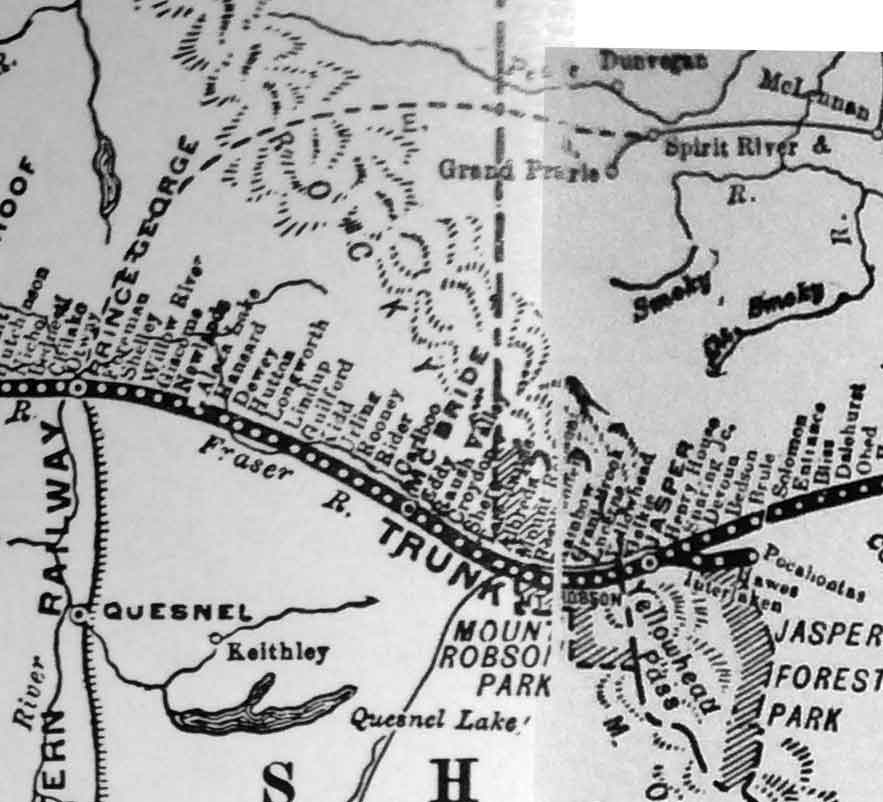
Grand Trunk Pacific map [ca. 1912]


[968]

Early Grand Trunk Pacific Railway map (above) cropped and orientated to show the original stations between McBride and Jasper, which were built between 1912 and 1914.

There are only 17 stations shown between Prince George and McBride on this original plan. Missing is Legrand, which was added in 1914 during construction, to make up the original 18 stations built on that stretch. Knole station became Rider sometime after 1916, so this map seems to be from between 1912 and 1916. Rooney station was renamed Goat River (railway point) sometime between 1918 and 1923.

The rail line between Prince George and McBride was often referred to as the “East Line.” The only access from McBride to the communities west of McBride was by rail.

William Pittman Hinton, general manager of the railway’s western lines, asked Josiah Clement Wedgwood, of the Wedgwood china family, to submit a list of names suitable for naming the stations on the new railway line. Many station names on the Grand Trunk Pacific Railway have a connection to England [excerpt taken from Penny for your thoughts].

References:

  • Penny Reunion Committee 1995. A Penny for Your Thoughts. Prince George: 1995
  • Olson, Raymond W. From Liaboe to Loos and Beyond. Prince George, B.C.: Raymond W. Olson, 2011
  • Olson, Raymond W. Ghost Towns on the East Line. Prince George, B.C.: Raymond W. Olson, 2017

Mastodon Mountain

Alberta-BC boundary. Mountain
S of Mount Fraser
52.6072 N 118.3344 W — Map 083D09 — GoogleGeoHack
Name officially adopted in 1963
Official in BCCanada
This mountain appears on:
Boundary Commission Sheet 28 (surveyed in 1921) [as “Mount Mastodon”]

“Mastodon Peak” adopted in 1924, derived from name on BC-Alberta Boundary sheet 28, 1921. Form of name changed to “Mastodon Mountain” in 1962 by Alberta and 1963 by British Columbia.

Named in 1922 by the Alberta-British Columbia Boundary Commission survey party because of a resemblance to the extinct form of elephant.

References:

  • Cautley, Richard William [1873–1953], and Wheeler, Arthur Oliver [1860–1945]. Report of the Commission appointed to delimit the boundary between the Provinces of Alberta and British Columbia. Part II. 1917 to 1921. From Kicking Horse Pass to Yellowhead Pass.. Ottawa: Office of the Surveyor General, 1924. Whyte Museum
  • Cautley, Richard William [1873–1953], and Wheeler, Arthur Oliver [1860–1945]. Report of the Commission Appointed to Delimit the Boundary between the Provinces of Alberta and British Columbia. Parts IIIA & IIIB, 1918 to 1924. From Yellowhead Pass Northerly. Ottawa: Office of the Surveyor General, 1925. Whyte Museum