Forks off Doré River Road
53.3181 N 120.2359 W Google — GeoHack
Roads are not in the official geographical names databases
Origin of the name unknown.
Named in association with Albreda Lake, a name dating to 1863.
During construction of the Canadian Northern Railway around 1915, Albreda had the first telegraph in the area. Albreda was the inspection point for the Blue River–Jasper subdivision of the rail line and may have had a CNoR 3rd Class depot at one time. (1)
The Albreda post office was open from 1923 to 1948, and again from 1956 to 1959. The small settlement was the site of a Japanese internment camp during World War II. (2)
The original Albreda station was on the Grand Trunk Pacific Railway line, as indicated on Arthur Wheeler’s 1912 topographical map of the Mount Robson region and on British Columbia Pre-emptor’s map 3H, 1914. That early station was located just east of Tête Jaune Cache and repositioned westward as shown Pre-emptor’s map Tête Jaune 3H 1919.
Entry from the 1918 Wrigley’s Directory (3)
ALBREDA — a station on the C.N.R., in the Fort George Provincial Electoral District, 7 miles from Tete Jaune Cache and 40 from Blue River, the post office and nearest commercial telegraph. Population, 21. Three homesteads open for pre-emption, four taken; all good land for gardening. Abundance of mica about 2 miles distant, and cordwood.
Abrams T farming
Askin A farming
Browson Julius A farming
Frederick John section foreman CNR
Frye Fred farming
Joyle Clifford farming
Lavoie Joseph farming
McGuiness C L telegraph operator CNR
McLaren David assistant postmaster
Swanson P farming
Entry from the 1922 Wrigley’s Directory (4)
ALBREDA — a station on the C.N.R. and G.T.P. Rys. Has G. N. W. Telegraph. Population, 21. Abundance of mica about 2 miles distant, and cordwood.
Christoff Steve sec foreman GTP
Frederick John sec foreman CNR
Frye Fred farming
Lavoie Joseph farming
MeGuinness C L tel opr
Nichols C Z agt CNR
Stewart Peter farming
The Great North Western Telegraph Co was established in 1880 and taken over by the Canadian Northern Railway on 1 January 1915. The railway itself was in financial difficulty, however, and was soon purchased by the federal government, subsequently forming a component of Canadian National Railways Co. In this way Great North Western Telegraph Co became Canadian National Telegraph Co. (5)

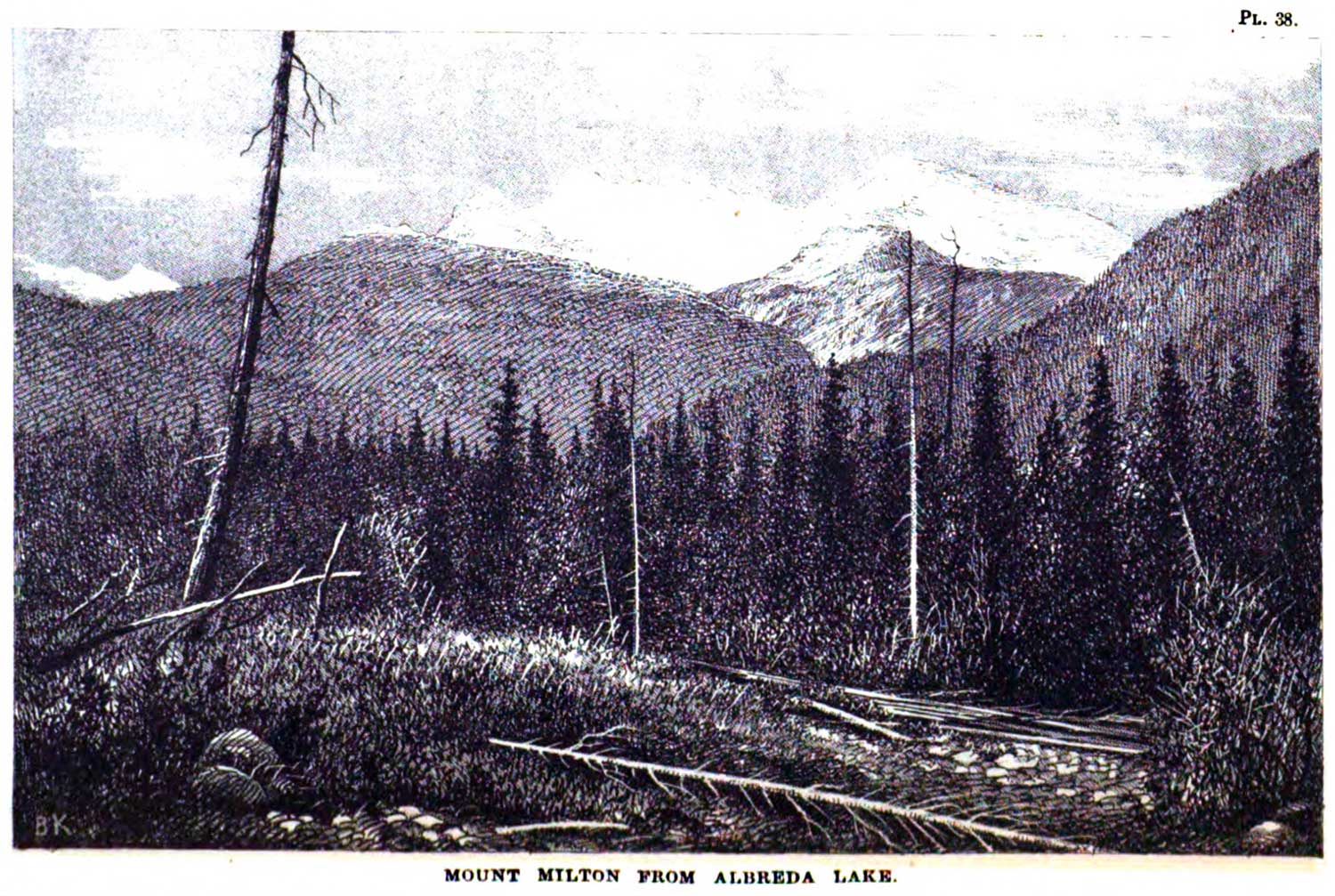
Mount Milton from Albreda Lake. George Monro Grant, plate 38 Ocean to Ocean: Sandford Fleming’s Expedition through Canada in 1872
On July 23, 1863, the British adventurers William Wentworth Fitzwilliam Milton [1839–1877] and Walter Butler Cheadle [1835–1910], heading south from Tête Jaune Cache, passed the height of land, and gained the watershed of the Thompson. This was occupied, they wrote, “by a small marshy lake, marked Albreda Lake in the map, filling the bottom of the ravine. It appeared to have been drained formerly by a stream flowing from either extremity; but the northern end was now blocked up by an old grass-grown beaver-dam, and its waters escaped only towards the south.”
The lake (now filled in) at the pass between the Fraser River and the North Thompson River was named after Milton’s aunt, Lady Albreda Elizabeth Wentworth-Fitzwilliam. In the 12th century Milton’s ancestor, Sir William Fitzwilliam, married Albreda, daughter of Robert de Lixores.
During construction of the Canadian Northern Railway around 1915, Albreda had the first telegraph in the area. Albreda was the inspection point for the Blue River–Jasper subdivision of the rail line. The Albreda post office was open from 1923 to 1948, and again from 1956 to 1959. The small settlement was the site of a Japanese internment camp during World War II.
Near Tête Jaune Cache
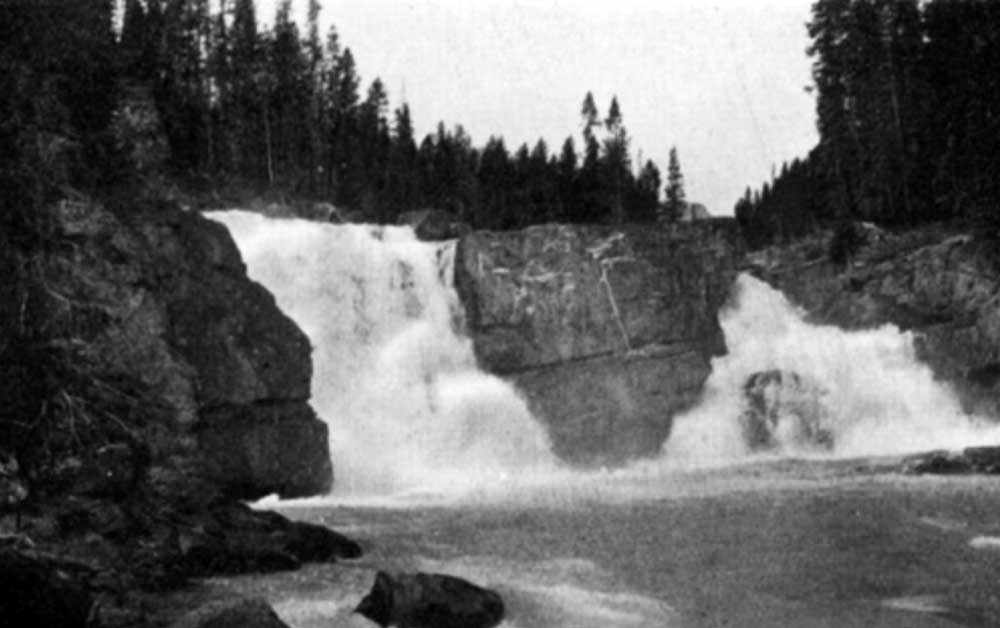
One of the eight Rainbow Falls in Canada.

Falls of the Moose River. J. Norman Collie, 1910
The Geographical Journal (London)
In the report of the 1911 Alpine Club of Canada–Smithsonian Robson Expedition, Arthur Oliver Wheeler [1860–1945] wrote:
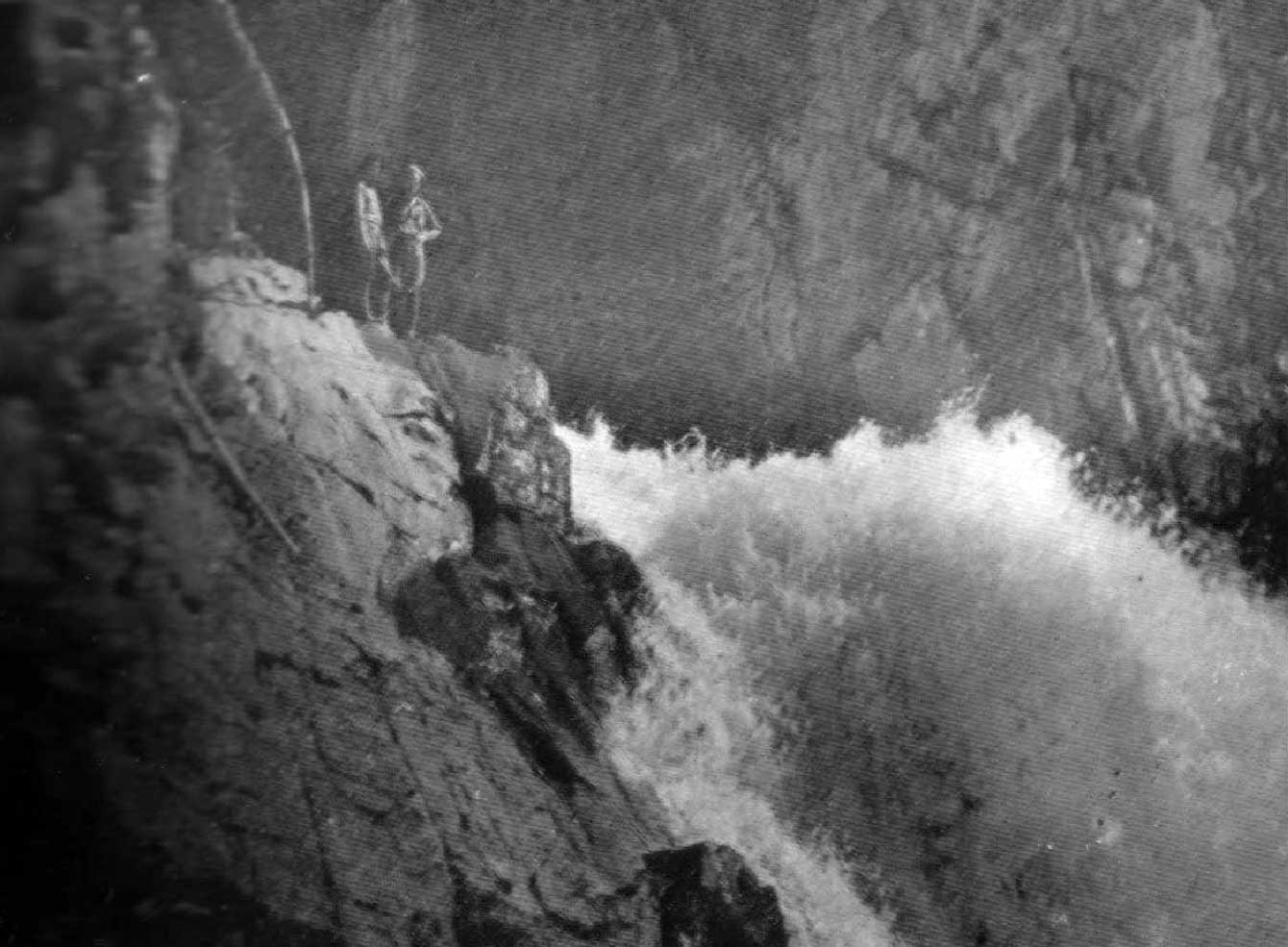
Moose River emerges from a canyon directly beside the railway. It is very fine and will be a most attractive feature to the travelling public. The canyon is not more than two hundred yards in length and about 150 feet deep. There are two falls near the head, of which the upper drops 50 feet and the lower 20 feet. Here the grandeur and awe of the spectacle culminates; the gorge is at its wildest, the sheer rock walls at their steepest; you are between the two falls; flying mist and spray fill the available space and eddy and circle continuously. On sunny days baby rainbows play hide and seek. I counted, at one and the same time, half a dozen at various points of view. The name Rainbow Falls and Canyon is suggested as attractive and appropriate; the more so that the mountain group, of which Robson is the dominating mass, is known as the Rainbow Mountains. The canyon is an exceptionally fine study of the action and effect of a powerful glacial torrent.
Wheeler indicated Rainbow Canyon on the map accompanying his report in the 1912 Canadian Alpine Journal.
It’s a bird.

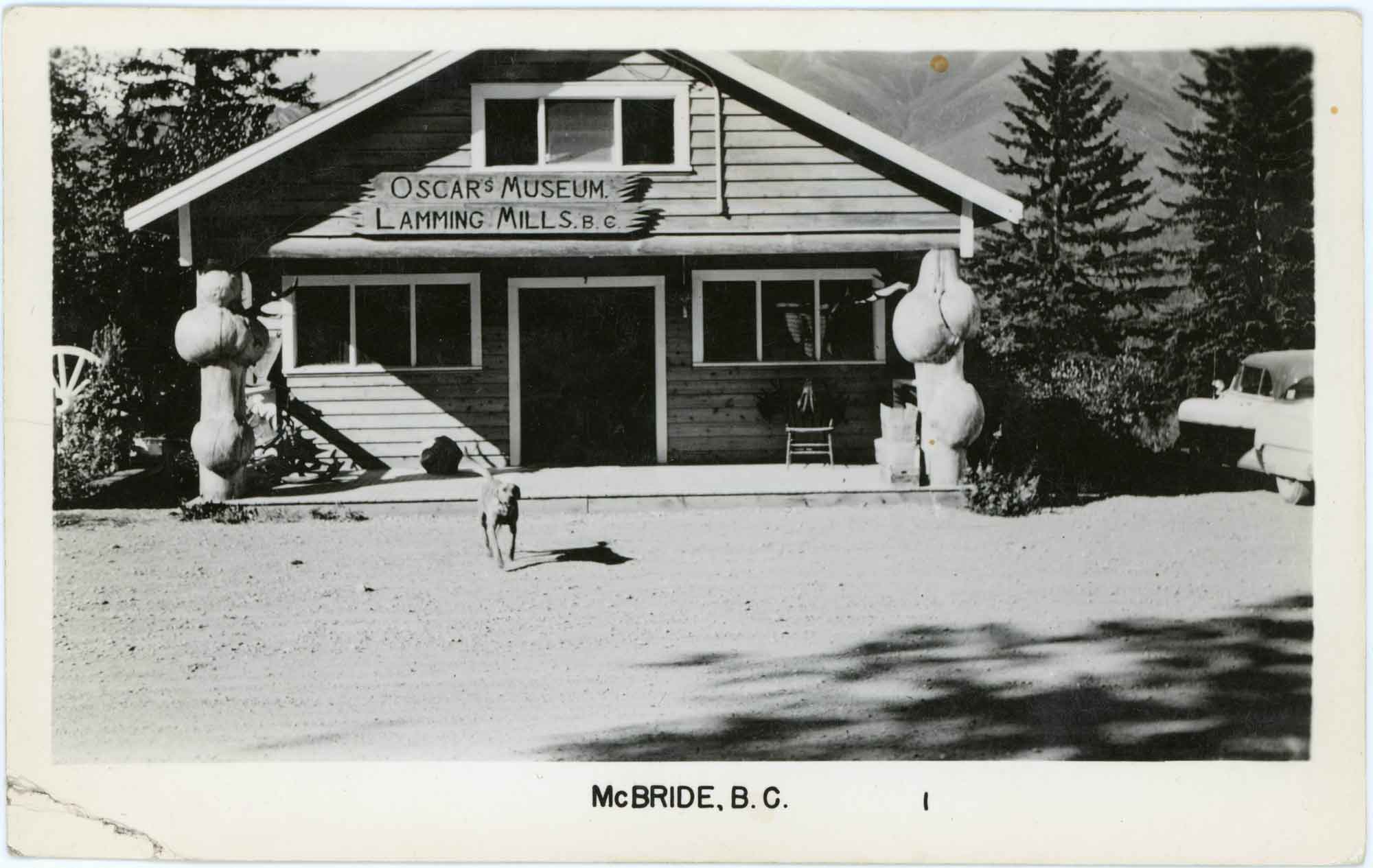
Oscar’s Museum in Lamming Mills, in the early sixties, before it was moved to Museum Road. Valley Museum & Archives Society [accessed 4 April 2025]
Oscar Laming received his degree from the Northwest School of Taxidermy in 1917, but not until the 1950s was he able to pursue his hobby. Oscar set out to complete his first small museum at Lamming Mills as a British Columbia Centennial project (the 100th anniversary of the establishment of the mainland colony of British Columbia in 1858), and 1958 the first museum opened in a garage behind his house. In 1959 Oscar was presented with the Award of Merit and the Certificate of Merit from the British Columbia government. These were on the recommendation of Minister of Lands and Forests Ray Gillis Williston who had visited the museum.
In 1963 Oscar sold his share of the mill, retired from the logging business, and began working on a new museum. On June 17, 1965, Oscar and Nellie opened the museum, near the Doré River, for business. The opening of Highway 16 to Prince George saw a temporary increase in visitors to the museum, but when the highway was rerouted visitors dropped. In1 973, Oscar and Nellie sold property and museum to Maurice Bonneville and moved to Winfield.
According to Bonneville, the museum was a big attraction before the construction of the CNR overpass which re-routed traffic and by-passed the museum. In 1973 there were approximately 9,000 visitors to the museum. The museum operated regularly until 1983. From then on it was operated only on request. The museum contains 30 animal rugs, 40 horn mounts, 45 fully mounted animals, 54 head mounts, 169 or more stuffed animals. Included is a rare kinkajou from Brazil. Also a rock collection, seashell collection, antiques, arrowheads, foreign currencies.
The museum was purchased by Don and Edna Monroe in December 1988.