Category Archives: Place

Mount Sig Harstad

British Columbia. Mountain
South of McBride, between Castle Creek and Raush River
53.13 N 120.106 W GoogleGeoHack
Earliest known reference to this name is 2021
Not currently an official name.

Not an official name.

Buried in the McBride cemetery:
Harstad, Sig   1896 – 1979
Harstad, Eva May   1914 – 1996
Harstad, Leon S.   1944 – 2008
Harstad, Robert A.   1949 – 1993
Harstad, Sheena Maree   1969 – 1970

There is an entry for Mount Sig Harstad in the Cebuano Wikipedia, where we find that “The land around Mount Sig Harstad is mostly mountainous, but immediately surrounding it are hills. The highest point in the vicinity has an elevation of 2,816 meters and is 2.6 km south of Mount Sig Harstad. Less than 2 people per square kilometer around Mount Sig Harstad. The nearest larger town is McBride, 19.4 km north of Mount Sig Harstad. The area around Mount Sig Harstad is almost completely covered in grass.”

There is also a Mount Sig Harstad page on Geonames.

References:

Edand Creek

British Columbia. Creek: Fraser River drainage
Flows NE into Fraser upstream of Doré River
53.3333 N 120.1833 W — Map 93H/8 — GoogleGeoHack
Earliest known reference to this name is 1985
Name officially adopted in 1985
Official in BCCanada

Adopted 1987 on 93H/8, as submitted in 1985 by Water Management Branch, Prince George. Name used on water licences (earliest date not cited). Origin/significance not explained.

References:

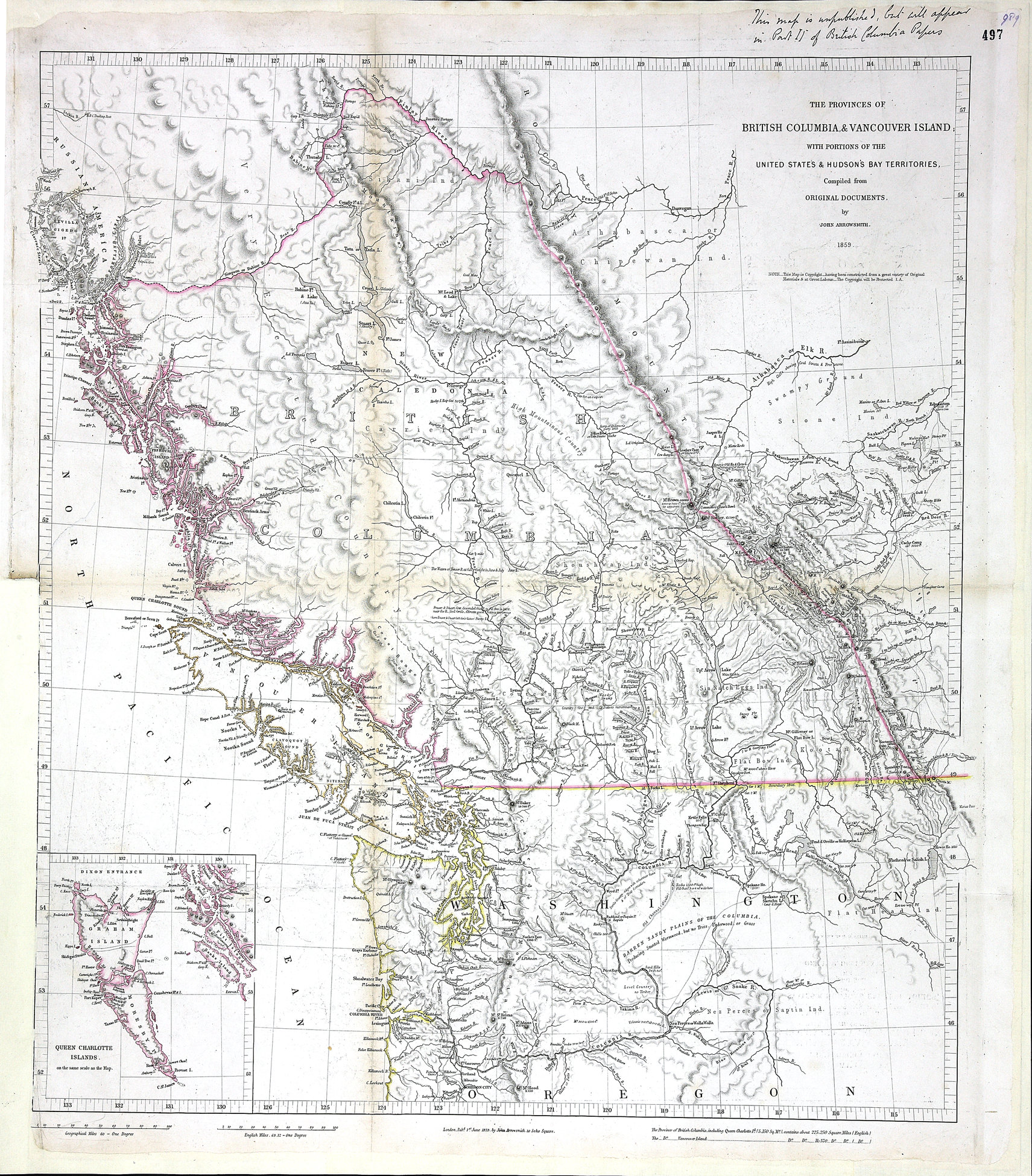
John Arrowsmith’s map 1859

Provinces of British Columbia and Vancouver Island; with portions of the United States and Hudson's Bay Territories. John Arrowsmith, 1859

Provinces of British Columbia and Vancouver Island; with portions of the United States and Hudson’s Bay Territories. John Arrowsmith, 1859
Colonial Dispatches, Uvic


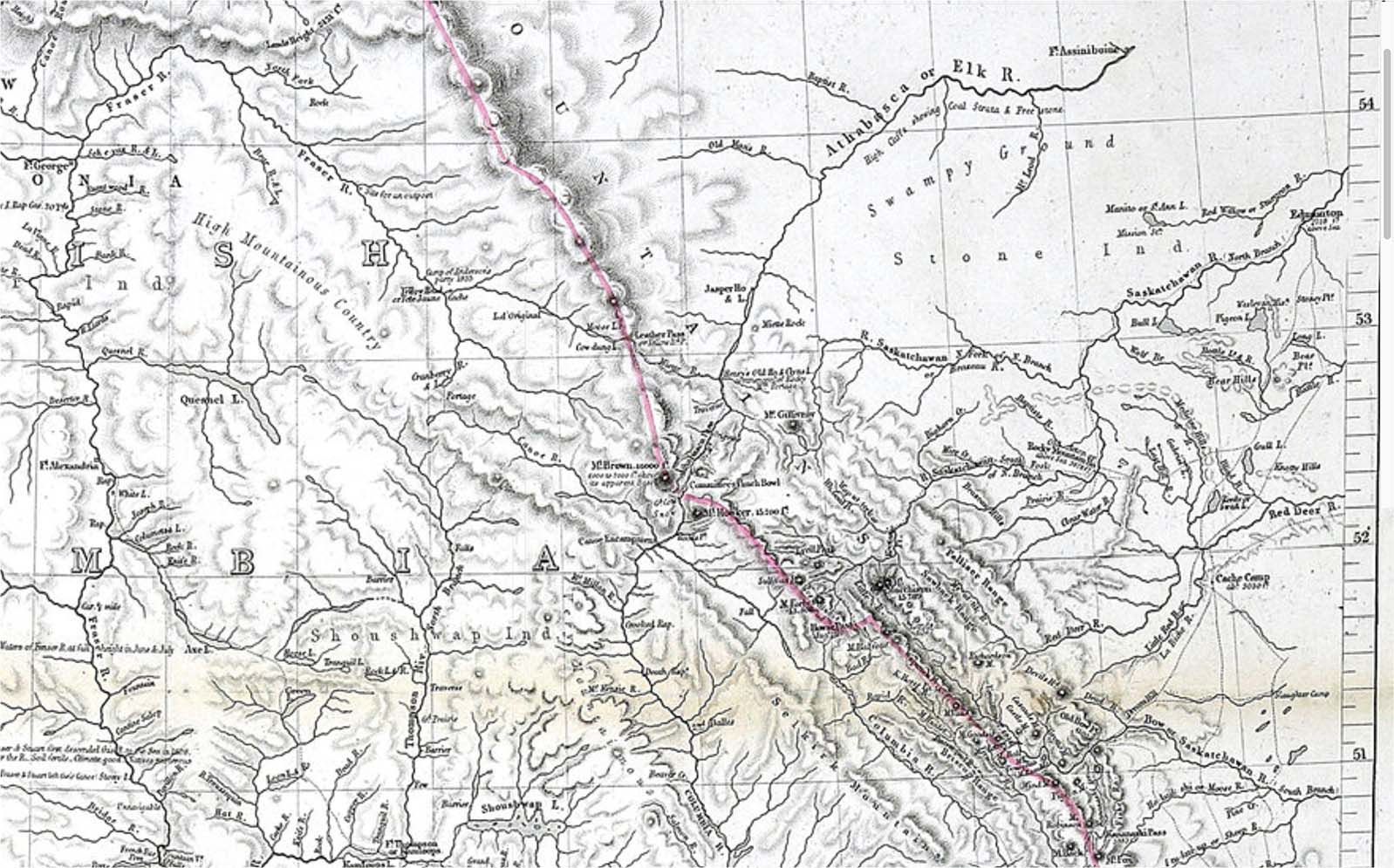
Detail of John Arrowsmith map,1859

Detail of John Arrowsmith map,1859
Colonial Dispatches, Uvic


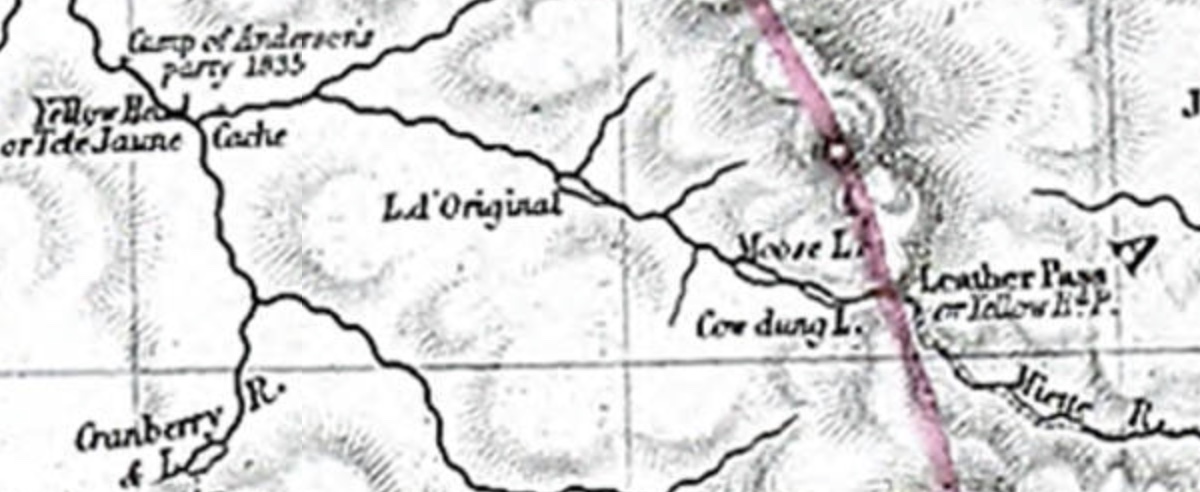
Detail of Tête Jaune Cache area, John Arrowsmith map,1859

Detail of Tête Jaune Cache area, John Arrowsmith map,1859
Colonial Dispatches, Uvic

THE PROVINCES OF
BRITISH COLUMBIA & VANCOUVER ISLAND
WITH PORTIONS OF THE
UNITED STATE’S & HUDSONS BAY TERRITORIES.
Compiled from ORIGINAL DOCUMENTS.
by JOHN ARROWSMITH.
1859

Handwritten note on map sheet: This map is unpublished but will appear in Part II of British Columbia Papers

John Arrowsmith (1790–1873) was born at Winston, County Durham, England. In 1810 he joined his uncle Aaron Arrowsmith in the cartography business. After his uncle died in 1823, the family firm was carried on by his sons Aaron and Samuel Arrowsmith, and John began working on his own. The Arrowsmiths were founding members of the Geographical Society of London in 1830. The junior Aaron left the family firm in 1832, and upon the death of Samuel in 1839, John merged it into his own successful business.

The map includes the note “Camp of Anderson’s party 1835” near the site of “Yellow Head or Tete Jaune Cache.”

References:

  • Arrowsmith, John [1790–1873]. Provinces of British Columbia and Vancouver Island; with portions of the United States and Hudson’s Bay Territories. 1859. UVic

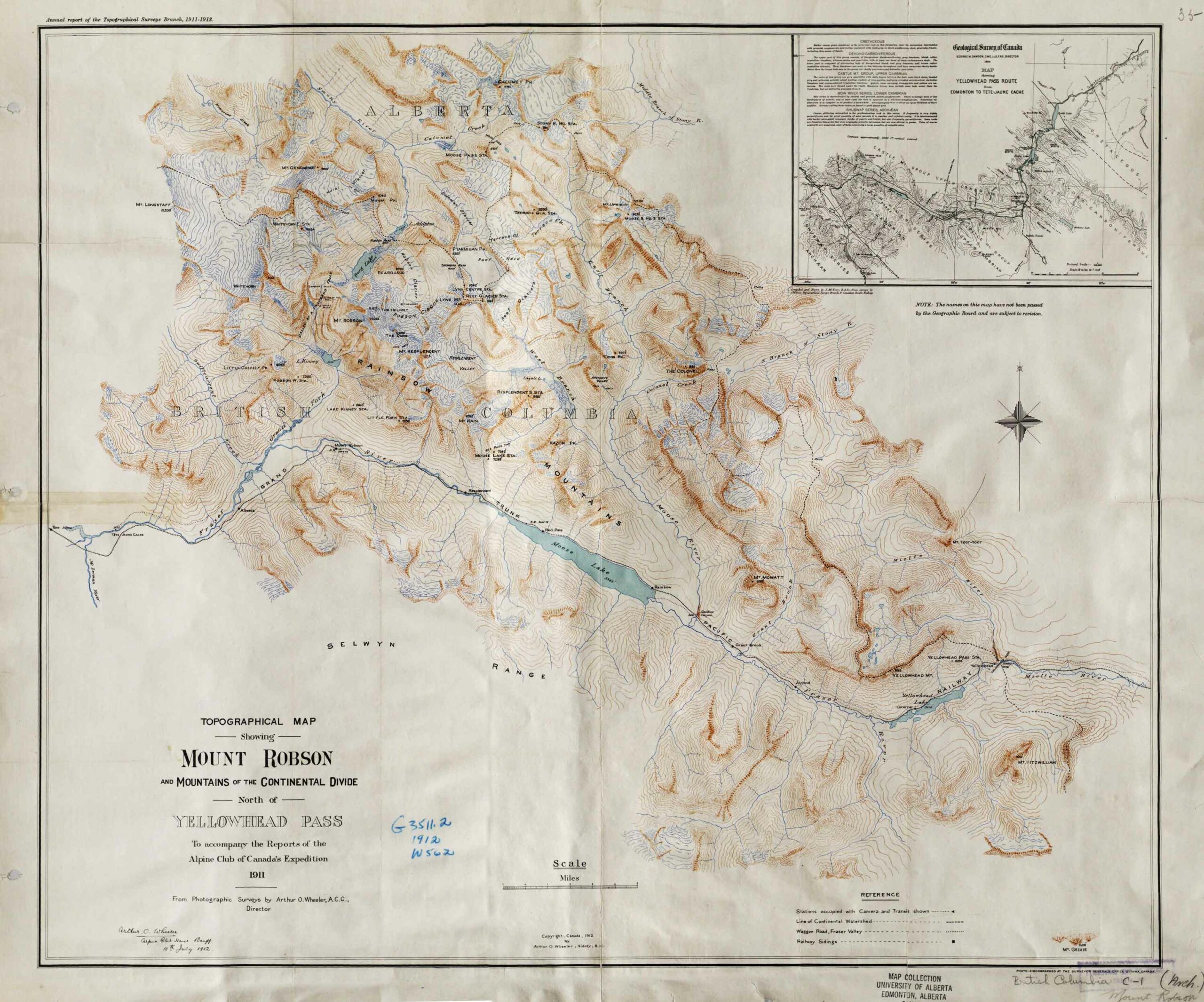
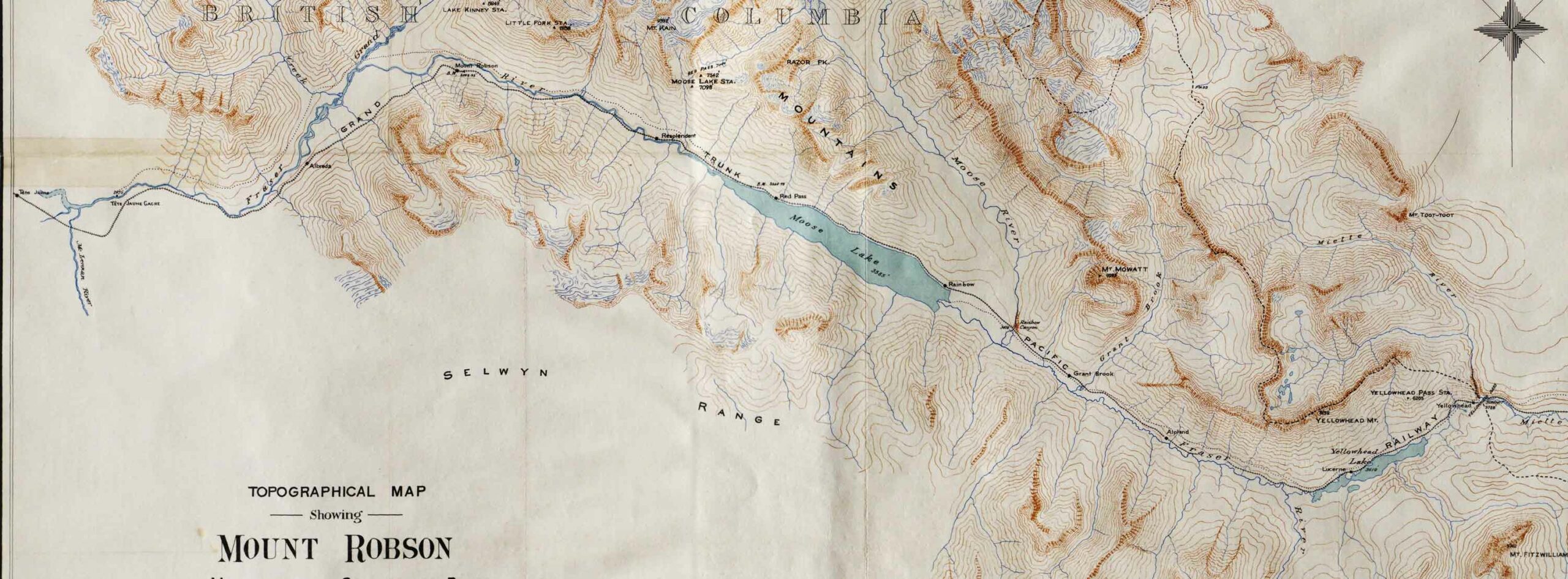
Arthur Wheeler’s map of the Mount Robson region 1912

Topographical Map Showing Mount Robson and Mountains of the Continental Divide North of Yellowhead Pass. Arthur O. Wheeler, 1912

Topographical Map Showing Mount Robson and Mountains of the Continental Divide North of Yellowhead Pass. Arthur O. Wheeler, 1912 Victoria Library, University of Toronto


Detail showing stations on the Grand Trunk Pacific Railway.

Detail showing stations on the Grand Trunk Pacific Railway. Victoria Library, University of Toronto

Topographical Map Showing Mount Robson and Mountains of the Continental Divide North of Yellowhead Pass
To accompany the Reports of the Alpine Club of Canada’s Expedition, 1911
From Photographic Surveys by Arthur Oliver Wheeler [1860–1945], A.C.C., Director
Annual report of the Topographical Surveys Branch, 1911-1912

With an inset showing a detail of the Geological Survey of Canada’s 1900 map of the Yellowhead Pass Route by James McEvoy [1862–1935] .

References:

  • Wheeler, Arthur Oliver [1860–1945]. “The Mountains of the Yellowhead Pass.” Alpine Journal, Vol. 26, No.198 (1912):382
  • Wheeler, Arthur Oliver [1860–1945]. “The Alpine Club of Canada’s expedition to Jasper Park, Yellowhead Pass and Mount Robson region, 1911.” Canadian Alpine Journal, Vol. 4 (1912):9-80. Alpine Club of Canada [accessed 2 April 2025]

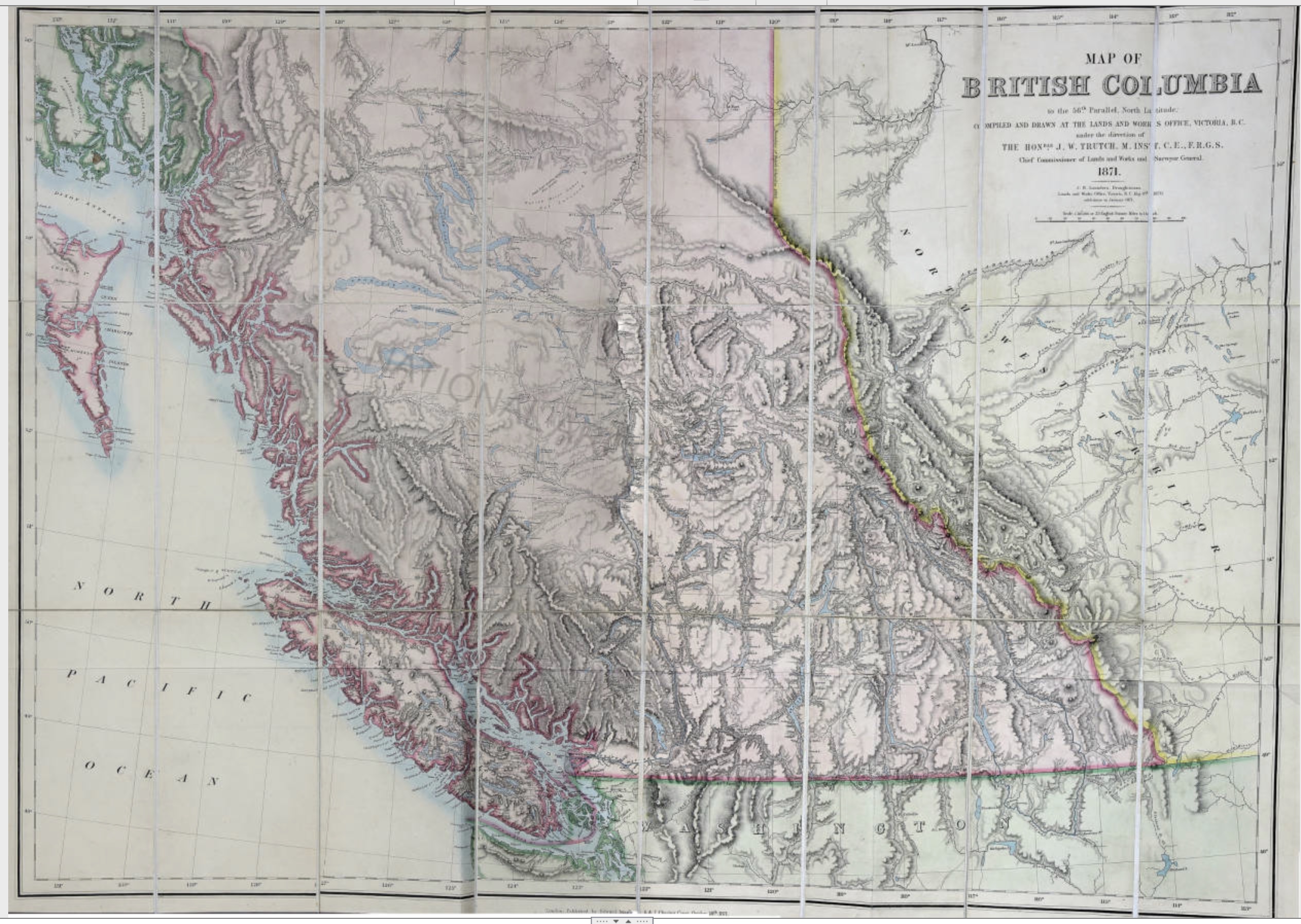
Joseph Trutch’s 1871 map of British Columbia

Trutch, Joseph William. Map of British Columbia to the 56th Parallel North Latitude, 1871

Trutch, Joseph William. Map of British Columbia to the 56th Parallel North Latitude, 1871
University of Victoria


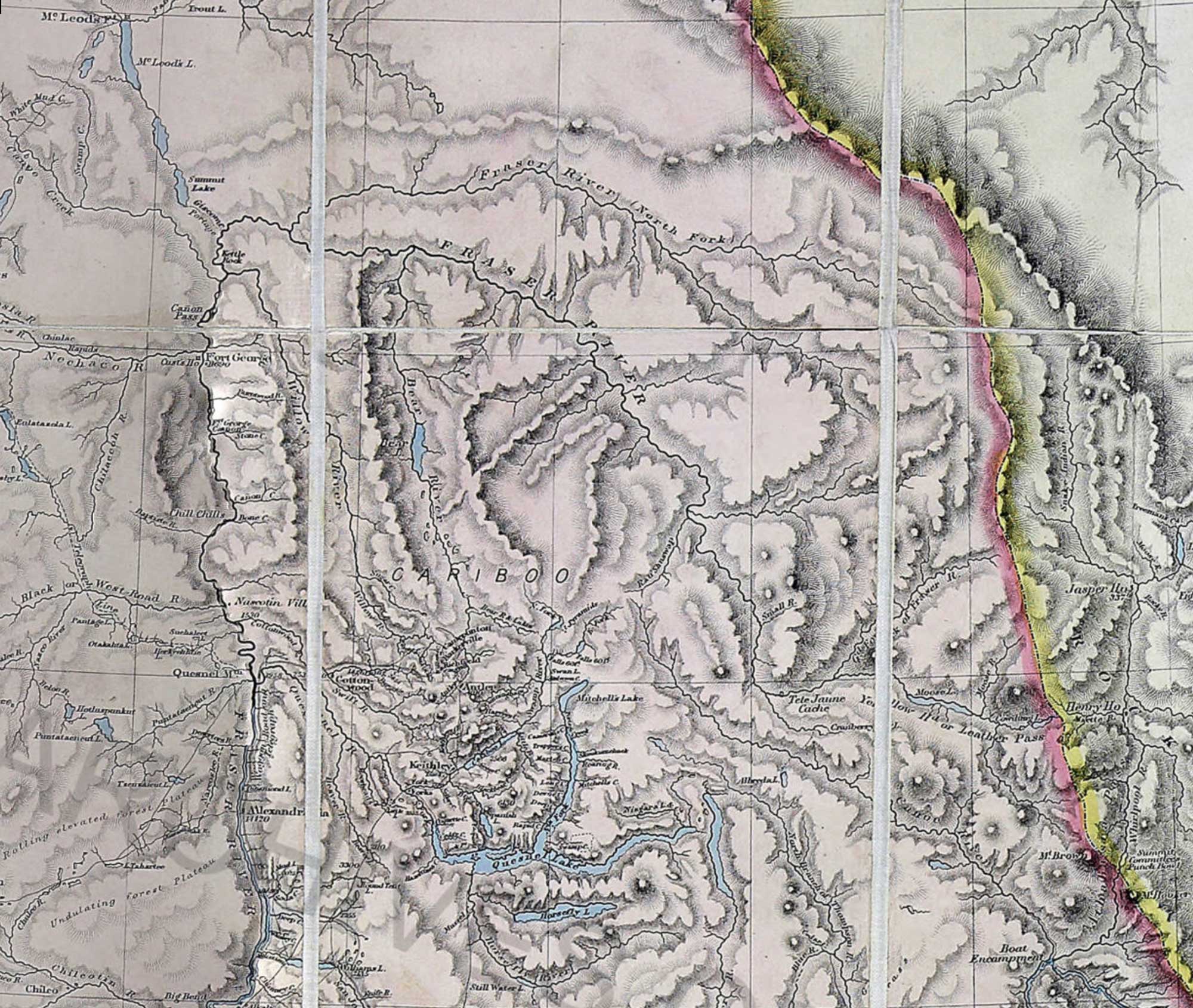
Trutch, Joseph William. Map of British Columbia to the 56th Parallel North Latitude, 1871 (detail)

Trutch, Joseph William. Map of British Columbia to the 56th Parallel North Latitude, 1871 (detail)
University of Victoria

References:

  • Trutch, Joseph William [1826–1904]. Map of British Columbia to the 56th Parallel North Latitude. Victoria, B.C.: Lands and Works Office, 1871. University of Victoria
  • Wikipedia. Joseph Trutch

South Fork Fraser River

British Columbia. Former name: Fraser River drainage
Downstream from headwaters to the confluence with McGregor River
Earliest known reference to this name is 1871 (Trutch map)
Not currently an official name.

Considering the confluence of McGregor River and Fraser River to be a fork, then the South Fork of the Fraser River runs up from the fork though Tête Jaune Cache to the headwaters at the Continental Divide in Mount Robson Park.

This nomenclature was formally adopted by the Geographic Board of Canada in 1910, as long-identified on maps and in journals. But in 1915 the Board renamed North Fork of the Fraser River to McGregor River, and Fraser River proper became the main source of the channel, the old South Fork of the Fraser River.(1)

I left Vancouver on May 20th. 1912, with a party of twelve men to survey land within the reserve on the South Fork of the Fraser River, about fifty miles below Tete Jaune Cache. There are three different routes to get into this country, probably the most expeditious one being via Edmonton-the way we went. Taking from Edmonton, by special permission of the Railway Commission, we travelled over the Grand Trunk Pacific as far as the end of steel. which at that time was Resplendent, twenty-nine miles west of the British Columbia-Alberta boundary. Owing to the fact that the Grand Trunk has not been opened for traffic farther west than Hinton, 185 miles west of Edmonton, it was necessary to get this special permission before we were allowed to travel the remaining ninety-eight miles to the end of steel. (2)

References:

  • 1. British Columbia Geographical Names. Fraser River
  • 2. Augustine, Alpheus Price [d. 1928]. “Report on Surveys on the South Fork of Fraser River.” Report of the Minister of Lands for the Province of British Columbia for the year ending 31st December 1912, (1913):240-242. Google Books

Columbia River

British Columbia. River: Columbia River drainage
Headwaters are Columbia Lake at Canal Flats
48.9997 N 117.6322 W — Map 82F/4 — GoogleGeoHack
Earliest known reference to this name is 1792 (Gray)
Name officially adopted in 1910
Official in BCCanada
Elevation: 3747 m

Adopted in the 9th Report of the Geographic Board of Canada, 1910, as named on maps and charts since 1795.

Called “Oregon River” by Jonathan Carver, 1766. Called “Rio de San Roque” by Bruno Heceta, who discovered the river’s mouth in 1775, and so-labelled on Spanish charts.

Named “Columbia River” in 1792, by Captain Robert Gray of Boston, after his ship Columbia, which entered the mouth of the river in May of that year. The name of Gray’s vessel honours Christopher Columbus, who reached the Americas in 1492.

“Columbia River / Fleuve Columbia” is among the 75 “Pan-Canadian names,” large and well-known Canadian features and areas designated in Treasury Board Circular 1983-58 to require presentation in both official languages of Canada on federal maps. In French, a fleuve is a river that flows into an ocean or sea.

References:

  • Arrowsmith, John [1790–1873]. Provinces of British Columbia and Vancouver Island; with portions of the United States and Hudson’s Bay Territories. 1859. UVic
  • British Columbia Geographical Names. Columbia River
  • Wikipedia. Columbia River